 Pyeongye
At a glance
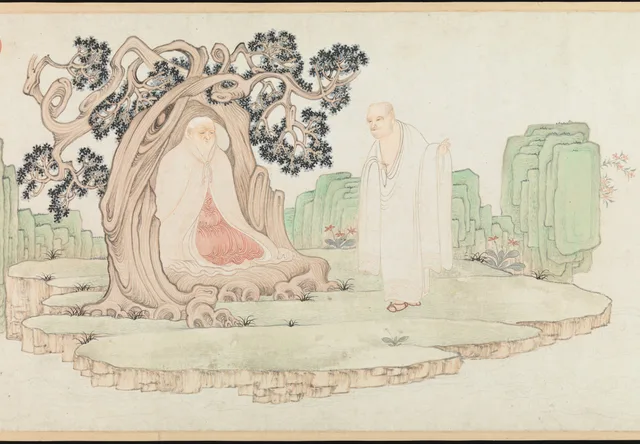
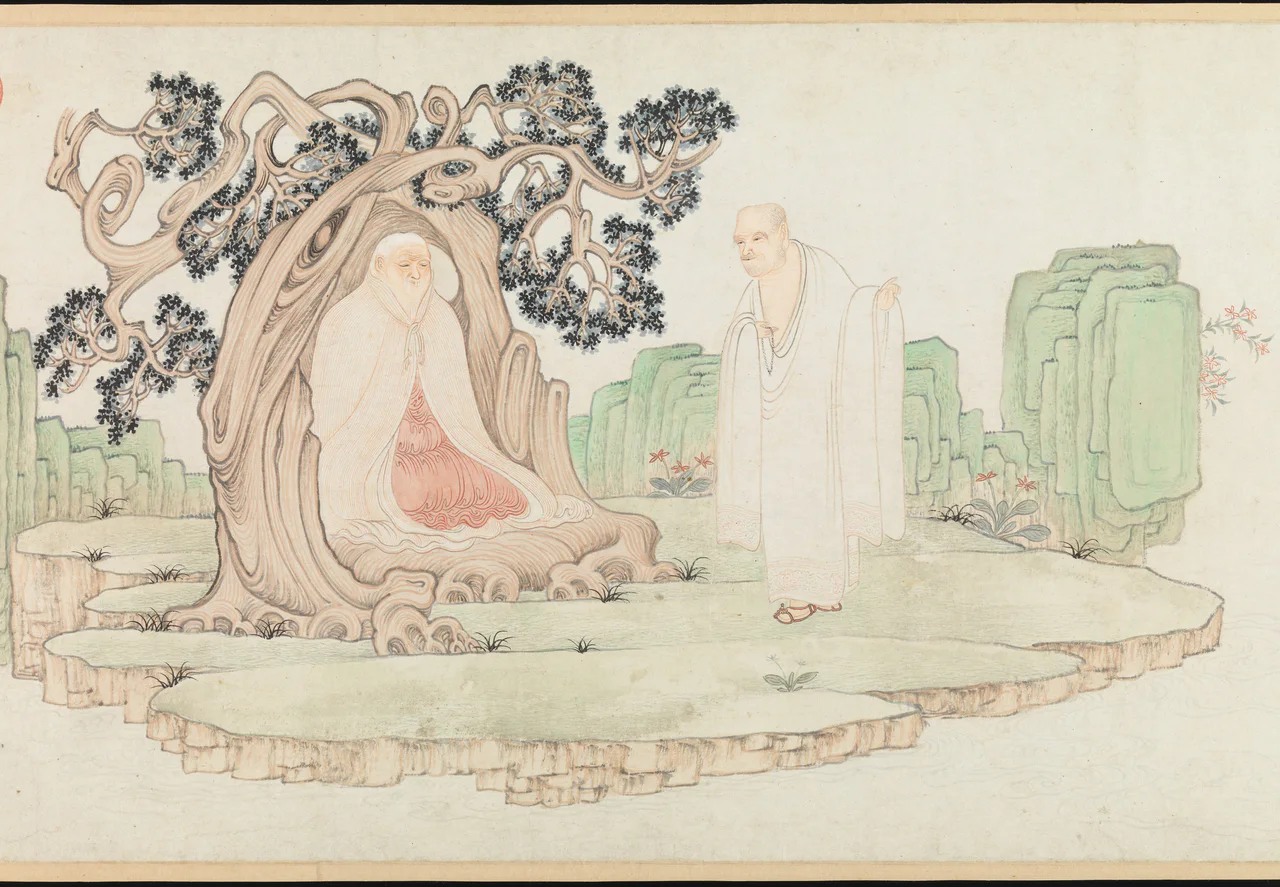
- A scene from a long scroll of sixteen luohans, the Buddha's enlightened disciples: one sits inside a hollow tree, another stands nearby holding prayer beads.
- Wu Bin, a painter of the late Ming dynasty, made it in 1591 in ink and light color on paper.
- The whole scroll is more than four meters long, so you meet the luohans one by one as you unroll it.
Reading the picture
5 places to look closer
Tap a number on the painting to jump to its note, or a close-up to see that spot in the whole picture.
An old monk sits in the hollow of an ancient tree. A white hooded robe covers him from head to knee, and his eyes are almost closed. His long eyebrows and beard are white. Inside the robe, a red undergarment ripples with layer after layer of wavy folds.
Zoom in on the trunk. The wood grain swirls around in fine lines, and a knot in the middle looks like a large, watching eye. At the ends of the branches, clusters of black leaves open like flowers. The tree seems alive, holding the monk inside it.
Now look at the standing luohan on the right. His right hand holds a string of prayer beads at his chest. His left hand is raised high, fingers lifted. There is a small smile on his lips. Is he saying something to his seated friend?
The green rocks at the far right look like flat slabs stacked one in front of another. They feel less like real stone and more like a stage set. Wu Bin is known for strange mountains and rocks that could hardly exist in nature.
Look at the very bottom. The ground under the luohans ends in a sharp cliff, as if cut with a knife. Below it, faint ripple lines suggest water. The luohans seem to stand on an island floating in a quiet sea.
When it was painted
In 1591 the Wanli emperor was on the throne of Ming China. That year Wu Bin filled a sheet of paper more than four meters long with sixteen luohans, one after another, and dated his work. Luohans are the Buddha's disciples who, in Buddhist belief, stayed on in the world after his death to guard his teaching.
Wu Bin was born in Putian, in Fujian province. He left home and worked in Nanjing, the southern capital, and he painted many Buddhist subjects. His skill became known at the top. The Wanli emperor called him to serve as a drafter in the Secretariat, a post given to him for his painting.
Painters of luohans had an old model to follow. Guanxiu, a monk who lived at the end of the Tang dynasty and into the next era, painted them with bulging brows, heavy eyebrows, and strange, almost alarming faces. The two luohans in this scene, though, have plain faces, like old men you might pass on a street.
One of Wu Bin's admirers was Mi Wanzhong, an official and a famous calligrapher. Mi acquired a Lingbi rock, a stone full of holes and peaks, and asked Wu Bin to paint it from ten different angles. That scroll sold at auction in Beijing in 2020 for more than 500 million yuan and made headlines.
This 1591 scroll belonged to the Edward Elliott family collection before Douglas Dillon gave it to the Metropolitan Museum in 1986.
Now look again at the green rocks at the far right. Here is a painter who could study one stone ten times over. Count the lines he laid along each standing slab, and you can feel how slowly he looked.
Questions to think about
- Look for itWhere can you find a shape in the tree that looks like the seated monk's face or eye?
- Why?Why might Wu Bin have surrounded such realistic faces with trees and rocks that look so unreal?
- What about you?The luohans chose to stay behind and protect something; is there anything you would refuse to walk away from, even when it would be easier to leave?
Same period
Painted around the same time,
somewhere else
Too good to keep to yourself
This painting,
for someone who comes to mind
They open it at full size
and see every brushstroke.
About this work
- Artist
- Wu Bin · 1583–1626
- Date
- dated 1591
- Medium
- Handscroll; ink and color on paper
- Size
- 32.1 × 415.4 cm
- Culture
- China
- Collection
- The Metropolitan Museum of Art
- Image
- Original long edge 4000px · shown at 2560px
- Original
- View on the museum's website ↗