 Pyeongye
Artwork · 16th century · Sesson Shūkei 雪村周継
LeoTurn on Magnifier at the lower right and move slowly across the painting.
Full screen opens it edge to edge.Tap the painting to fill the screen.
Spread two fingers to look closer.
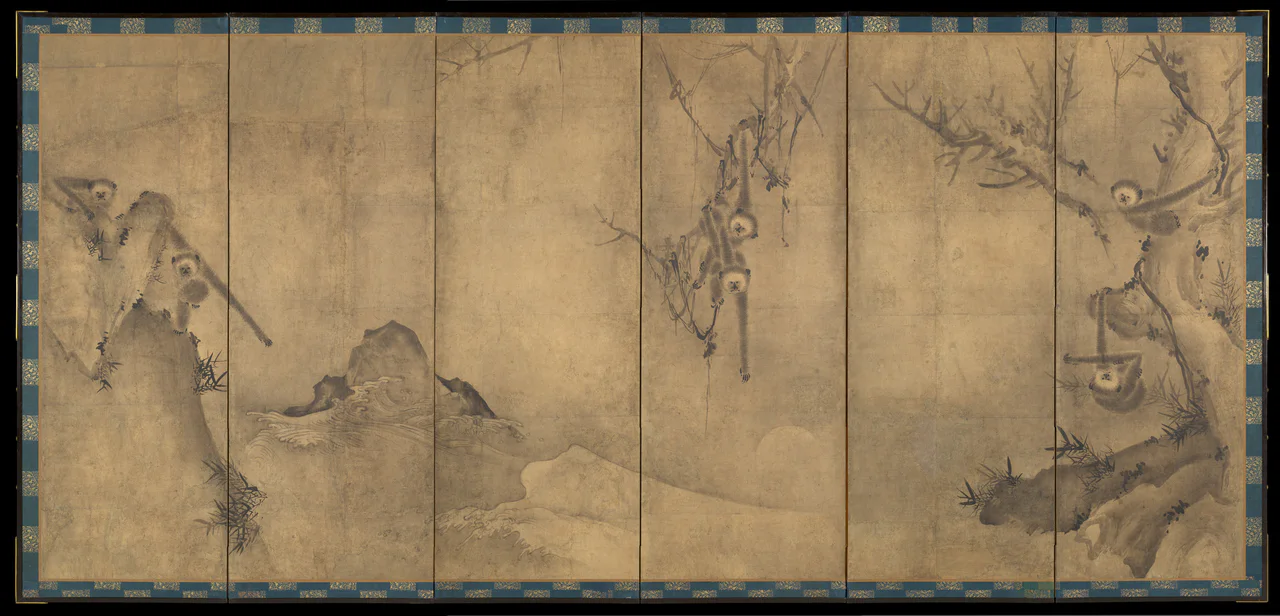
Gibbons in a Landscape
Sesson Shūkei 雪村周継ca. 1570Pair of six-panel screens; ink on paper157.5 × 348 cm
At a glance
- Gibbons swing from branches and cling to rocks above waves crashing against stone, all painted in ink alone.
- Sesson Shūkei, a Japanese Zen monk painter, made this pair of six-panel folding screens on paper around 1570.
- Each screen is about 5 feet tall and more than 11 feet wide. Across all that paper, the brush brings each tuft of fur to life.
Reading the picture
5 places to look closer
Tap a number on the painting to jump to its note, or a close-up to see that spot in the whole picture.
Zoom in on the gibbons hanging in the middle. One hangs from a branch by a single arm, and another dangles below it. The lowest gibbon's arm drops down even longer than its body. With pale fur ringing their round faces and small black noses, they look both sweet and serious.
Now follow that arm down. Above the waves there is a faint round shape, as if the paper was left unpainted there. East Asian painting has an old theme of monkeys reaching for the moon's reflection in water. What this round shape is, the painter leaves for you to decide.
Look at the rock on the far left. One gibbon peers down from the top, while another drapes a long arm over the rock. The fur is built up from many short brushstrokes laid over each other, so it looks soft and fluffy.
On the right, a gibbon hangs from a rock by one arm and stretches the other straight out to the side. Its body is curled up like a ball, and it looks right at us. On the hanging arm, the fur is drawn in long vertical strokes, so the arm seems to stretch.
Drop down to the water. Waves curl up around dark rocks, and the foam is drawn in thin lines like cloud patterns. Unlike the quiet gibbons above, this part moves so much you can almost hear it.
When it was painted
Around 1570, Sesson was a monk in his sixties. The Met gives his dates as about 1504 to about 1589. He spent his whole working life in eastern Japan, far from the capital, Kyoto. It was the Warring States period, when regional lords fought one another for land.
He was born in Hitachi Province, today's Ibaraki Prefecture, into the Satake, the warrior family that ruled it. Instead of a sword, he took up the brush as a Zen monk. He moved around the east: Aizu, Odawara, Kamakura. In Aizu the lord Ashina Moriuji supported him, and in Odawara he painted under the Hōjō family.
In old age he settled in a small hermitage near Miharu, in today's Fukushima Prefecture, with help from the local Tamura family. Today a hermitage in Kōriyama called Sesson-an is known as the successor to that hut.
In Japan he is often paired with an earlier ink master: Sesshū of the west, Sesson of the east. Sesshū died around the time Sesson was born. Both names begin with the same character, 雪, meaning snow.
Gibbons do not live in Japan. Japanese Zen monks treasured gibbon paintings by the Chinese Song dynasty monk Muqi, and by the late 1400s the subject had become a favorite for large paintings. The Met reads these screens as a chain of gibbons reaching for the moon's reflection, an image Zen uses for a mind chasing illusions. The pair came to the museum in 1992, bought with a group of funds and gifts.
Look at the middle again. The long arm at the bottom of the chain points down toward the faint round glow on the water. The old monk left the space between that hand and that glow as bare paper.
More by the same painter
Questions to think about
- Look for itHow many gibbons are on this screen, and what is each one holding on to?
- Why?Why do you think Sesson left so much empty paper around the gibbons?
- What about you?Have you ever chased something you could not quite catch, like the moon in the water? Should you have stopped, or kept reaching?
Same period
Painted around the same time,
somewhere else
Too good to keep to yourself
This painting,
for someone who comes to mind
They open it at full size
and see every brushstroke.
About this work
- Artist
- Sesson Shūkei 雪村周継 · 1504–1589
- Date
- ca. 1570
- Medium
- Pair of six-panel screens; ink on paper
- Size
- 157.5 × 348 cm
- Culture
- Japan
- Collection
- The Metropolitan Museum of Art
- Image
- Original long edge 4000px · shown at 2560px
- Original
- View on the museum's website ↗