Pyeongye
Painters · 16th century
Albrecht Altdorfer
1480–1538
A German painter who served Regensburg on the Danube as councilman and city architect, and who made pictures and prints in which forests and trees, not people, take center stage.
Scenes from a life
The life of Albrecht Altdorfer,
scene by scene
- 1505Regensburg
In 1505 a new name goes into the citizens' register of Regensburg: Albrecht Altdorfer, "painter from Amberg." A young painter of about twenty-five has settled in this busy city on the Danube.
No record tells us where he learned to paint. But Regensburg became the place where he would live, work, and be buried.
- 1513Regensburg
In 1513 Altdorfer buys a house in Regensburg. A few years later he bought a second one.
Around this time he also took on work for Emperor Maximilian I. He drew in pen in the margins of the emperor's prayer book, and he helped with a huge printed procession celebrating the emperor's glory. A Regensburg painter was now working for the emperor.
- 1519Regensburg
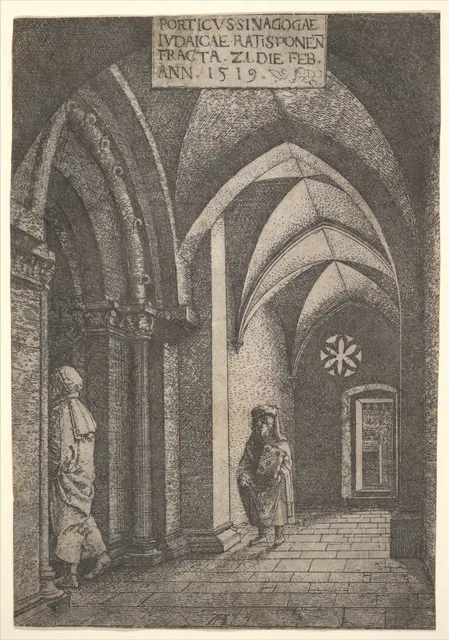
In February 1519 the Regensburg city council decides to expel the city's Jewish community. Altdorfer, a council member, was among the men chosen to deliver the order. The Jews were given two hours to empty the synagogue and five days to leave the city.
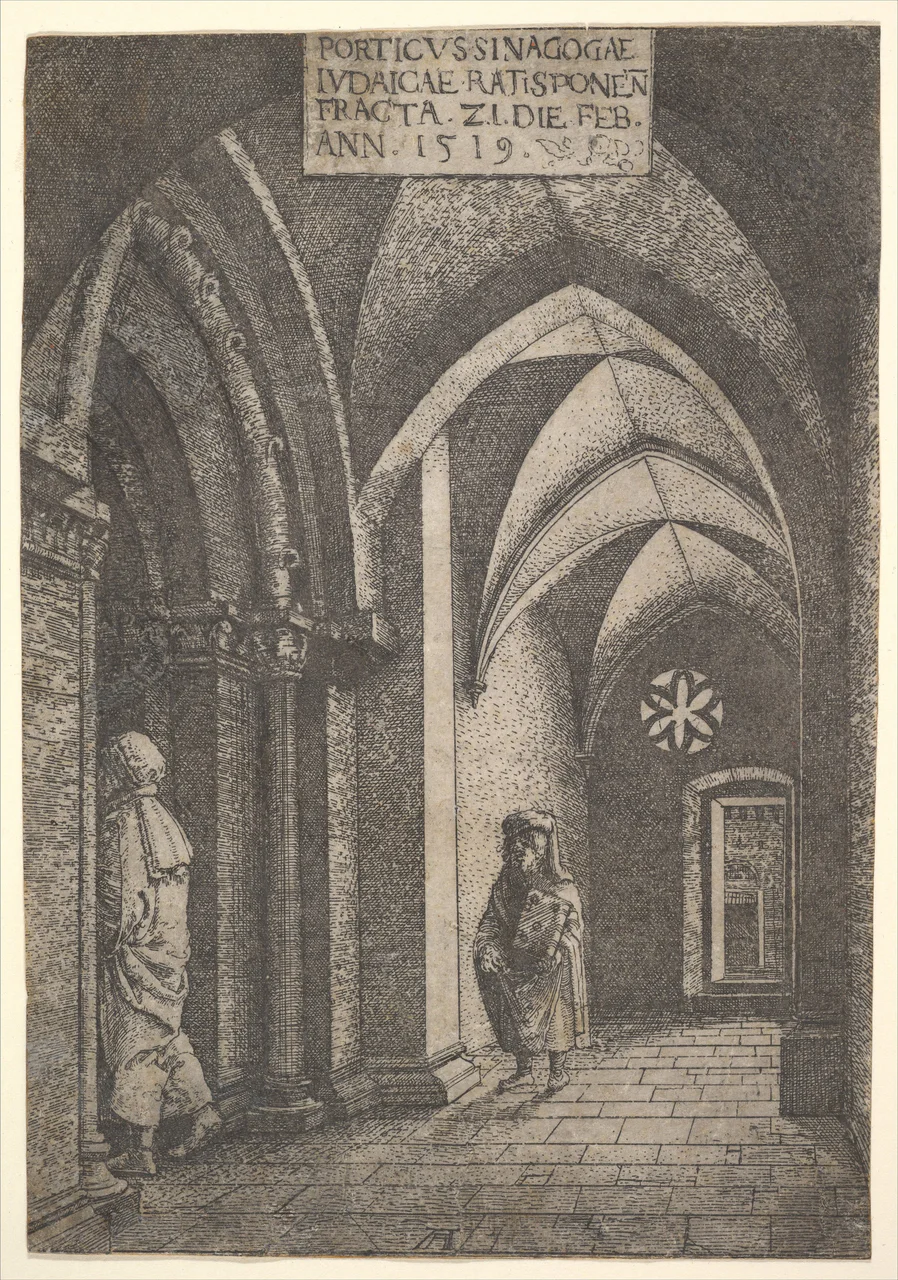
The synagogue was torn down soon after. Just before that, Altdorfer etched its interior on two copper plates. On the stone tablet at the top of this print, a Latin line says the synagogue was destroyed on February 21, 1519. Under the pointed vaults stand two men. The one in the middle carries a big book tucked under his arm.
 Painted around this timeThe Entrance Hall of the Regensburg Synagogue
- 1520sRegensburg
Where the synagogue stood, a wooden chapel goes up in a hurry. Inside hangs an old painting of the Virgin and Child, called the Beautiful Mary. Word of miracles spread, and pilgrims poured in.
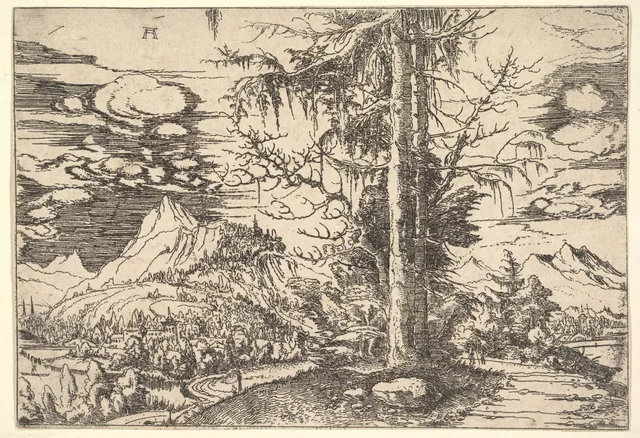
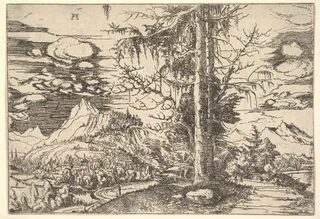
Altdorfer cut this image in woodcut several times, including one printed in several colors. In the same few years he also made small etchings of pure landscape, with no people and no story. In Landscape with a Double Spruce, a tall tree takes over the middle of the picture.
Painted around this timeLandscape with a Double Spruce - 1528Regensburg
Regensburg elects Altdorfer mayor. For two years he had already been the city architect, looking after its walls and buildings. Mayor was about as high as a citizen could rise.
He said no. Duke William IV of Bavaria had ordered a large painting from him, and he needed the time. The result, finished in 1529, is The Battle of Alexander at Issus. Vast armies clash below, while the sky curves overhead with the sun and the moon in it at once.
- 1535Vienna
Now in his mid-fifties, Altdorfer travels down the Danube to Vienna. He goes on an official mission for the city of Regensburg, to the court in Vienna.
Six years earlier, in 1529, Ottoman armies had besieged this very city. Around then Altdorfer, as city architect, had worked on strengthening the walls of Regensburg. The young painter from Amberg had become a man the city trusted with its business at court.
- 1538Regensburg
In February 1538 Altdorfer dies in Regensburg. On the day he died, he dictated his will. It is the only personal document of his that survives. He was buried in the city's Augustinian church.
The battle painting he made for the duke now hangs in the Alte Pinakothek in Munich. His etchings of the synagogue hall and the double spruce have traveled further, all the way to the Metropolitan Museum in New York.
People around them
- Maximilian Ithe Holy Roman Emperor who gave him work on his prayer book and printed procession.
- William IV of Bavariathe duke who commissioned The Battle of Alexander at Issus.
Works