Pyeongye
Painters · 16th century
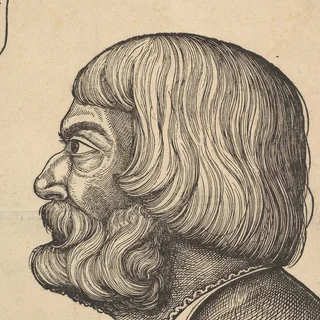
Albrecht Dürer
1471–1528
A goldsmith's son from Nuremberg who made his name across Europe with prints, and who wrote down nearly everything in letters and travel diaries.
Scenes from a life
The life of Albrecht Dürer,
scene by scene
- 1484Nuremberg
A thirteen-year-old boy sits in front of a mirror and draws his own face in silverpoint. Silverpoint cannot be erased, so every line had to be right the first time. Years later he added a note to the sheet: he had drawn it from a mirror when he was still a child.
His father was a goldsmith, and the boy was already learning the trade. But he wanted to paint. His father regretted the lost training time, yet he gave in. On November 30, 1486, Albrecht was sent as an apprentice to the Nuremberg painter Michael Wolgemut.
- 1494Nuremberg
After several years of wandering along the Rhine to learn his craft, the young painter comes home. His bride was Agnes, daughter of the Nuremberg citizen Hans Frey.
In the family chronicle Dürer later wrote, Hans Frey gave 200 florins with his daughter. The wedding took place on July 7, 1494. The couple had no children, and Agnes stayed at his side until his death.
- 1506Venice
In Venice, Dürer writes a long letter home to his friend Willibald Pirckheimer. He grumbles that local painters run down his work for not being in the antique style. One man was different, he says. The old painter Giovanni Bellini praised him in front of several gentlemen and wanted something of his, promising to pay well.
Dürer was painting a large altarpiece for the German merchants who lived in the city. As his return drew near, he confessed to his friend that here he was treated as a gentleman, while at home he was only a parasite.
- 1515Nuremberg
In May, a rhinoceros shipped from India is led off a boat in Lisbon. No living rhino had been seen in Europe for well over a thousand years. A letter describing the animal, with a rough sketch, traveled from Lisbon to Nuremberg. Working only from those, Dürer drew the beast and turned it into a woodcut.
That is why his rhino wears what looks like plates of armor, with a small extra horn on its back. The real animal never reached its next owner. It was being sent as a gift to the pope when its ship went down, and it drowned. That same year Emperor Maximilian I granted Dürer a yearly pension of 100 florins.
- 1518Augsburg
On June 28, 1518, the imperial diet is meeting in Augsburg. High up in the palace, in a small room, Dürer sits across from Emperor Maximilian I and draws his face. On the sheet he wrote down the day and the little room where it happened.
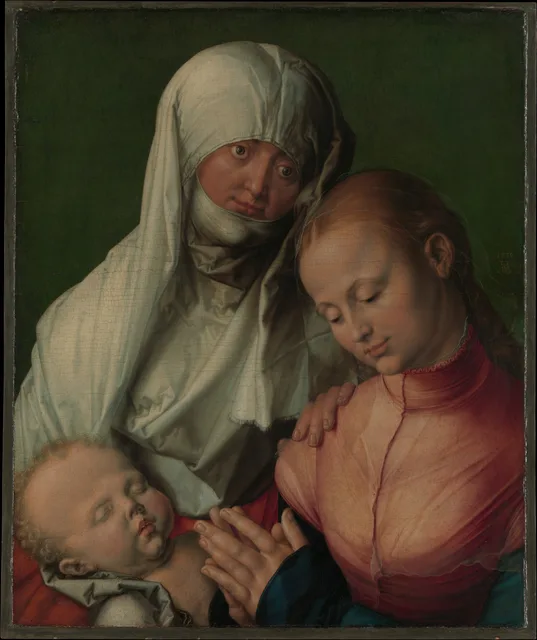
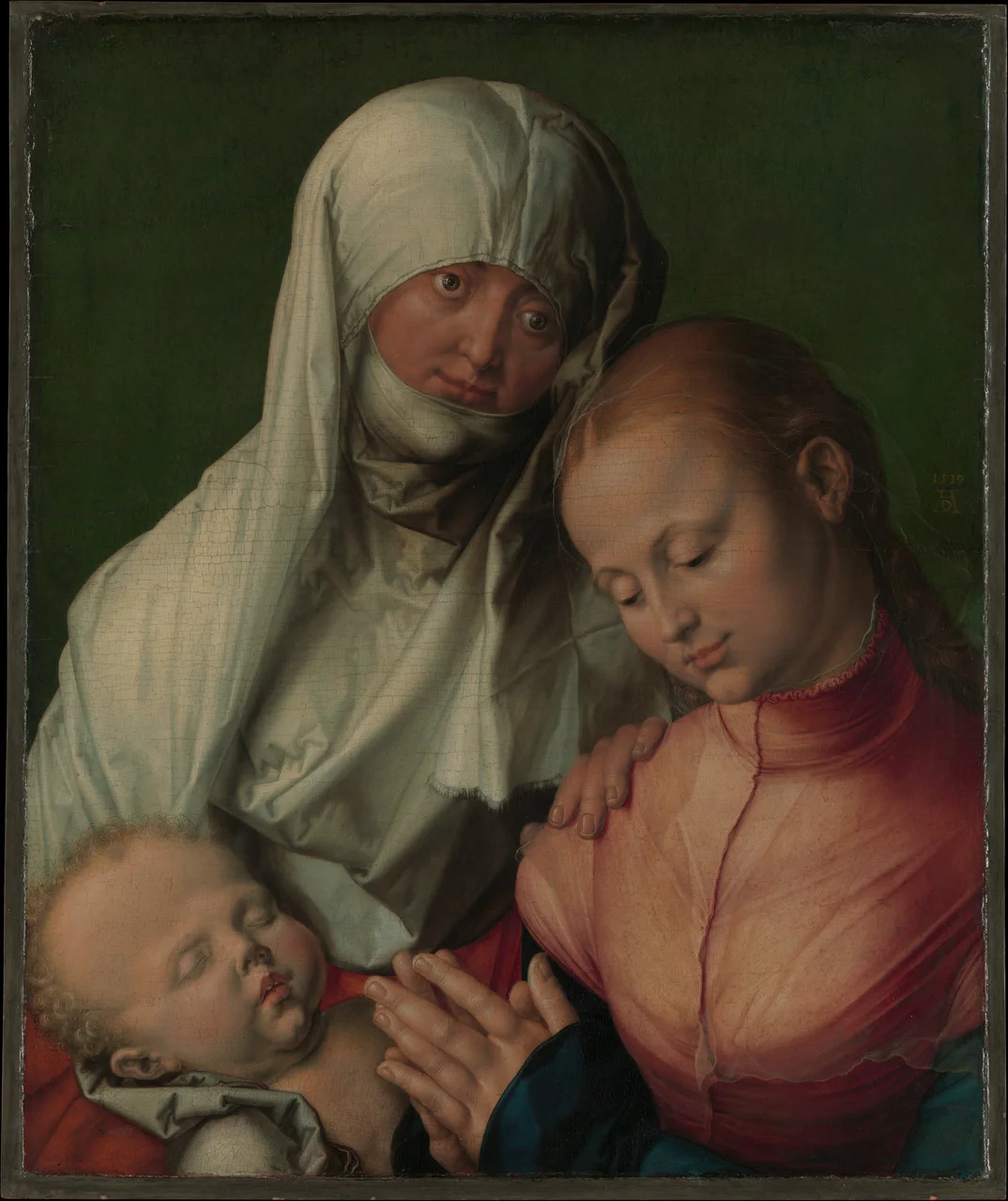
Half a year later, in January 1519, the emperor died, and the pension stopped coming. Around then Dürer painted Virgin and Child with Saint Anne on a linden panel. Grandmother Anne, wrapped in a white headcloth, rests her hand on Mary's shoulder. Mary folds her hands over the sleeping child.
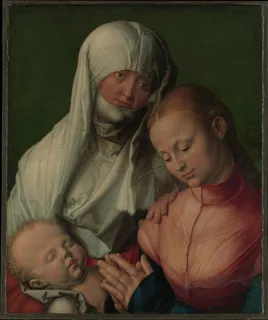 Painted around this timeVirgin and Child with Saint Anne
- 1520Antwerp
On the evening of August 5, 1520, the painters' guild of Antwerp invites Dürer, his wife, and their maid to a banquet in the guild hall. The table is set with silver, and costly dishes keep arriving. Dürer described the evening in his travel diary.
A little later, in Brussels, he saw the objects sent from Mexico to the young emperor Charles V. There was a sun made of gold and a moon made of silver. He wrote that he had never seen anything in all his days that so rejoiced his heart.
- 1521Antwerp
In 1521 the Dutch printmaker Lucas van Leyden invites Dürer to a meal in Antwerp. Dürer draws the younger artist's face in silverpoint. In early July, King Christian II of Denmark sends for him to make his portrait. The king then takes him along to Brussels and seats him at a banquet held for Charles V.
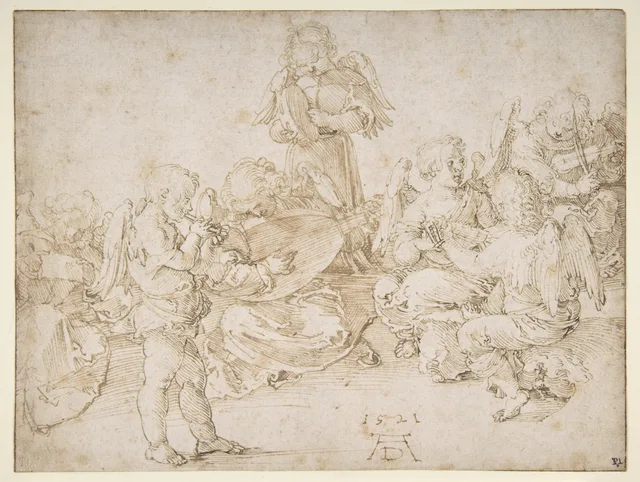
Music-Making Angels is a pen drawing from that same year. A chubby angel plays a pipe, another hugs a big lute, and one at the right saws at a fiddle. At the bottom center you can find the date 1521 and his monogram, a small D tucked under a large A.
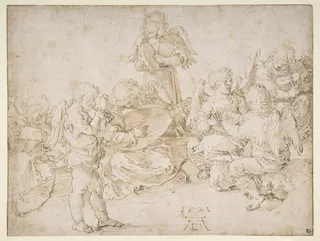 Painted around this timeMusic-Making Angels
- 1526Nuremberg
In October 1526, Dürer presents two tall wooden panels to the Nuremberg city council. They show four figures from the Bible, John, Peter, Mark, and Paul, painted at about life size. The council hung them and sent him 100 florins in return.
He had been ill often since the Netherlands trip. Head of a Young Woman, drawn the year after he came home, is drawn in black chalk on green paper. Dürer died in Nuremberg on April 6, 1528. His old friend Pirckheimer wrote the words for his tomb.
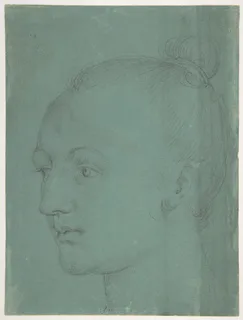 Painted around this timeHead of a Young Woman
People around them
- Albrecht Dürer the Elderhis father, a goldsmith who finally let his son become a painter.
- Michael Wolgemutthe Nuremberg painter who took the fifteen-year-old Dürer as an apprentice.
- Agnes Freyhis wife from 1494, who went with him on the long Netherlands journey.
- Willibald Pirckheimera Nuremberg scholar and lifelong friend, who received his letters from Venice.
- Giovanni Bellinithe aging Venetian painter who praised Dürer in front of the city's gentlemen.
- Maximilian Ithe emperor who gave him work and granted him a yearly pension.
Works