 Pyeongye
Artwork · 16th century · Albrecht Altdorfer
LeoTurn on Magnifier at the lower right and move slowly across the painting.
Full screen opens it edge to edge.Tap the painting to fill the screen.
Spread two fingers to look closer.
At a glance
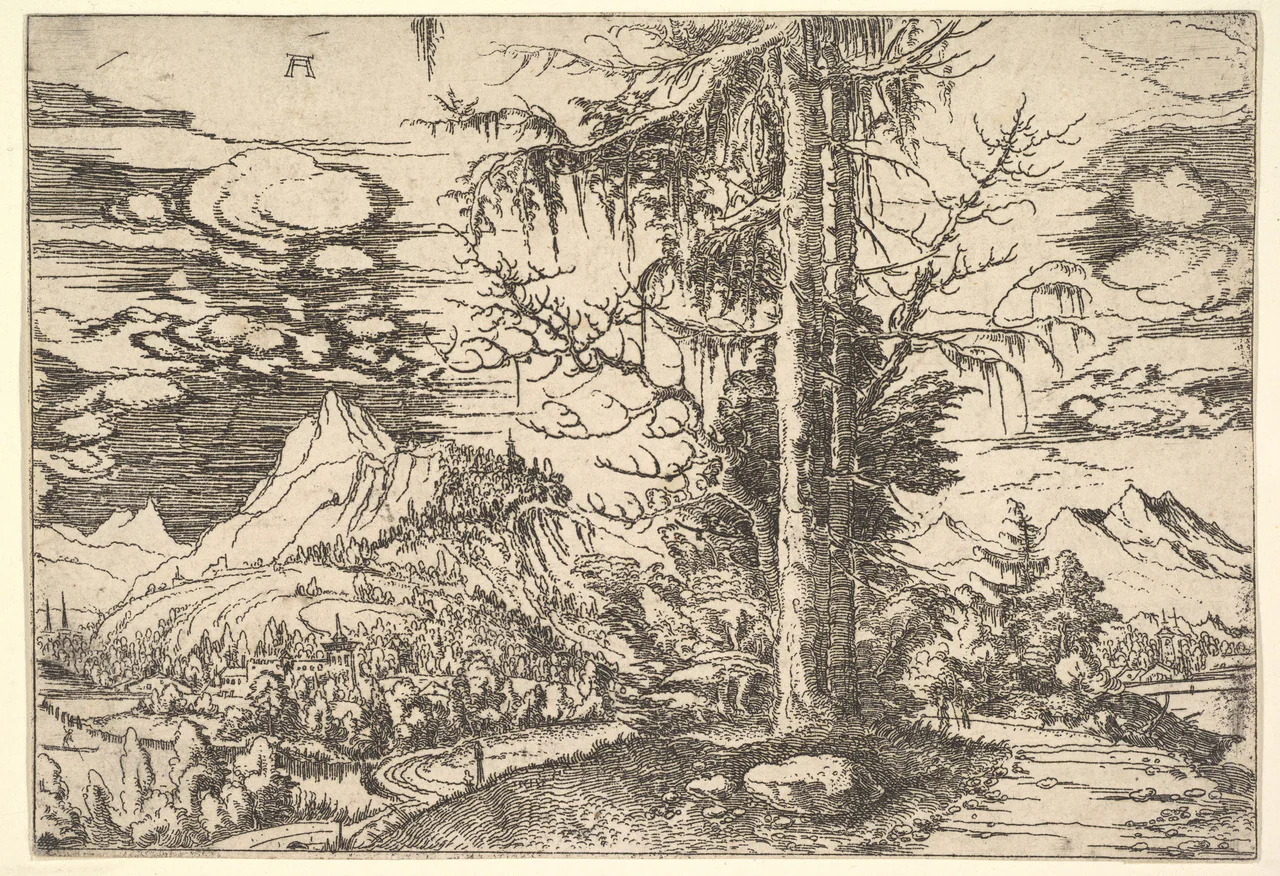
- A spruce that splits into two trunks from a single base fills the middle of the sheet, with sharp peaks, a village, and a winding road behind it.
- Albrecht Altdorfer, a painter in Regensburg, Germany, made this etching around 1521–22.
- There is no hero and no story here, just trees and land, on a sheet about the size of your hand.
Reading the picture
5 places to look closer
Tap a number on the painting to jump to its note, or a close-up to see that spot in the whole picture.
Zoom in on the big tree in the middle. Two trunks rise side by side from one base. The bark is built from short curved strokes packed close together. The top of the tree runs right off the upper edge of the sheet, so you never see where it ends.
Zoom in on the branches reaching out to the left. Long threads hang from every branch like beards. They look like the moss that drapes the trees of an old forest. Altdorfer's trees are never neat. They twist, droop, and tangle.
Look at the upper left corner of the sky. There is a mark of a small A set inside a larger A. It is Altdorfer's monogram, the initials he put on his work. He signed small, in one corner of a wide sky.
Drop down to the village at the lower left. A tower with a pointed roof, a town wall, and houses crowd together among the trees. Buildings and trees are drawn with the same fine lines, so the village seems buried in the forest.
Zoom in on the bend in the road near the bottom center. A thin post with a little roof stands there, and beside it is a small cross shape. In this huge landscape, that is how small the human trace is.
When it was painted
When Altdorfer made this etching in the early 1520s, he was about forty. He had become a citizen of Regensburg, a city on the Danube River, in 1505, and by 1519 he sat on its city council. He was a painter of forests, and he was also a man who helped run his town.
Forests had held him for years. In his Saint George in the Forest of 1510, the knight fighting the dragon is nearly swallowed by a wall of leaves. Painters who shared his love for the woods and hills of the Danube valley are now called the Danube School.
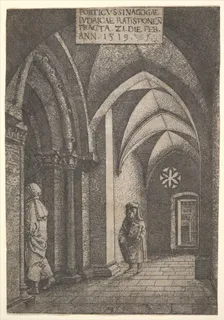
A few years before this print, the city went through a dark episode. In February 1519, Regensburg expelled its Jewish community and tore down the synagogue. Altdorfer, then a council member, etched two views of the synagogue's interior just before it was destroyed. A pilgrimage church to the Beautiful Virgin rose on the site, and Altdorfer made paintings and woodcuts for that pilgrimage.
Over the next few years he made several etchings, like this one, that show nothing but landscape. To make an etching, an artist coats a metal plate with a waxy layer, draws through it with a needle, and lets acid bite the lines into the metal. In Europe at that time, a print whose only subject was the scenery, with no Bible story or myth, was very rare.
In 1526 Altdorfer became the city's master builder. In 1528 he was elected mayor, but he turned the office down so he could paint The Battle of Alexander, a large picture ordered by the Duke of Bavaria. He died in Regensburg in 1538.
Look again at the spruce in the middle. A busy man of civic duties gave the whole center of this small plate to a single tree.
More by the same painter
Questions to think about
- Look for itFar off on the right, below the mountains, can you find a church tower hiding among the trees?
- Why?Why do you think Altdorfer cut the top of the tree off at the edge of the sheet?
- What about you?Five hundred years ago, an artist made a picture out of nothing but forest and mountains. How close is that feeling to why we go hiking or camping in the woods today?
Same period
Painted around the same time,
somewhere else
Too good to keep to yourself
This painting,
for someone who comes to mind
They open it at full size
and see every brushstroke.
About this work
- Artist
- Albrecht Altdorfer · 1480–1538
- Date
- ca. 1521–22
- Medium
- Etching
- Size
- 11 × 16 cm
- Collection
- The Metropolitan Museum of Art
- Image
- Original long edge 3327px · shown at 2560px
- Original
- View on the museum's website ↗