Pyeongye
Painters · 15th century
Andrea Mantegna
1430–1506
A painter from Padua who loved the carved stones of ancient Rome, drew people and rocks with lines as hard as sculpture, and served the Gonzaga court at Mantua for more than forty years.
Scenes from a life
The life of Andrea Mantegna,
scene by scene
- 1448Padua
At seventeen, Andrea took his own teacher to law. The teacher was Francesco Squarcione, a Paduan painter who had taken the boy in as an adopted son and trained him. Andrea argued that Squarcione had profited from his work, and in 1448 he won his way out of the workshop.
That same year, now on his own, he signed on with Niccolò Pizzolo to paint frescoes in the Ovetari Chapel of the Eremitani church in Padua. A teenager was about to cover the walls of a major city church.
- 1453Padua
Around twenty-two, Mantegna married Nicolosia, daughter of the well-known Venetian painter Jacopo Bellini. The marriage made him brother-in-law to Giovanni Bellini. For years afterward the two painters kept a close eye on each other's work.
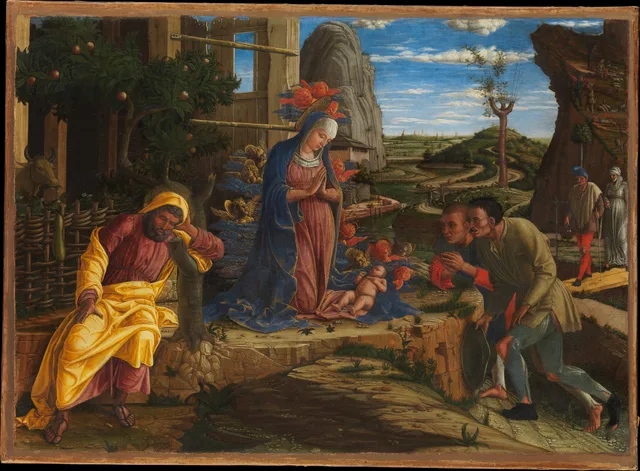
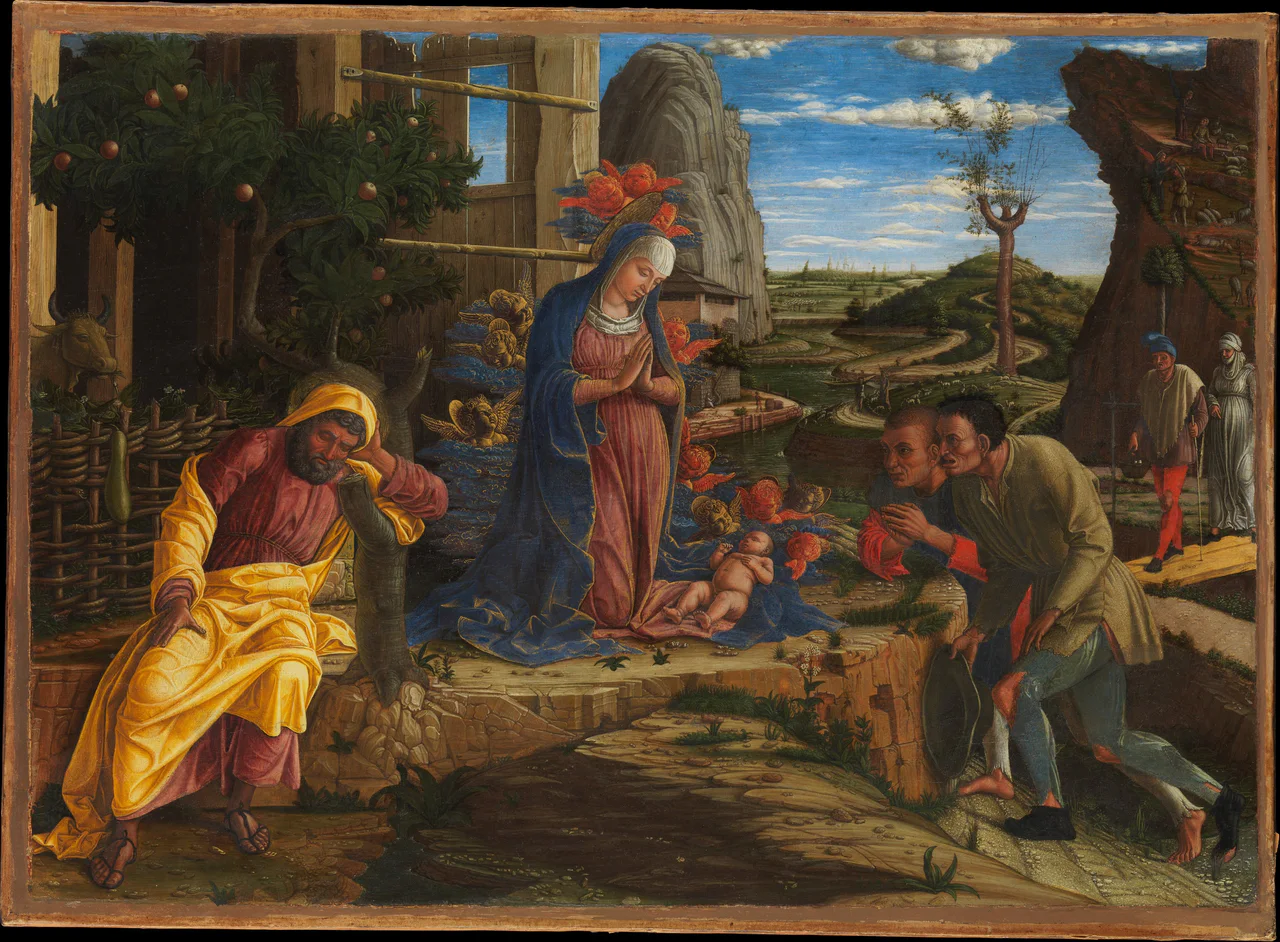
The Adoration of the Shepherds belongs to these years. Look at the far right edge. A man in a blue cap and red hose walks in with a staff and a small basket, and a woman wrapped in white follows behind him. In the middle distance a pale road winds over the hills, and up at the top left the shed roof is missing boards, so the sky shows through.
 Painted around this timeThe Adoration of the Shepherds
- 1457Padua
Imperatrice Ovetari, whose family had paid for the chapel, sued the painter. Her complaint: his fresco of the Assumption showed only eight apostles instead of twelve. The painters called in to judge decided there simply was no room for twelve in that narrow space, and they sided with Mantegna.
The chapel he defended was almost entirely destroyed by Allied bombs in 1944. Today we know it from surviving fragments and old photographs.
- 1460Mantua
Ludovico Gonzaga, ruler of Mantua, had been trying to hire Mantegna as his court painter since 1457. In 1458 he offered a yearly salary, a house, and firewood. Mantegna still did not come. He first had to finish a large altarpiece in Verona for Gregorio Correr, abbot of San Zeno.
Only in 1460 did he move his family to Mantua. From then until his death, more than forty-five years later, he worked for the Gonzaga.
- 1474Mantua
In a room of the Gonzaga palace, nearly ten years of fresco work came to an end. High on a wall Mantegna painted a tablet held up by winged children. On it he wrote that the room was dedicated to Ludovico and his wife Barbara, and added the date, 1474. Today people call it the Camera degli Sposi, the Bridal Chamber.
In the middle of the ceiling he painted an opening to the sky, as if the roof had a round hole in it. Winged children and women lean over a balustrade and peer down into the room. Anyone standing below can't help looking up.
- 1475Mantua
That September an engraver named Simone Ardizzoni wrote to Marquis Ludovico with a complaint. He and his fellow printmaker Zoan Andrea, he said, had been beaten up by men sent by Mantegna. Simone wrote that Mantegna was angry because the two had copied his engravings and printed them again. In October the marquis sent a letter summoning both printmakers.
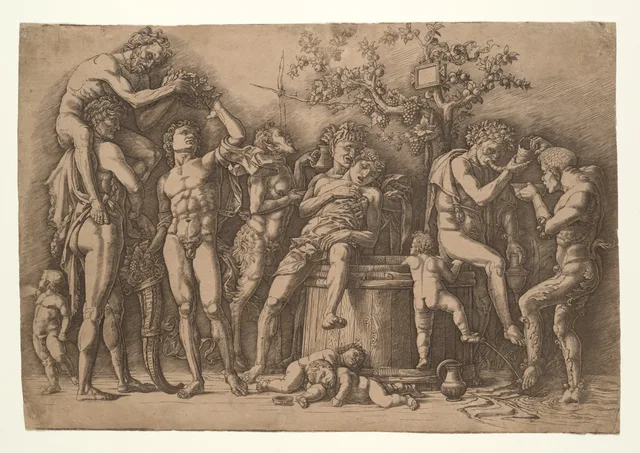
Bacchanal with a Wine Vat is one of his engravings from these years. Look at the big barrel in the middle. A man crowned with vine leaves holds a jug in one hand and laughs as he props up a limp, drunken young man. Below the barrel two babies have fallen asleep in a heap, and on the right another child climbs up to peer into the vat.
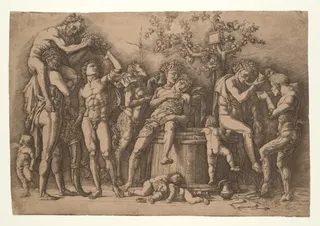 Painted around this timeBacchanal with a Wine Vat
- 1496Mantua
A Jewish banker in Mantua, Daniele da Norsa, bought a house and had an image of the Virgin on its front wall removed. The city was furious. Marquis Francesco Gonzaga was away at the time. When he came back, he had a small church built on the site of the house and made the banker pay for the painting that would hang in it.
Mantegna painted it. The Madonna della Vittoria shows Francesco kneeling under the Virgin's protection, in thanks for the battle of Fornovo in 1495. The picture was taken to France in 1797 and now hangs in the Louvre.
- 1506Mantua
In old age Mantegna was deep in debt. In January 1506 he wrote that he would sell an ancient Roman bust he had long treasured, a portrait of the empress Faustina, to Isabella d'Este, the marquis's wife. Isabella had asked for it more than once.
On 13 September that year Mantegna died in Mantua. He was buried in the chapel he had set aside for his tomb in the church of Sant'Andrea. The hard, exact line of the boy who walked out of Squarcione's workshop is still here, in the bare feet and split rocks of The Adoration of the Shepherds and in every finely cut stroke of Bacchanal with a Wine Vat.
People around them
- Francesco Squarcionethe Paduan painter who adopted and trained young Mantegna, and from whom he broke away after a legal fight in 1448.
- Nicolosia Bellinihis wife from 1453, the daughter of the painter Jacopo Bellini.
- Giovanni Bellinihis Venetian brother-in-law, a painter who watched Mantegna's work closely, as Mantegna watched his.
- Ludovico Gonzagathe ruler of Mantua who brought Mantegna to his court and gave him the Bridal Chamber to paint.
- Isabella d'EsteFrancesco Gonzaga's wife, who commissioned paintings from Mantegna and bought his Faustina bust in his final year.
Works