Pyeongye

Painters · 15th century
Botticelli
1444–1510
A Florentine painter born and buried in the Ognissanti neighborhood, who painted for the Medici, for the pope in Rome, and in old age turned to darker pictures of faith.
Scenes from a life
The life of Botticelli,
scene by scene
- 1458Florence
In 1458 a Florentine tanner named Mariano Filipepi sat down to fill out his tax return. He had to list everyone in his household. When he reached his son Sandro, he wrote that the boy was thirteen, was learning to read, and was in poor health.
That one line is among the very few records of the painter's childhood. The family lived near the church of Ognissanti. Many scholars think the name Botticelli came from a family nickname meaning little barrel.
- 1470Florence
The Mercanzia, the merchants' court of Florence, wanted seven large panels of the Virtues for its hall. Each would show one Virtue as a seated woman. The job went to Piero del Pollaiuolo. But Tommaso Soderini, one of the men overseeing the project, steered one panel to a young painter in his mid-twenties, Sandro Botticelli.
The result was Fortitude, a woman in armor resting a mace across her lap. It hangs in the Uffizi today and is one of his earliest dated works. He is generally thought to have trained with the friar-painter Filippo Lippi.
- 1478Florence
On Sunday, April 26, 1478, during Mass in Florence Cathedral, men drew daggers on the Medici brothers. The plotters were led by the Pazzi family. Giuliano de' Medici was killed. His brother Lorenzo was wounded but escaped.
The conspirators were caught and hanged from the windows of the government palace. That summer the city gave Botticelli an unusual job: paint the hanged traitors on the outside wall of a public building, where everyone could see them. A July decision to pay him forty florins for the work survives. The painting itself does not.
- 1481Rome
In October 1481, four painters were named together in a contract in Rome: Botticelli, Domenico Ghirlandaio, Cosimo Rosselli, and Pietro Perugino. Pope Sixtus IV wanted the walls of his new chapel covered with ten large story scenes. We know it now as the Sistine Chapel.
Botticelli took three of them: the Temptations of Christ, the Trials of Moses, and the Punishment of Korah. By 1482 he was back home in Florence.
- 1489Florence
In May 1489 a moneychanger named Benedetto Guardi was fitting out his family chapel in the church of Cestello in Florence. He ordered an altarpiece from Botticelli, and the monastery's book of benefactors recorded the commission. The subject was the Annunciation. That large panel is now in the Uffizi.
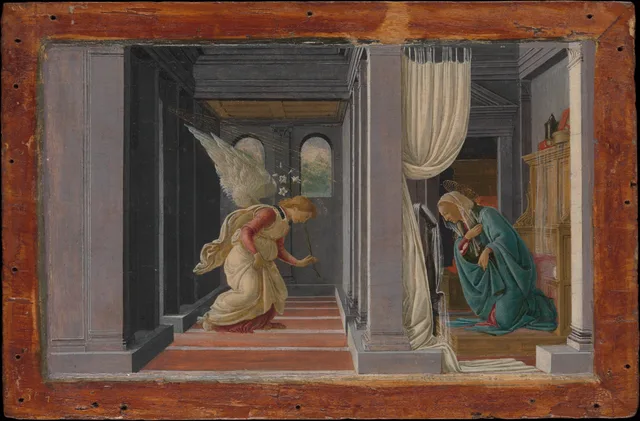
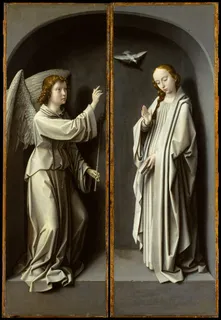
Around the same time Botticelli painted a much smaller Annunciation, meant for a home. It is only about a foot wide. On the left an angel kneels. Past a column on the right, Mary in a blue cloak bows her head.
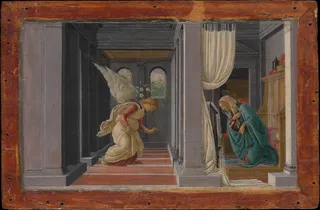 Painted around this timeThe Annunciation
- 1491Florence
In January 1491 Lorenzo de' Medici called together the leading artists of Florence. The cathedral still had no finished front, and several designs had been submitted. Botticelli was among those asked for an opinion. The meeting ended with the decision put off for another day.
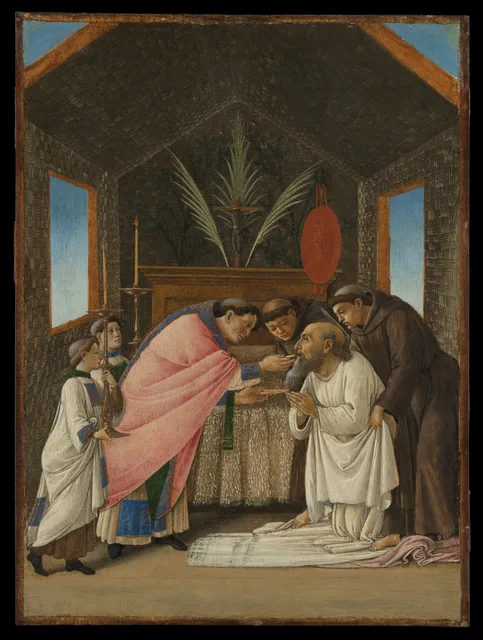
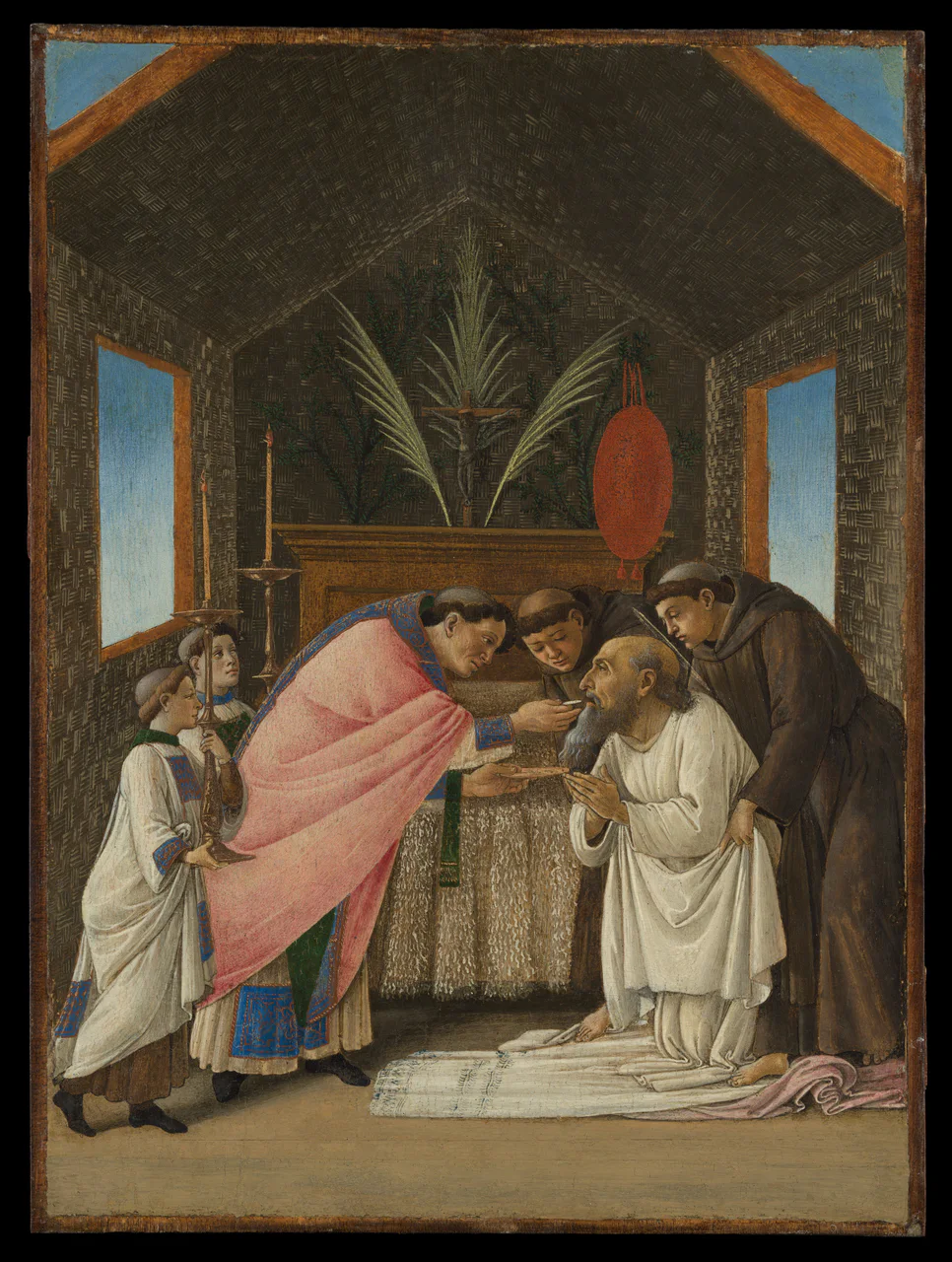
In these years he painted The Last Communion of Saint Jerome, a panel just over a foot tall. A priest in a pink vestment bends toward the old saint, who kneels to receive the bread. Two friars in brown lean in behind to watch.
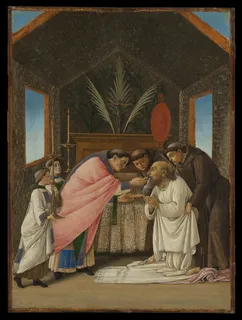 Painted around this timeThe Last Communion of Saint Jerome
- 1500Florence
As the year 1500 ended, Botticelli wrote a few lines in Greek across the top of the picture now called the Mystic Nativity. He named himself, Alessandro, and said he painted it at the end of 1500, during the troubles of Italy. Because he dated it in his own words, the painting is still much discussed.
The troubles were real. French armies had marched into Italy in 1494 and taken Milan in 1499, and Florence was torn by its own quarrels. Above the stable, angels fly in a ring. The painting is now in the National Gallery in London.
- 1510Florence
In January 1504, Botticelli, then around sixty, was called to a meeting to decide where Michelangelo's David should stand. Leonardo da Vinci, Perugino, and Filippino Lippi were there too. In May 1510 he died and was buried at Ognissanti, the church of the neighborhood where he grew up.
For a long time afterward his name faded. In the later nineteenth century, English painters and critics began to look at his work again. The two small panels on this site are now at The Metropolitan Museum of Art in New York.
People around them
- Mariano Filipepihis father, a tanner, who described young Sandro in his 1458 tax return.
- Filippo Lippithe friar-painter generally thought to have trained him.
- Filippino LippiFilippo's son, listed in 1472 as a boy working with Botticelli, later a painter in his own right.
- Tommaso Soderinithe Mercanzia official who steered the Fortitude commission to Botticelli in 1470.
- Lorenzo de' Medicisurvived the Pazzi attack, led Florence, and called the 1491 meeting on the cathedral front.
Works