 Pyeongye
Artwork · 15th century · Andrea Mantegna
LeoTurn on Magnifier at the lower right and move slowly across the painting.
Full screen opens it edge to edge.Tap the painting to fill the screen.
Spread two fingers to look closer.
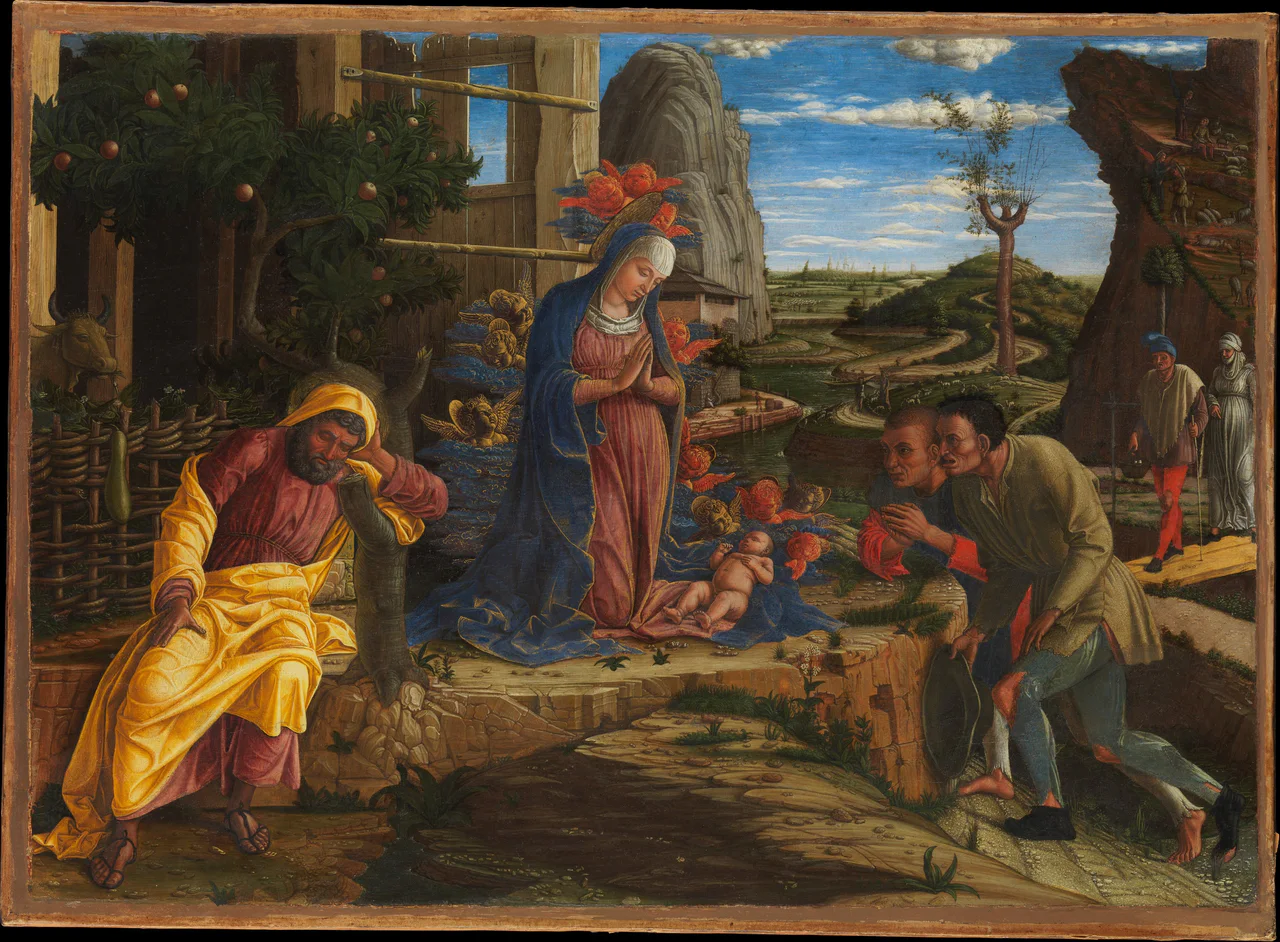
The Adoration of the Shepherds
Andrea Mantegnashortly after 1450Tempera on canvas, transferred from wood40 × 55.6 cm
At a glance
- The Virgin Mary kneels before the newborn Christ Child while two shepherds edge in from the right to worship him.
- Andrea Mantegna painted it shortly after 1450, when he was only about twenty.
- The picture is small, about 22 inches wide, yet every torn legging, bare foot, and distant sheep is painted with sharp clarity.
Reading the picture
5 places to look closer
Tap a number on the painting to jump to its note, or a close-up to see that spot in the whole picture.
Start at the lower left with the man wrapped in a yellow cloak. This is Joseph, Mary's husband. He leans on a tree stump, props his head on his hand, and has closed his eyes. Everyone else is wide awake for the big moment, and he has nodded off.
Now move to the center. The baby lies on a fold of Mary's blue mantle, one chubby hand on his chest and the other lifted, gazing upward. Around him float small angel heads with red and gold wings, tucked into a cloud of blue.
Look at the two shepherds on the right. The one in front presses his hands together. The one behind him leans over his friend's shoulder with his mouth hanging open. Their creased foreheads, thick knuckles, and sunburned faces look like those of real working men.
Zoom in on their feet. You can see a bare foot and blue leggings full of holes. Right beside it, another foot wears a battered black shoe. Mantegna lets their clothes tell you these visitors were poor.
Up in the right corner, on the reddish cliff, a winged angel has appeared among shepherds and their flock. In the Gospel of Luke, an angel tells shepherds in the fields that a child has been born, and they hurry off to find him. Mantegna tucks that earlier moment into a corner, so the story runs from the hilltop down to the front of the picture.
When it was painted
Andrea Mantegna was born near Padua, and at about ten he joined the workshop of the Paduan painter Francesco Squarcione. Squarcione adopted him as his son. But in 1448, at seventeen, Mantegna went to law against his master and set up on his own.
That same year he took on frescoes for the Ovetari Chapel in the Church of the Eremitani in Padua. In 1449 he was called to the court of Ferrara to paint a portrait of its ruler, Lionello d'Este. He was not yet twenty, and already a court wanted him.
The Met suggests this small picture may have been commissioned by Borso d'Este, who succeeded his brother Lionello as ruler of Ferrara in 1450. In the early 1600s the painting belonged to Cardinal Pietro Aldobrandini in Rome. It came to the Metropolitan Museum in 1932.
Mantegna loved ancient Roman sculpture and inscriptions, and he drew people with crisp outlines that make them look almost carved. In 1453 he married Nicolosia, the daughter of the Venetian painter Jacopo Bellini, which made the painter Giovanni Bellini his brother-in-law. From 1460 he worked as court painter to the Gonzaga family in Mantua. Most of his Ovetari Chapel frescoes were destroyed by bombing in 1944.
Look at the picture again. The shepherds' torn leggings and bare feet, and the cracked layers of rock, are all held inside lines as firm as carved stone. A young man of about twenty, trained by ancient sculpture, looked this closely at two poor shepherds.
More by the same painter
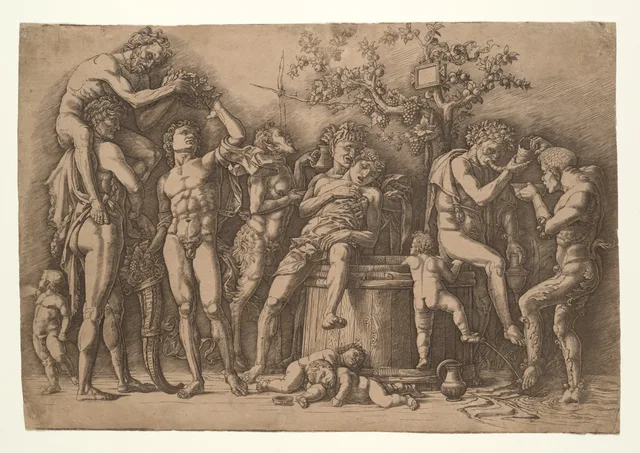
Questions to think about
- Look for itCan you spot the angel bringing the news to the shepherds on the cliff at the upper right?
- Why?Why do you think Mantegna showed the shepherds with torn leggings and bare feet?
- What about you?While everyone celebrates, Joseph has fallen asleep from exhaustion. Who in our own lives works quietly in the background until they are worn out, and how could we notice and thank them?
Same period
Painted around the same time,
somewhere else
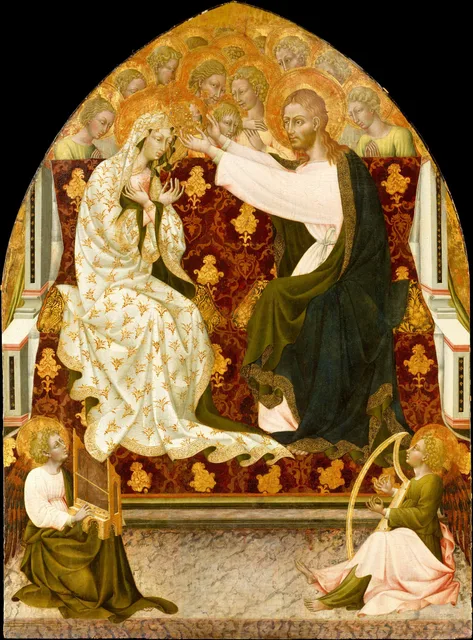 Coronation of the VirginGiovanni di Paoloca. 1455
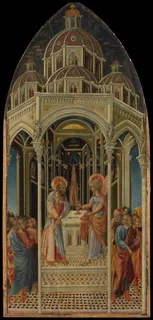 The Annunciation to Zacharias; (verso) The Angel of the AnnunciationGiovanni di Paoloca. 1455–60
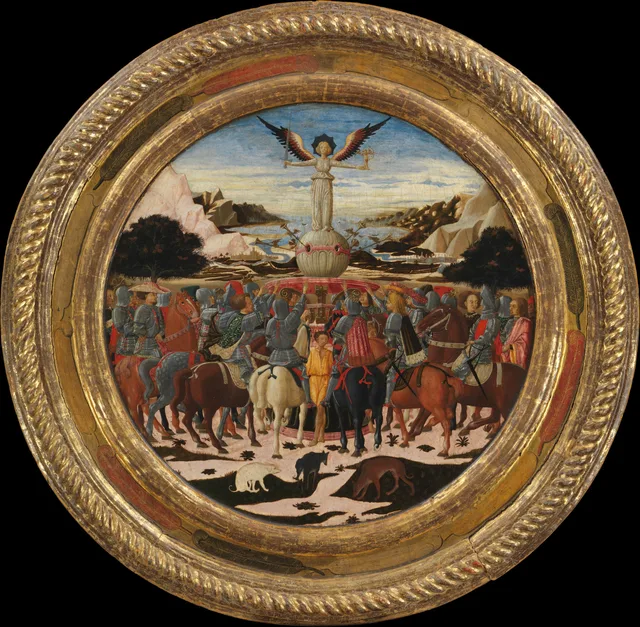 The Triumph of Fame; (reverse) Impresa of the Medici Family and Arms of the Medici and Tornabuoni FamiliesGiovanni di ser Giovanni Guidica. 1449
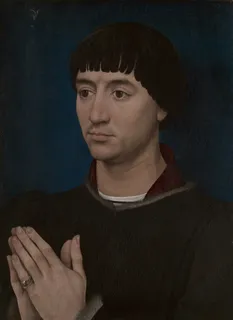 Portrait of Jean Gros (recto); Coat of Arms of Jean Gros (verso)Rogier van der Weyden1460–64
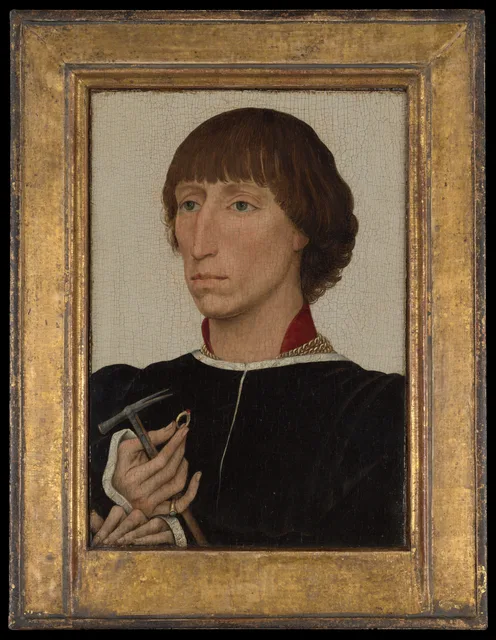 Francesco d'Este (born ca. 1429, died after 1486)Rogier van der Weydenca. 1460
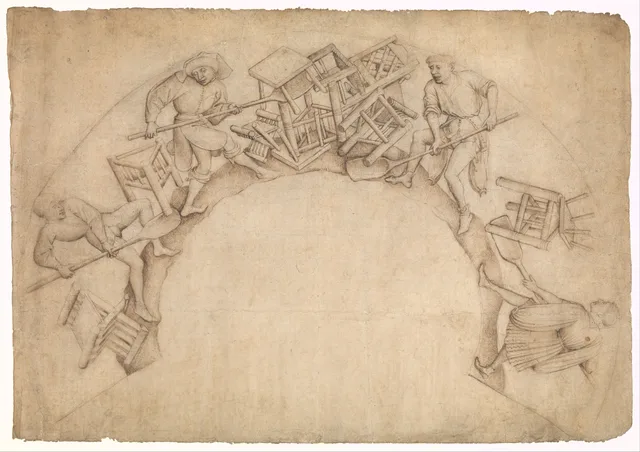 Men Shoveling Chairs (Scupstoel)Vranke van der Stockt1444–50
Too good to keep to yourself
This painting,
for someone who comes to mind
They open it at full size
and see every brushstroke.
About this work
- Artist
- Andrea Mantegna · 1430–1506
- Date
- shortly after 1450
- Medium
- Tempera on canvas, transferred from wood
- Size
- 40 × 55.6 cm
- Collection
- The Metropolitan Museum of Art
- Image
- Original long edge 3911px · shown at 2560px
- Original
- View on the museum's website ↗