Pyeongye
Painters · 14th century
Bartolo di Fredi
1353–1410
A painter of fourteenth-century Siena who worked for more than half a century, filling church walls and altarpieces with stories and serving in his city's government along the way.
Scenes from a life
The life of Bartolo di Fredi,
scene by scene
- 1353Siena
In 1353 two young Sienese painters rent a workshop together. One is Bartolo di Fredi, the other Andrea Vanni. It is the first time Bartolo's name turns up in the records.
Two years later, in 1355, he was entered in the register of the Sienese painters' guild. Now he could take commissions as a fully recognized painter. Siena at the time was still pulling itself back together after the Black Death had torn through the city a few years earlier.
- 1367San Gimignano
In 1367 Bartolo finishes a huge job in the main church of San Gimignano, the town of towers near Siena. He has covered the whole left wall with stories from the Old Testament. He signed the wall and dated it 1367.
The wall is divided into panels that run from God creating the world to Noah's ark and the trials of Job. Even people who could not read could follow the Bible story from picture to picture. The frescoes are still there today.
- 1372Siena
In November 1372, Bartolo trades his brush for public office. Siena was governed in three districts, and he was chosen captain of the people for the district of Camollia, for November and December.
That year he was also among those sent out to greet the city's incoming chief magistrate, the podestà, as he approached Siena. A painter, standing in for his city to welcome its new official. He would hold public office again in later years.
- 1382Montalcino
From March to June 1382, Bartolo serves as one of the priors who ran Siena's government. In the same year he painted a Descent from the Cross for the church of San Francesco in Montalcino, a hill town south of Siena.
Montalcino kept coming back to him. In 1388 he painted a Coronation of the Virgin altarpiece for the town and signed and dated it. It now hangs in Montalcino's museum.
- 1389Siena
In 1389 a commission arrives for an altarpiece for the shoemakers' guild chapel inside Siena Cathedral. The job went to Bartolo, his son Andrea, and their fellow painter Luca di Tommè. Father and son were now working side by side in the same shop.
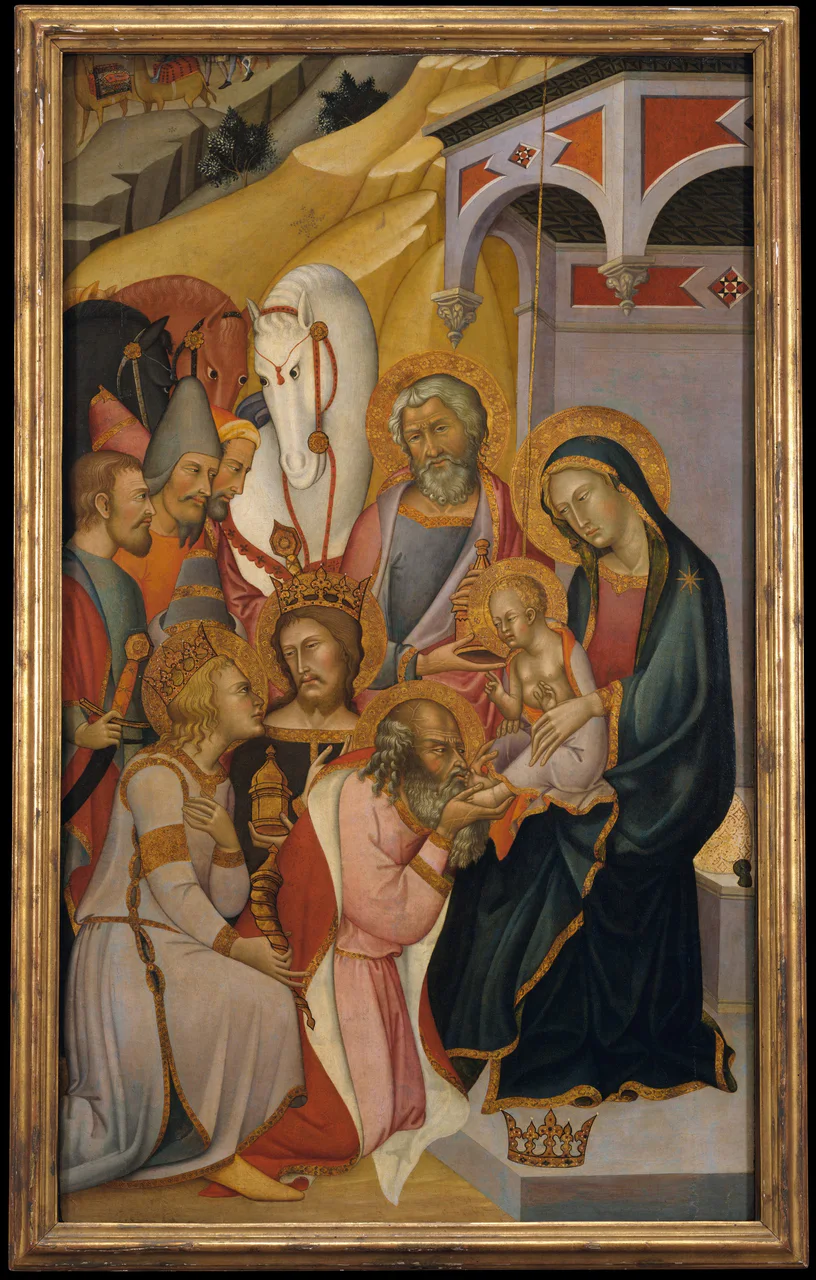
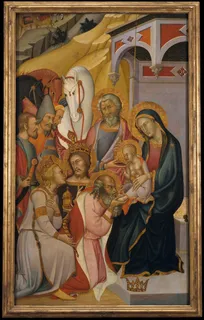
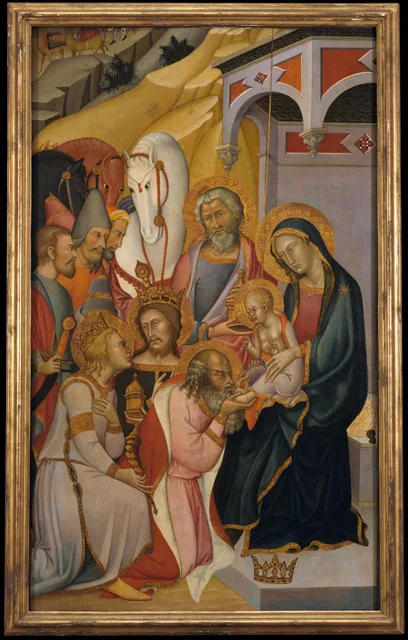
The Adoration of the Magi comes from around this time. The oldest king has set his golden crown on the ground and bends to kiss the baby's foot. A gold star shines on the shoulder of Mary's deep blue cloak. Up in the top left corner, two camels plod over a hill.
 Painted around this timeThe Adoration of the Magi
- 1410Siena
On January 26, 1410, Bartolo di Fredi dies in Siena. Fifty-seven years had passed since he and Andrea Vanni first rented their workshop. In that time he had filled church walls and altars across Siena and its neighboring towns.
His son, Andrea di Bartolo, carried on the workshop. The Adoration of the Magi later lost its upper section, and a fragment of the missing procession is now in the museum in Dijon, France. The rest passed through several collections before entering the Metropolitan Museum of Art in 1975.
People around them
- Andrea Vannithe Sienese painter who rented a workshop with Bartolo in 1353.
- Andrea di Bartolohis son and pupil, who worked beside him and took over the workshop.
- Luca di Tommèthe fellow Sienese painter who shared the 1389 cathedral altarpiece commission.
Works
Paintings by
Bartolo di Fredi on Pyeongye
More paintings by this artist will be added.
Contemporaries