 Pyeongye
Artwork · 14th century · Bartolo di Fredi
LeoTurn on Magnifier at the lower right and move slowly across the painting.
Full screen opens it edge to edge.Tap the painting to fill the screen.
Spread two fingers to look closer.
At a glance
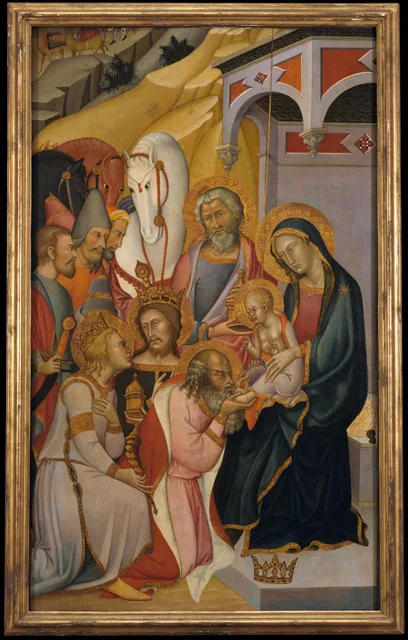
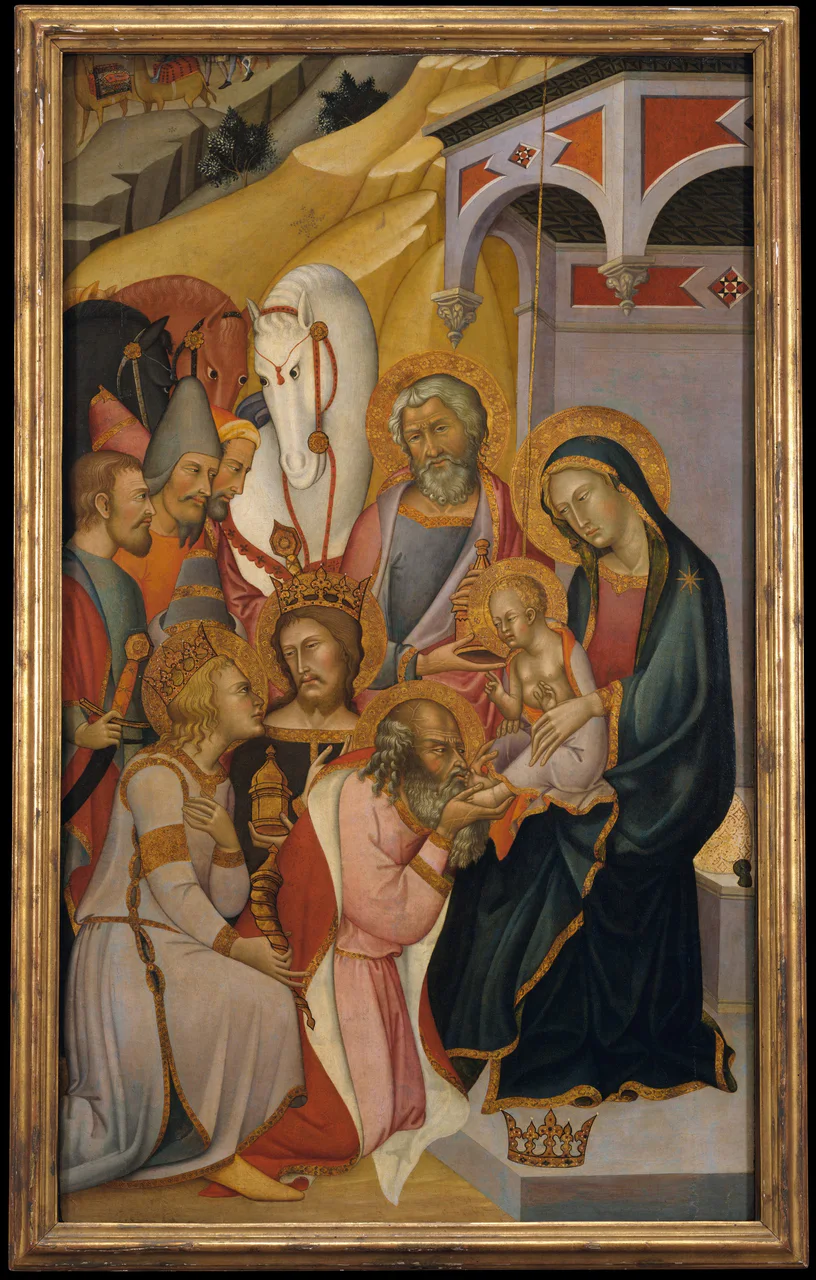
- Three kings who have traveled a long way kneel before the infant Jesus to offer their gifts, while horses and attendants crowd in behind them.
- Bartolo di Fredi of Siena, in Italy, painted it around 1390 in tempera and gold on a wooden panel.
- Every small ornament gets careful attention, from the gold halos and patterned hems to the saddle cloths on the camels.
Reading the picture
5 places to look closer
Tap a number on the painting to jump to its note, or a close-up to see that spot in the whole picture.
Zoom into the old king at the bottom center. Bald, with a long gray beard, he cradles the baby's foot in his hand and kisses it. You can see every wrinkle on his forehead and the arch of his brows. The gold halo behind his head is stamped all over with tiny flower shapes.
Look down at Mary's feet. A gold crown sits on the floor. The old king has taken it off and set it down before the child. He has put aside the sign of his power in order to kneel.
Zoom into Mary's shoulder. A single gold star shines on her deep blue cloak. Painters of this period often placed a star on Mary's mantle. Even the gold border along the edge of the cloak is worked with a pattern.
Find the white horse on the left. Its red bridle is studded with round gold ornaments, and a red tassel hangs below its brow. Behind it, a brown horse's head and the faces of attendants are packed tightly together. The kings' company seems to stretch on beyond the edge of the panel.
Climb up to the top left corner. Two camels are walking beyond the hill. Their backs are draped with cloths patterned in red and black. This little scene reminds us of the journey of the kings, who followed a star from the East.
When it was painted
By about 1390, Bartolo di Fredi had been painting in Siena for close to forty years. He first turns up in the records in 1353, renting a workshop with a fellow painter, Andrea Vanni. Two years later he joined the Sienese painters' guild.
In the years that followed he covered the left wall of the great church in nearby San Gimignano with stories from the Old Testament, signing and dating the work in 1367. His son, Andrea di Bartolo, also became a painter and worked alongside him. Bartolo painted the Adoration of the Magi more than once. Another large version still hangs in the Pinacoteca Nazionale in Siena.
This panel is not complete. According to the Metropolitan Museum, its top has been cut off. The upper part once showed the procession of the Magi, and a fragment of it survives today in the Musée des Beaux-Arts in Dijon, France.
The cut-down panel then traveled a long way. By 1862 it was listed in the collection of Johann Anton Ramboux, a German painter and collector in Cologne. It passed to a museum in Cologne, then to collectors in England and America, and finally to the New York banker Robert Lehman. It came to the Metropolitan Museum in 1975 with the rest of his collection.
Now look again at the top left corner. The camels and the people walking over the hill are sliced off at the top edge, so for some of them only the legs remain. Just above that line, the kings' procession once continued. That is the part that was cut away.
Questions to think about
- Look for itWhere is the youngest of the three kings, and what is he holding?
- Why?Why do you think the painter had the old king take off his crown and set it on the floor?
- What about you?The most powerful person in the picture kneels in the lowest place. Have you ever seen someone with power lower themselves like that today?
Same period
Painted around the same time,
somewhere else
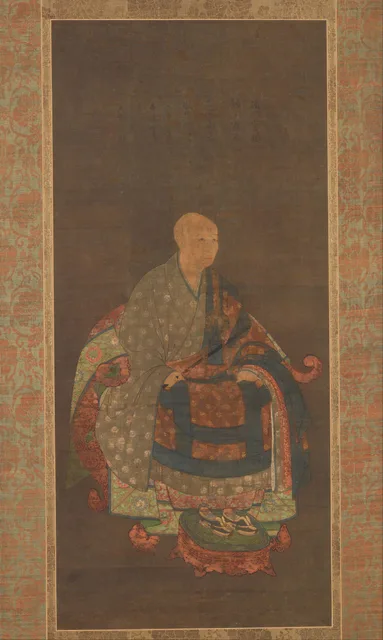 Portrait of Shun'oku MyōhaUnknown artist · Japanca. 1383
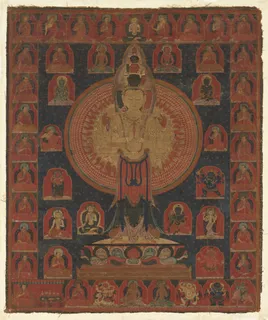 Thousand-Armed Chenresi, a Cosmic Form of the Bodhisattva AvalokiteshvaraUnknown artist · Tibet14th century
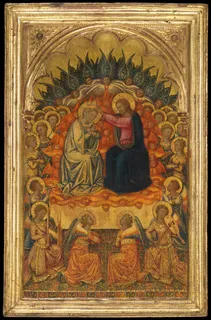 The Coronation of the VirginNiccolò di Buonaccorsoca. 1380
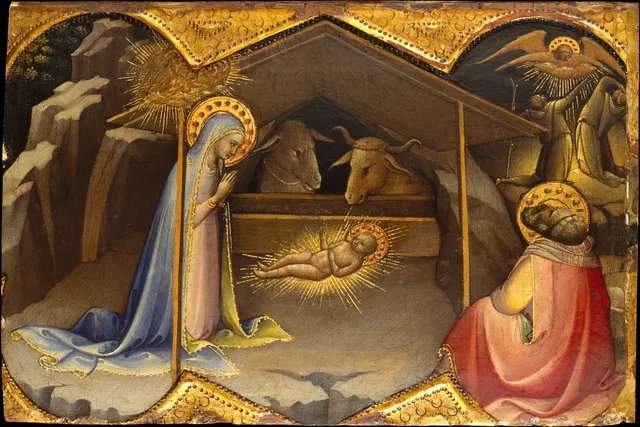 The NativityLorenzo Monacoca. 1406–10
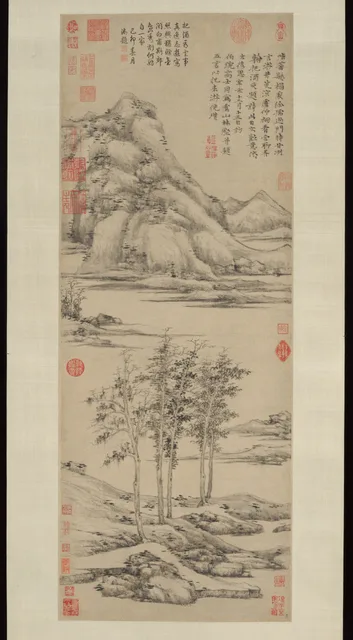 Woods and Valleys of Mount YuNi Zandated 1372
 Three Virtues (Temperance, Hope, and Fortitude or Justice) and Studies of a Seated ManLorenzo Monacoca. 1420
Too good to keep to yourself
This painting,
for someone who comes to mind
They open it at full size
and see every brushstroke.
About this work
- Artist
- Bartolo di Fredi · 1353–1410
- Date
- ca. 1390
- Medium
- Tempera and gold on wood
- Size
- 148.6 × 89.2 cm
- Collection
- The Metropolitan Museum of Art
- Image
- Original long edge 3722px · shown at 2560px
- Original
- View on the museum's website ↗