Pyeongye
Painters · 15th century
Bernat Martorell
1427–1452
A fifteenth-century Barcelona painter whose name was forgotten for centuries, so that scholars called him only "the Master of Saint George," until an old contract gave it back.
Scenes from a life
The life of Bernat Martorell,
scene by scene
- 1427Barcelona
On July 1, 1427, a contract is drawn up for a new altarpiece at the convent of Pedralbes in Barcelona. A priest signs for the abbess, and a carpenter named Pere Puig agrees to build the wooden frame. The frame had to follow a drawing by the painter Bernat Martorell.
That contract is the first time Martorell's name appears in the records. He came from Sant Celoni, a small town north of Barcelona, where his father was a butcher.
- 1433Barcelona
In 1433 the city councillors of Barcelona write Martorell a receipt. It covered paintings he had made for the Trentenari, the city's council of thirty. From then on he was a painter officially settled in the city.
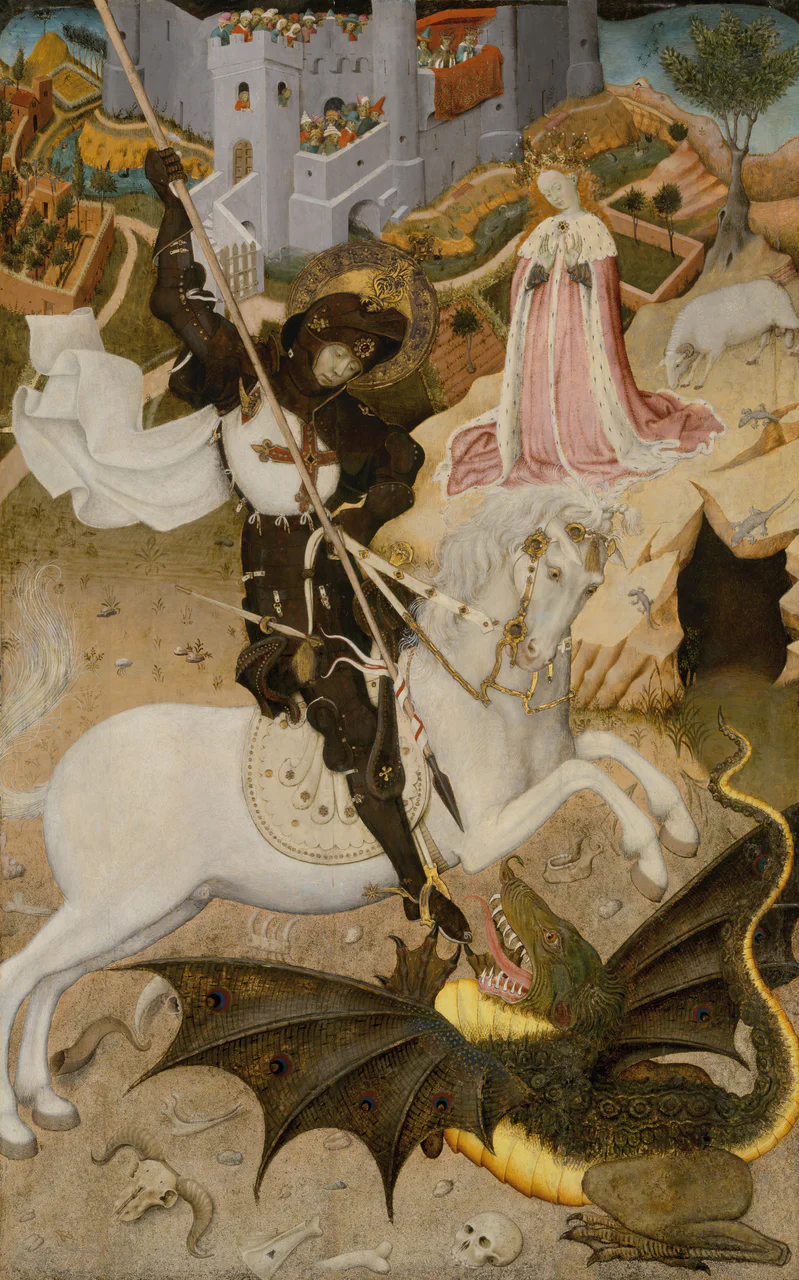
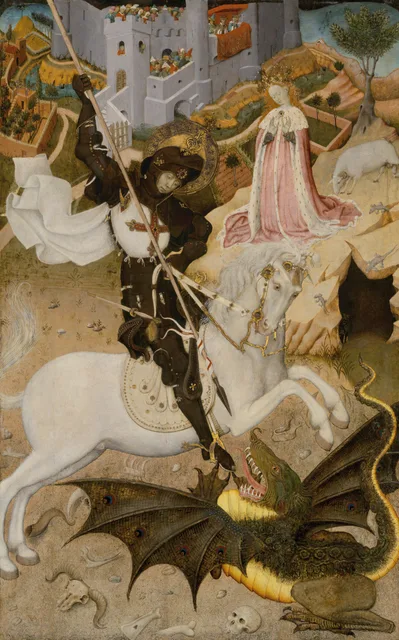
Saint George and the Dragon came a year or two later. The saint, on a white horse, aims the point of a long lance down at the dragon. On the right, a princess in a pink gown and a white fur cape holds her hands together. Townspeople crowd the battlements. Look at the sandy ground: skulls and bones lie everywhere, and small lizards creep over the rocks by the cave.
This panel was once the center of an altarpiece. Four smaller scenes of the saint's martyrdom surrounded it, and those four are now in the Louvre in Paris. The Art Institute of Chicago thinks it was probably made for the chapel of the palace of the government of Catalonia, whose patron saint is George.
 Painted around this timeSaint George and the Dragon
- 1437Barcelona
In the summer of 1437 Martorell signs a contract with the nobleman Bernat de Corbera. The job was an altarpiece of Saint Peter for the church of Sant Pere in Púbol, a village near Girona. That altarpiece is now in the art museum in Girona.
On October 2 of the same year, the Barcelona councillors pay him for a drawing. He had drawn a model that was sent all the way to Flanders, where a stained-glass window for the Trentenari hall of the city hall would be made from it. Sadly, the window has not survived.
- 1445Barcelona
In 1445 Simó Salvador, bishop of Barcelona, dies in Rome. Following the wishes in his will, a large altarpiece was to be set up in Barcelona Cathedral, and Martorell took on the work.
Its subject is the Transfiguration, the Bible story in which Christ's face and clothes shine with light on a mountain. The altarpiece still stands inside the cathedral today. In October 1449 Martorell was also paid for an altarpiece of Saint Benedict, ordered by a canon, Antoni Portella, who had died.
- 1452Barcelona
On December 13, 1452, Martorell makes his will. He gave his second wife, Bartomeua Figueres, the use of his property, and named his young son Bernat as his heir.
The will was opened on the 23rd of that month, around the time of his death in Barcelona. His widow carried on the workshop. Yet for all his success, his name soon slipped out of memory.
- 1933Chicago
In the early 1900s the French art historian Émile Bertaux named the unknown artist of this panel "the Master of Saint George." No one knew his real name. Later the Catalan scholar Agustí Duran i Sanpere found Martorell's name in the contract for the Púbol altarpiece, and one by one, paintings in the same hand were given back to him.
Meanwhile Saint George and the Dragon had passed to the American collector Charles Deering. In 1933 his two daughters gave it to the Art Institute of Chicago. So the saint fighting the dragon hangs in Chicago, while the four scenes of his martyrdom remain in Paris.
People around them
- Pere Puigthe carpenter who agreed in 1427 to build the Pedralbes altarpiece frame from Martorell's drawing.
- Bernat de Corberathe nobleman who ordered the Saint Peter altarpiece for Púbol in 1437.
- Simó Salvadorthe bishop whose will led to the Transfiguration altarpiece in Barcelona Cathedral.
- Bartomeua Figuereshis second wife, who kept the workshop going after his death.
- Agustí Duran i Sanperethe Catalan scholar who found Martorell's name in the Púbol contract.
Works
Paintings by
Bernat Martorell on Pyeongye
More paintings by this artist will be added.