Pyeongye
Painters · 15th century
Rogier van der Weyden
1399–1464
A fifteenth-century Flemish painter who trained in Tournai, became the official painter of Brussels, and is remembered for grieving faces and quiet, watchful portraits.
Scenes from a life
The life of Rogier van der Weyden,
scene by scene
- 1427Tournai
In March 1427 the Tournai painters' guild wrote a new name in its book: Rogelet de le Pasture, a pupil entering the workshop of the painter Robert Campin. Scholars take him to be the future Rogier. The son of a Tournai knife maker, he was already about twenty-seven.
Why a grown man signed on as a pupil so late is still a puzzle. Five years later, on August 1, 1432, he became a master in the same guild.
- 1435Leuven
Around 1435, the Great Crossbowmen's Guild of Leuven ordered an altarpiece for its chapel. Rogier painted Christ being lowered from the cross, with Mary collapsing beside him, the figures close to life-size. They crowd a shallow golden box. Look at the two upper corners and you find tiny crossbows worked into the decoration, the badge of the guild that paid for it.
Later the painting passed to Queen Mary of Hungary and was taken to Spain. Today it hangs in the Prado in Madrid.
- 1436Brussels
Rogier moved from Tournai to Brussels. His French name, de le Pasture, became the Dutch van der Weyden; both mean "of the meadow." By March 1436 he was named as the official painter of the city.
The post was created just for him and was meant to end when he died. The city asked him for four large paintings on the theme of justice for the courtroom of the town hall, a reminder to the judges who sat there. The paintings burned in 1695, when French troops bombarded Brussels. A tapestry in Bern gives some idea of how they looked.
- 1450Rome
1450 was a Jubilee year, when pilgrims streamed to Rome. Rogier was among them. We know because the humanist Bartolomeo Facio, writing at the court of Naples in 1456, put it into his book of famous men.
According to Facio, Rogier stood in front of Gentile da Fabriano's frescoes in the Lateran basilica and admired them greatly. A painter from the north, looking hard at a painter from the south. Those frescoes are now lost.
- 1460Brussels
In December 1460 a young painter from Milan, Zanetto Bugatto, arrived in Brussels. Bianca Maria Sforza, Duchess of Milan, had sent him to learn from Rogier. He stayed in the workshop until the spring of 1463.
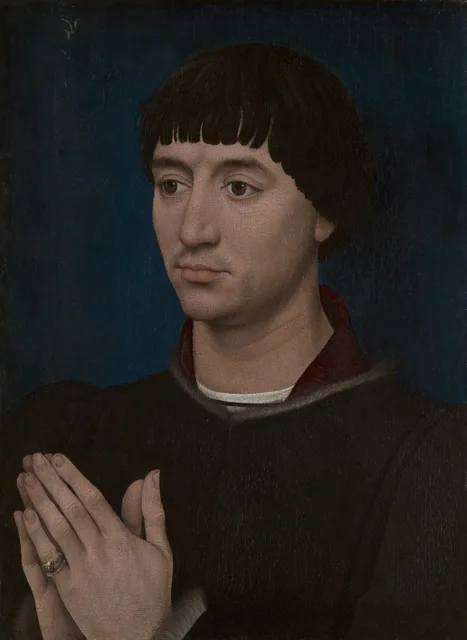
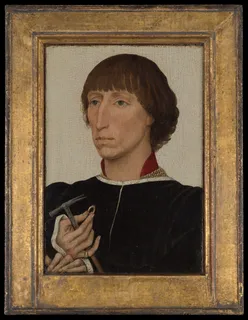
In May 1463 the duchess wrote to Rogier to thank him for teaching her painter. Around this time Rogier also painted Francesco d'Este, a young nobleman from Ferrara living at the Burgundian court.
Painted around this timeFrancesco d'Este (born ca. 1429, died after 1486) - 1464Brussels
Rogier died in Brussels on June 18, 1464. He was buried in the chapel of St. Catherine in the church of St. Gudula.
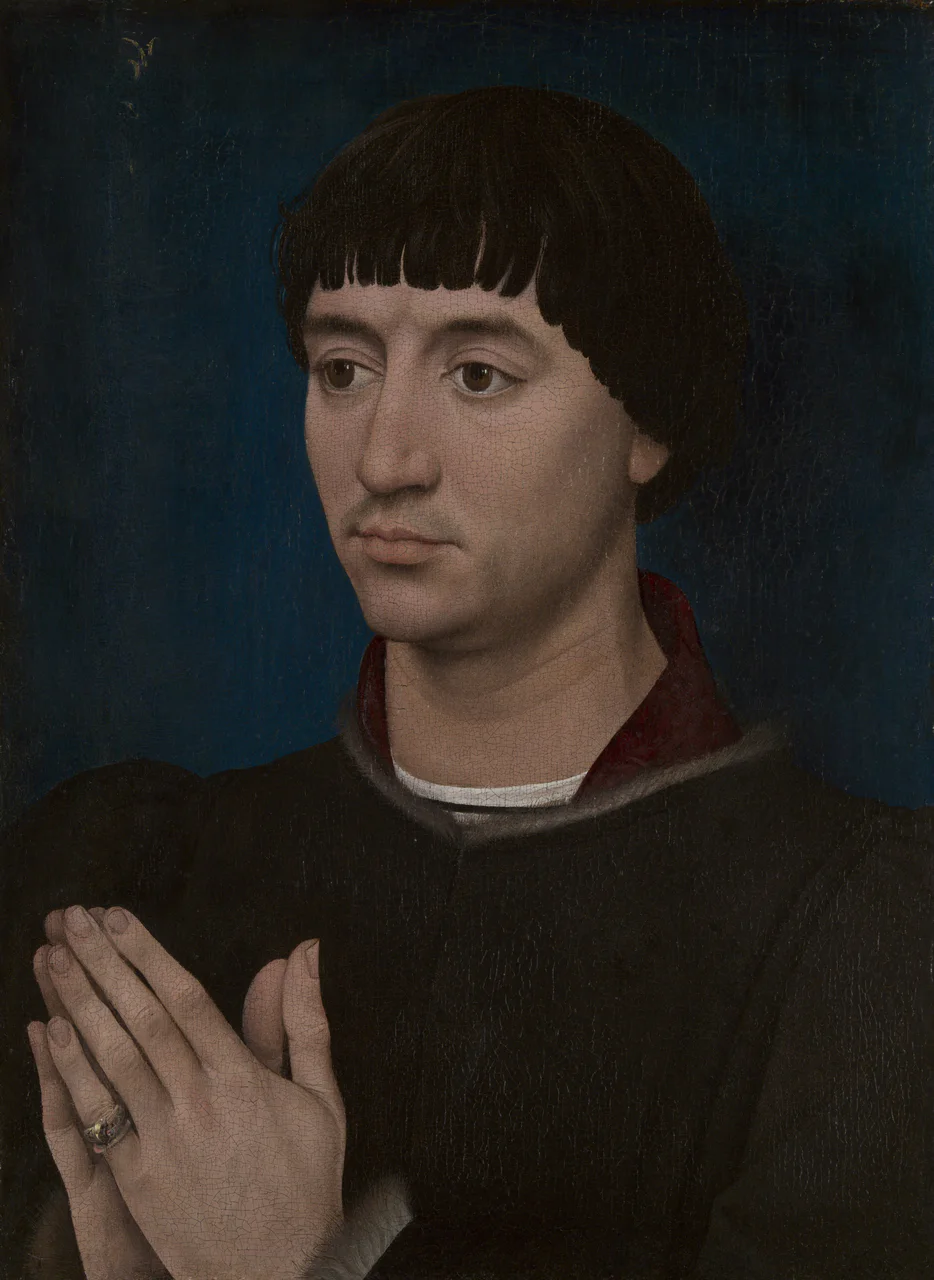
His eldest son, Cornelis, had long since become a monk at the Carthusian house of Hérinnes. In his last years Rogier gave help to that monastery, to the Carthusians of Scheut near Brussels, and to the poor of St. Gudula. His small portrait of Jean Gros, an official at the Burgundian court, comes from these final years.
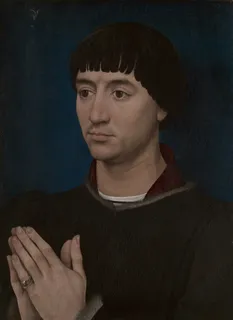 Painted around this timePortrait of Jean Gros (recto); Coat of Arms of Jean Gros (verso)
People around them
- Robert Campinthe Tournai painter in whose workshop Rogier trained.
- Elisabeth Goffaerthis wife.
- Cornelishis eldest son, who became a Carthusian monk.
- Bianca Maria Sforzathe Duchess of Milan who sent her painter to study with him.
- Zanetto Bugattothe Milanese painter who trained in his workshop.
Works