Pyeongye
Painters · 15th century
Petrus Christus
1444–1476
A fifteenth-century Flemish painter who settled in Bruges after Jan van Eyck's death and carefully signed and dated many of his pictures.
Scenes from a life
The life of Petrus Christus,
scene by scene
- 1444Bruges
On July 6, 1444, a new name went into the citizens' register of Bruges. Petrus Christus had paid to become a citizen of the city. The record says he came from Baerle. Where he was and what he did before that day is unknown.
A painter from outside Bruges needed citizenship to work there. It was exactly three years since the city's famous painter, Jan van Eyck, had died.
- 1446Bruges
In 1446 Edward Grimston, an envoy of King Henry VI of England, crossed the Channel. That year his diplomatic work took him to Calais and Brussels. He also had Christus paint his portrait. In the picture you can see the collar that marked a man in the English king's service.
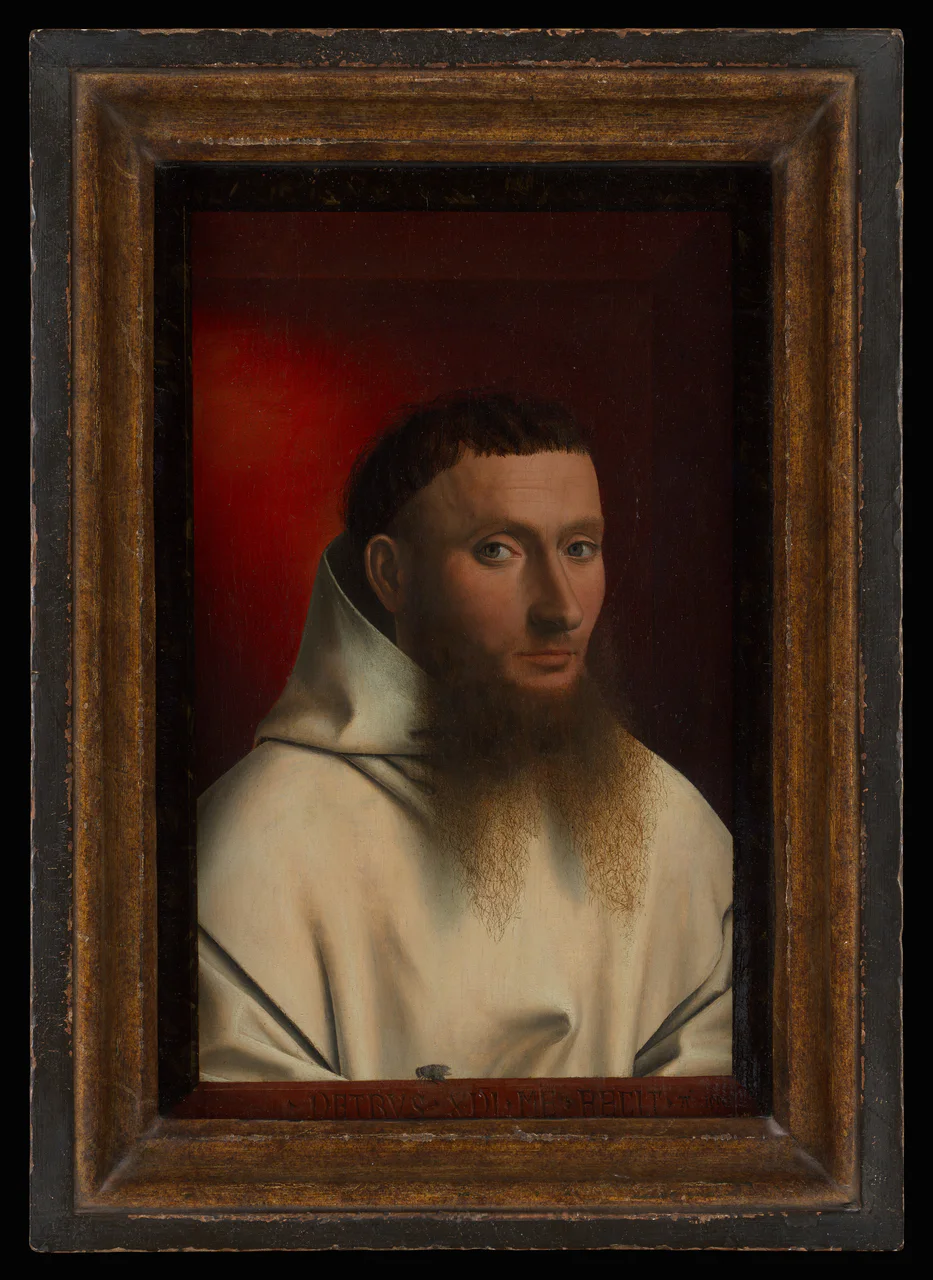
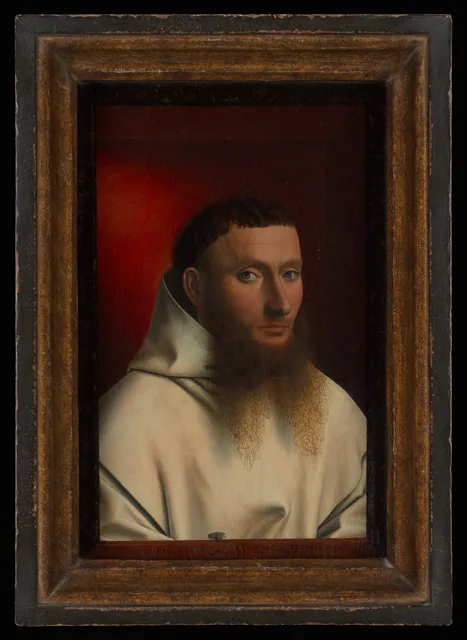
The portrait still belongs to Grimston's descendants and has been on loan to the National Gallery in London since 1927. In the same year Christus painted a Carthusian monk against a red wall and wrote his own name and the date, 1446, below.
 Painted around this timePortrait of a Carthusian
- 1449Bruges
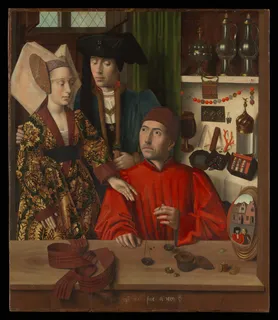
Three years later Christus painted a goldsmith's shop. A craftsman weighs a ring while a young couple stands beside him, and a round convex mirror on the counter shows the street outside. Once again Christus signed the picture and dated it 1449.
That same year Philip the Good, Duke of Burgundy, ordered a gift from a Bruges goldsmith named Willem van Vleuten. It was for the wedding of Mary of Guelders to King James II of Scotland. Some scholars think the goldsmith in the painting is this man.
Painted around this timeA Goldsmith in his Shop - 1454Bruges
In 1454 a special order came to Christus. The Count of Étampes wanted three exact copies of a painting of the Virgin kept in Cambrai Cathedral. People believed that image could work miracles.
So a famous holy picture was to be copied, and the job went to a painter in Bruges. Sadly, none of the three copies Christus made has survived.
- 1463Bruges
Around 1462 Christus and his wife, Gaudicine, joined the Confraternity of Our Lady of the Dry Tree in Bruges. Isabella of Portugal, Duchess of Burgundy, was also a member. It was a religious brotherhood of some of the most prominent people in the city.
In 1463 the city of Bruges gave him a job. Together with the painter Pieter Nachtegale, he was to supervise the making of two large stage decorations. By now he was a painter the city trusted.
- 1476Bruges
We know roughly when Christus died because of the confraternity's account books. Sometime between September 2, 1475, and December 19, 1476, they record his death. The exact day is not known.
He had signed and dated several of his paintings. Thanks to those words, we can still recognize the monk of 1446 and the goldsmith of 1449 as his work.
People around them
- Gaudicinehis wife, who joined the Dry Tree confraternity with him.
- Edward Grimstonthe English envoy who had Christus paint his portrait in 1446.
- The Count of Étampesthe patron who ordered three copies of the Cambrai Virgin in 1454.
- Pieter Nachtegalethe painter who shared a city commission with him in 1463.
Works
Paintings by
Petrus Christus on Pyeongye
Hidden stories in Petrus Christus's paintings