Pyeongye
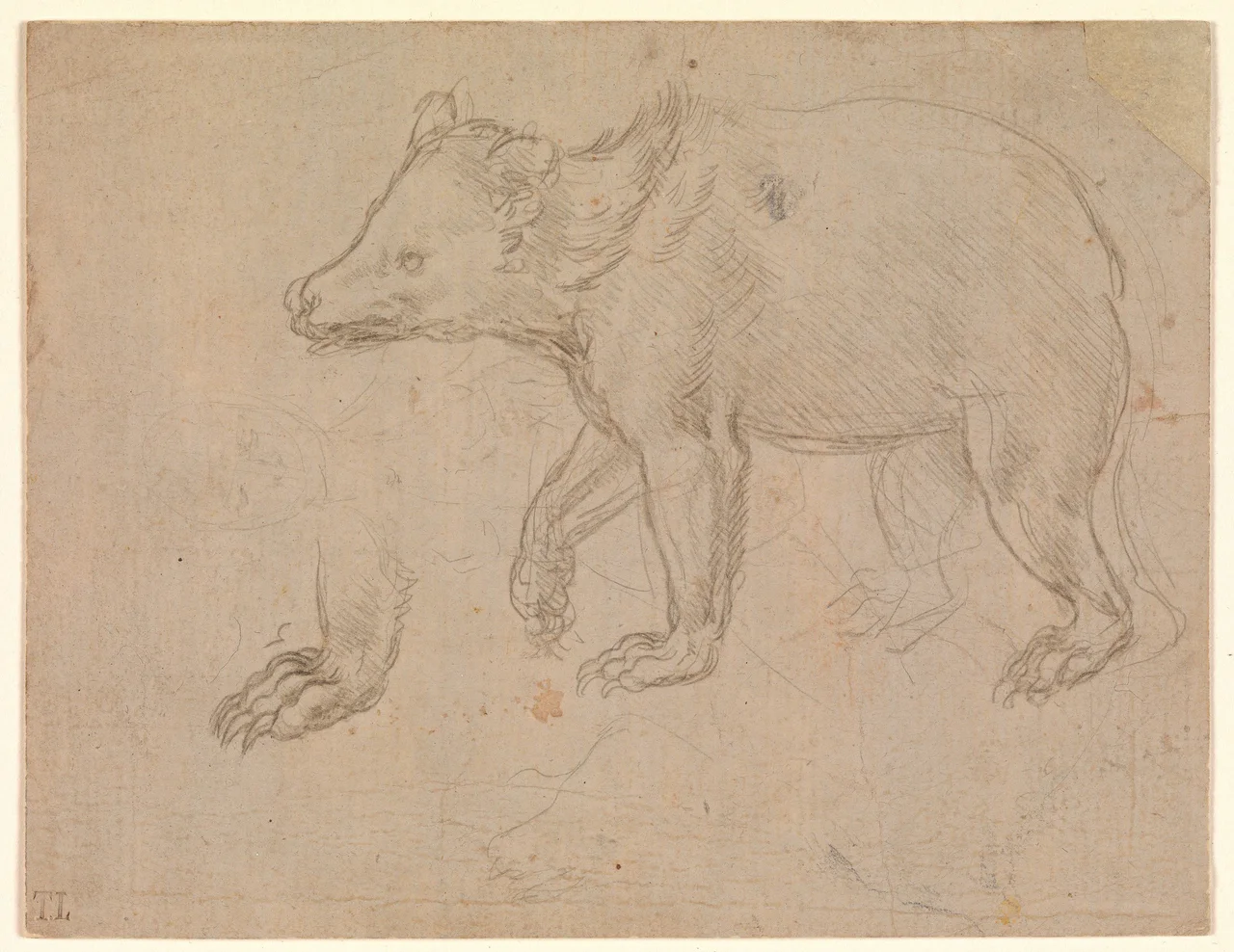
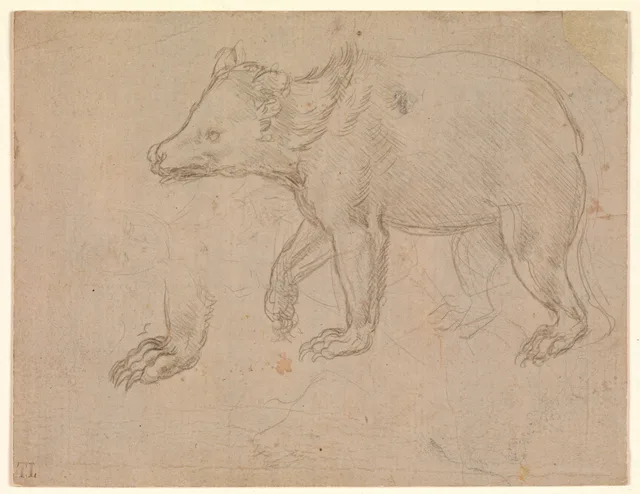
A bear is walking slowly across the paper. One front leg is lifted, and its head stretches forward to the left. But below the bear's head, in the empty lower left corner, there is something odd. A large paw floats there by itself, not attached to any body.
This drawing is A Bear Walking, by Leonardo da Vinci, made around 1482 to 1485. The sheet is just 10.3 by 13.3 centimeters, about four by five inches. It would fit in the palm of your hand. Around 1482, Leonardo left Florence and moved to Milan.
Start with the bear's face.
At the end of a long snout, the nose curls into a rounded tip. You can see one small, round eye. Around the mouth and under the jaw, rows of short strokes stand for fur. The lines are very fine, and the darks are never much darker than the lights.
These are not pencil lines. Leonardo used silverpoint. A pointed stylus tipped with silver is dragged across paper that has first been coated with a prepared ground. Here the ground is a pale buff color. Silverpoint cannot be rubbed out with an eraser. Once a line goes down, it stays.
Now look at the big paw in the lower left.
It is drawn larger than the paws on the walking bear. Thick, knobby toes line up side by side, and long curved claws reach out from their tips. Strokes follow the direction of the fur on top of the foot. On the walking bear, the toes are small and hard to read. Here, Leonardo stopped and studied them again, up close.
Bears walk the way people do, with the whole sole of the foot flat on the ground. To draw a bear's weight pressing into each step, you need to know how that foot is built. In a way, this one loose paw holds up the whole walking bear.
Because silverpoint cannot be erased, this sheet also keeps a record of the artist changing his mind. Look near the bear's back legs.
Around the darker legs, many very faint lines cross and tangle. They look like tries at placing the legs in slightly different spots. Leonardo did not erase the first attempt. He simply drew over it, searching for a better line.
The bear's back and side are filled with slanted hatching. Most of these strokes run from upper left down to lower right. That direction shows up again and again in drawings by Leonardo, who was left-handed.
All his life, Leonardo filled notebooks with careful studies of animals and of the human body. Even this tiny sheet shows that habit at work: a mind trying to figure out how a bear moves and how its foot is built. The sheet is now in the Robert Lehman Collection at the Metropolitan Museum of Art in New York.