Pyeongye
Painters · 15th century
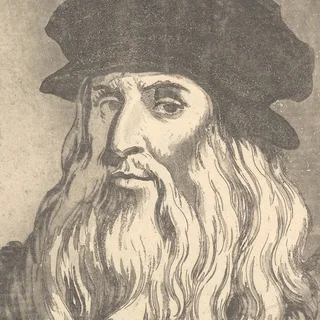
Leonardo da Vinci
1452–1519
A painter who trained in a Florence workshop, worked in Milan and Rome, and died in France, filling sheet after sheet with what he looked at, from a bear's claws to the bowed head of the Virgin.
Scenes from a life
The life of Leonardo da Vinci,
scene by scene
- 1452Vinci
An old man named Antonio turned to the last page of an old notary's register and added a line. His son Piero had a new grandson, born on Saturday, April 15, in the third hour of the night. The boy was named Leonardo. Counting hours from sunset, as people did then, that was around ten in the evening.
Antonio also wrote down the name of the priest who baptized the baby. The father, Piero, was a notary, and he was not married to the boy's mother, Caterina. That one short note is how we know about a night more than five hundred years ago.
- 1476Florence
In April 1476 an unsigned note was dropped into one of Florence's boxes for anonymous accusations. It charged several young men with sodomy, and Leonardo was on the list. The note said he lived with Andrea del Verrocchio.
He had already joined the Florentine painters' Company of Saint Luke in 1472, yet he was still working in his teacher's shop. The accusation was anonymous, so it could not stand on its own. About two months later the men were cleared, on condition that no one accused them again.
- 1482–85Milan
Around the age of thirty, Leonardo drafted a letter to Ludovico Sforza, the ruler of Milan. The draft still survives. Most of it is not about painting at all. He lists portable bridges, ways to knock down fortresses, cannons, and covered war wagons.
Painting and sculpture come only near the end, along with an offer to make a bronze horse honoring the Sforza family. Then he went to Milan and stayed for many years.
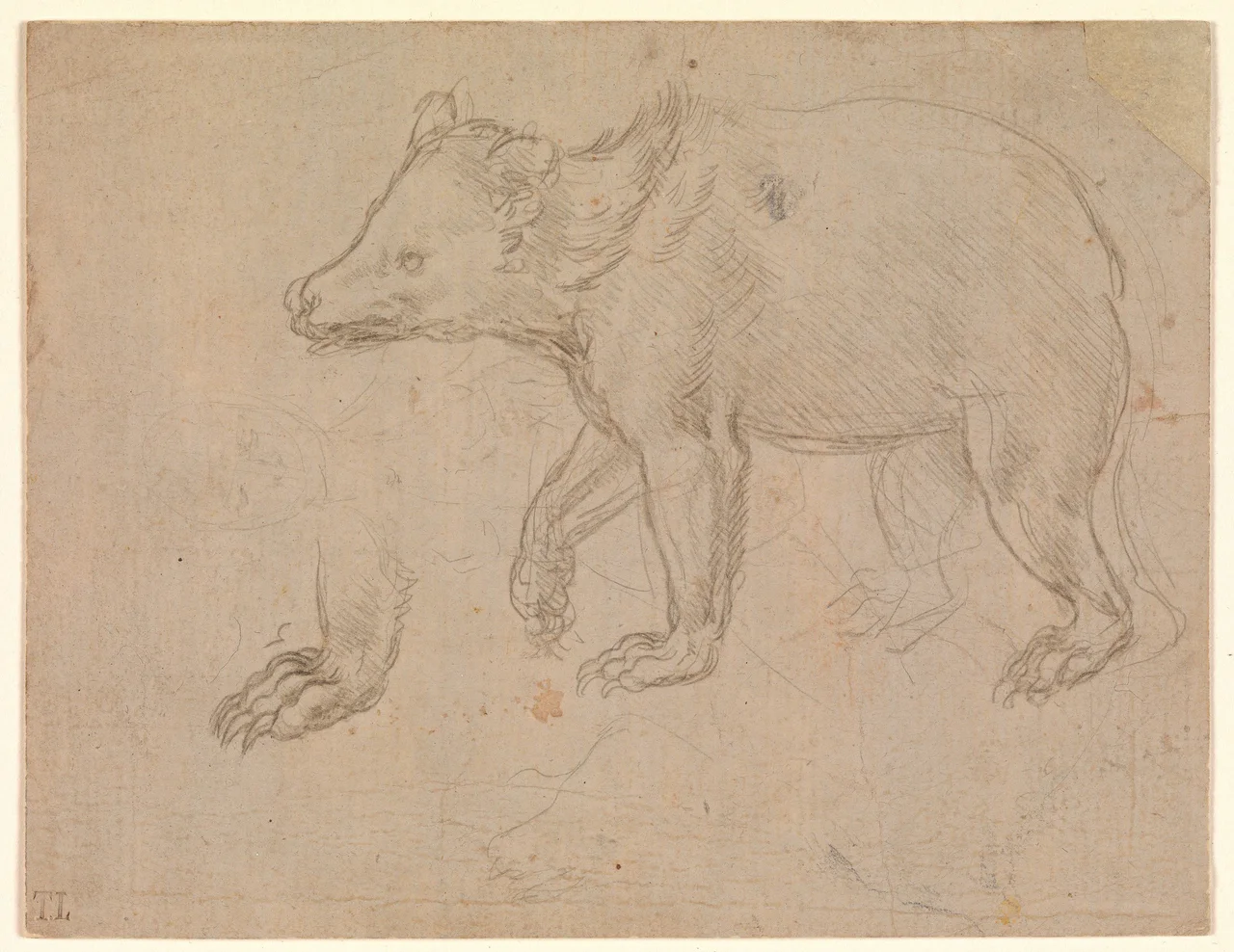
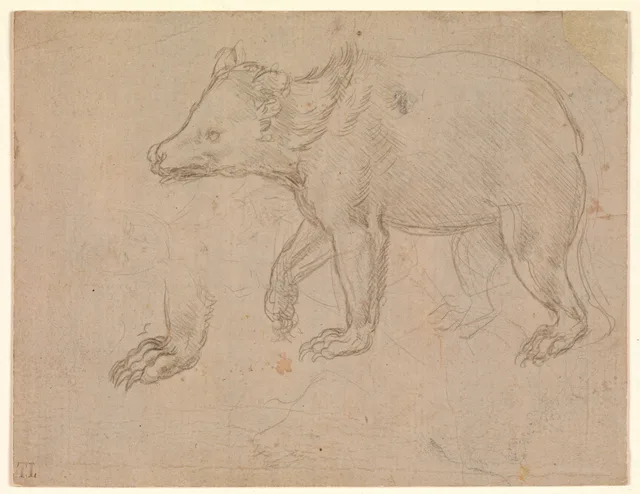
A Bear Walking is a silverpoint drawing from about 1482 to 1485, small enough to fit in your palm. The bear faces left and lifts one front paw as it steps. Down at the lower left, a single large paw with curved claws is drawn again on its own.
 Painted around this timeA Bear Walking
- 1490Milan
On July 22, 1490, a ten-year-old boy named Giacomo moved into Leonardo's house. Leonardo noted the date in his notebook, then kept a running list of the trouble that followed. Money set aside to pay for the boy's new clothes went missing. So did a silverpoint stylus that his assistant Giovanni Antonio had left lying on a drawing.
Next to the list Leonardo called the boy a thief, a liar, stubborn, and a glutton. He did not send him away. The boy, nicknamed Salai, stayed at Leonardo's side for many years.
- 1499Milan
In 1493 crowds in Milan gathered around a huge horse made of clay. It was Leonardo's full-scale model for a monument to Ludovico's father, Francesco Sforza, and it only needed to be cast in bronze. But in 1494 Ludovico sent the bronze to Ercole d'Este in Ferrara to be made into cannons. A French army was marching into Italy.
In 1499 that French army took Milan. Archers used the clay horse for target practice, and it was destroyed. Leonardo left Milan the same year.
- 1513Milan
On September 24, 1513, Leonardo wrote a quick line in his notebook: he was leaving Milan for Rome, with Francesco Melzi, Salai, and a few others. In Rome he would work under the protection of Giuliano de' Medici, brother of Pope Leo X. Melzi was a young man from a noble Milanese family who had been his pupil for several years.
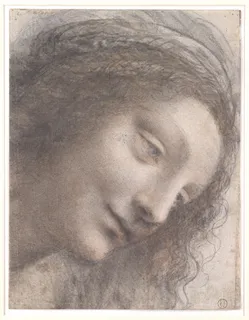
In the years before he left, Leonardo kept returning to a painting of the Virgin and Child with Saint Anne, now in the Louvre. The Head of the Virgin in Three-Quarter View Facing Right, from 1510 to 1513, is a study connected with the Virgin in that picture. Her head bends low and her eyes look down. He rubbed black chalk into soft shadows, and curls ripple down the right side like water.
 Painted around this timeThe Head of the Virgin in Three-Quarter View Facing Right
- 1517Amboise
On October 10, 1517, Cardinal Luigi of Aragon and his party called on Leonardo at his house at Cloux, near Amboise. Leonardo had crossed the Alps in 1516 at the invitation of the French king, Francis I. The cardinal's secretary, Antonio de Beatis, wrote up the visit in his travel journal.
Leonardo showed them three paintings: a Florentine lady painted from life, a young Saint John the Baptist, and the Virgin and Child seated in the lap of Saint Anne. De Beatis noted that Leonardo's right hand was paralyzed, so no more great work could be expected from his brush.
- 1519Amboise
On April 23, 1519, Leonardo had a notary draw up his will. His books and the tools of his trade as a painter all went to Francesco Melzi. A garden outside Milan was split in half between his servant Battista de Vilanis and Salai.
He died at Cloux on May 2. Vasari later wrote that he died in the arms of Francis I, but scholars doubt the story. Melzi carried the notebooks and drawings back to Italy and kept them, and in later years the sheets passed through many hands and scattered. The bear and the Virgin's head on this site are now at the Metropolitan Museum of Art in New York.
People around them
- Ser Piero da Vincihis father, a notary who worked in Florence.
- Andrea del Verrocchiohis teacher, who ran a busy workshop in Florence.
- Ludovico Sforzathe ruler of Milan, whom Leonardo served for many years.
- Salaia boy who moved in at ten and stayed with Leonardo for many years.
- Francesco Melzia pupil from a noble Milanese family who inherited the notebooks and drawings.
- Francis Ithe French king who brought Leonardo to France.
Works
Paintings by
Leonardo da Vinci on Pyeongye
Hidden stories in Leonardo da Vinci's paintings