Pyeongye
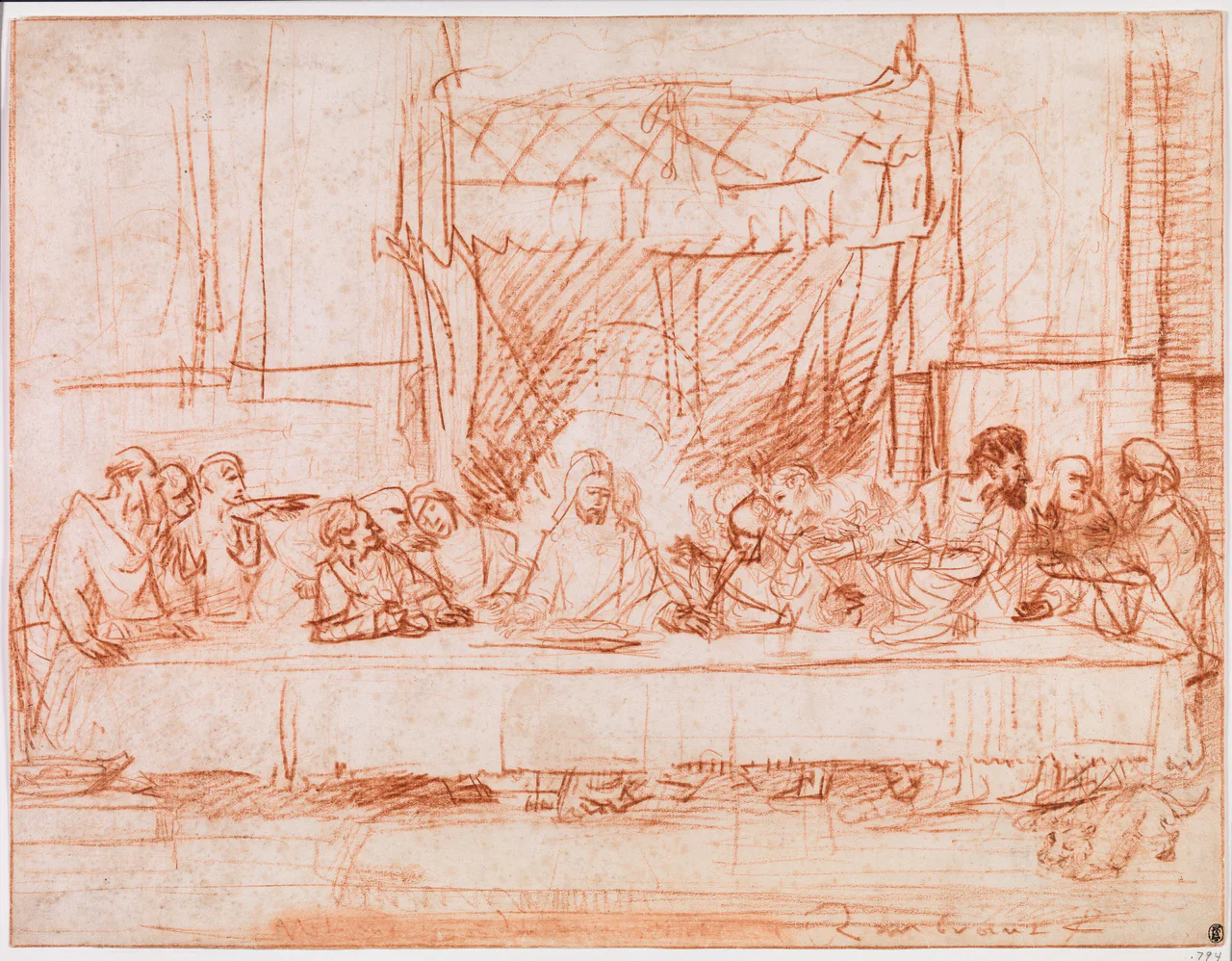
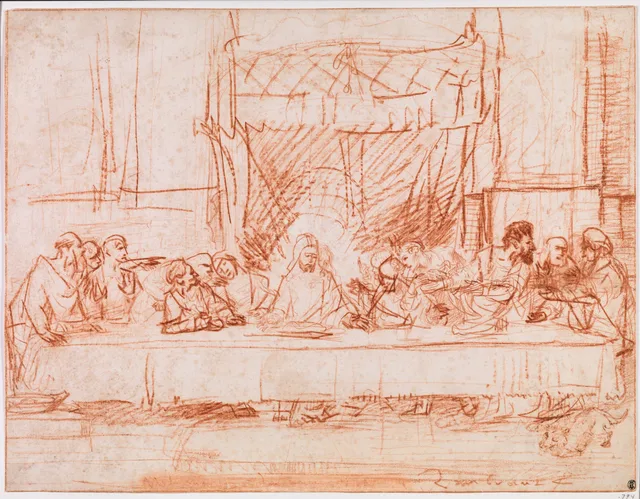
Red chalk lines race across the paper. Along a long table, people sit in a row. The man in the middle bows his head a little and stays still. On either side, others twist, raise their hands, and lean into one another. Does the scene look familiar?
This drawing is The Last Supper, after Leonardo da Vinci, made in red chalk by Rembrandt van Rijn in 1634–35. The original is Leonardo's wall painting of the Last Supper, made in the 1490s in the dining hall of the monastery of Santa Maria delle Grazie in Milan.
Here is the catch. Rembrandt never traveled to Italy. He never stood in front of the Milan wall. He knew the composition from prints. So this is a copy of a copy: someone else's engraved version, translated once more by Rembrandt's hand.
Start with the figure of Christ in the center.
Thin, pale lines carefully follow the face and the folds of the robe. Over them, a few thick, dark strokes cut across at an angle. Two very different kinds of line share one sheet. Scholars think Rembrandt first copied the composition carefully in fine lines, and later went back over it with a broader chalk.
The heavier lines made their biggest change above the diners' heads.
In Leonardo's painting, the wall behind Christ has three windows, and you can see the landscape outside. On Rembrandt's sheet, something like a huge canopy hangs in that space instead. In the middle, what looks like a tassel dangles on a cord, and long folds of cloth fall on either side. Underneath, he darkened the space with heavy hatching.
An open, airy room has become a shadowy stage. Instead of light pouring in through windows, the figures now seem to rise out of the dark.
Now look at the lower right corner, on the floor under the table.
An animal that looks like a dog crouches low. You can make out a round head, an ear, and a leg. There is no dog in Leonardo's painting. Under that solemn table, Rembrandt slipped in a small piece of everyday life.
When he made this drawing, Rembrandt was about twenty-eight. He was building a name as a portrait painter in Amsterdam, and in 1634 he married Saskia. A busy young painter with plenty of commissions was still taking time to study an Italian picture painted more than a century before.
Leonardo's wall painting began to decay not long after it was finished. He had painted it on a dry wall with an experimental method, instead of into wet plaster. But the scene traveled far beyond the Alps through prints. The Leonardo that Rembrandt met had made that same journey.