Pyeongye
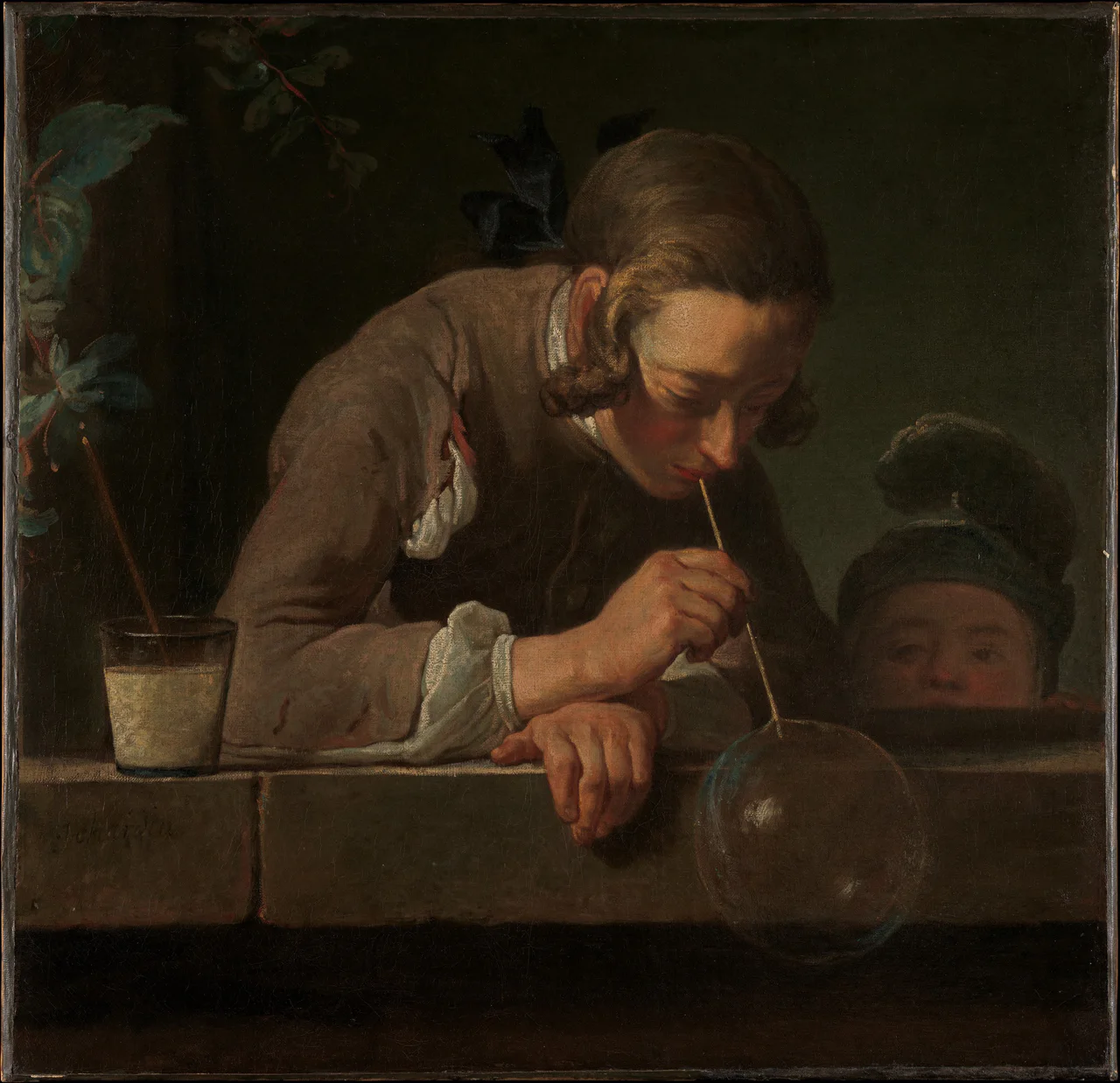
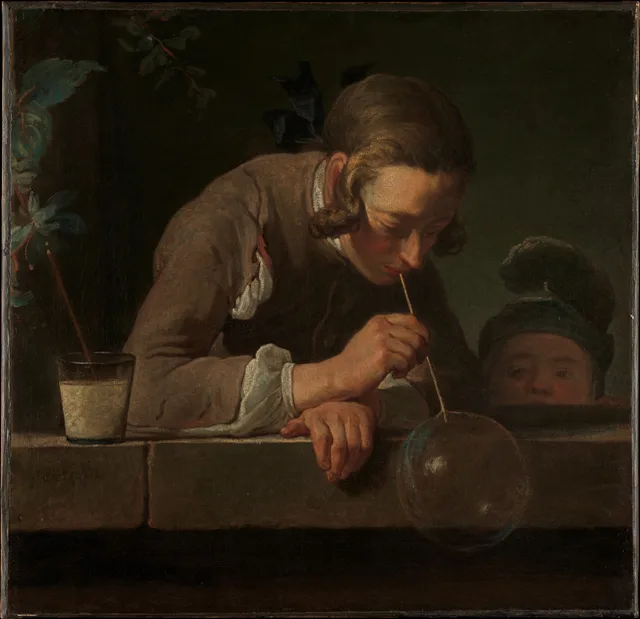
A young man leans out over a stone window ledge, his arm resting on it. A thin straw sits between his lips. At its tip, a bubble is swelling. He is breathing out very, very gently. One puff too hard and it is gone.
Paintings are usually made to last. Yet Jean Siméon Chardin built this one around something that will vanish in a few seconds. Why a soap bubble?
Start with the bubble itself.
It is nearly the size of his head. Its edge is a single hair-thin line, tinged here and there with blue and a faint yellow. Inside, there is almost nothing. You can see the edge of the stone ledge running straight through it.
Two small white flecks sit on its surface, one at the upper left and one at the lower right. Those are reflections of light. Chardin left the inside of the bubble empty and added one fine outline and two dabs of white. Your eye does the rest, and a round, glassy bubble appears.
Where did it come from? Slide over to the far left end of the ledge.
A glass tumbler holds cloudy, yellowish water. Soapy water. The paint is laid on in a grainy, speckled way, like foam. A second straw leans in the glass. When the bubble pops, the young man will dip his straw back in and try again.
Chardin first made his name as a painter of still life. When he was admitted to the French Royal Academy of Painting and Sculpture in 1728, it was as a painter of animals and fruit. He was a man who looked hard at cups, jugs, and peaches, things that hold still. In the early 1730s he began painting scenes with people in them. This picture comes from those years.
You can still feel the still-life painter here. The tumbler could almost be a small still life on its own. The stone is scrubbed in with rough strokes. High on the sleeve of the young man's brown coat, a scrap of white cloth pokes out where a seam seems to have split. Everything around the bubble is solid and heavy. In the middle of it hangs the lightest, weakest thing in the picture.
Now look past the ledge on the right.
A small child in a cap peers over the stone. Only the eyes and a pink nose show. The mouth is hidden behind the ledge. The child is watching, waiting. Will it burst? Will it float away?
Soap bubbles turn up often in European art. Dutch painters in particular used them to stand for how short and fragile life is. There was even an old Latin saying that a human being is a bubble. Many viewers see that idea in Chardin's picture too.
But notice what Chardin left out. No skull, no snuffed candle, none of the heavy props of a sermon in paint. There is a young man, a child, and the bubble they are both watching. Before any moral, you feel the held breath.
Chardin painted this scene more than once. Besides this canvas at The Metropolitan Museum of Art, other versions survive in other American museums. A moment that lasts seconds, and the painter kept coming back to catch it again.