 Pyeongye
Artwork · 18th century · Jean Siméon Chardin
LeoTurn on Magnifier at the lower right and move slowly across the painting.
Full screen opens it edge to edge.Tap the painting to fill the screen.
Spread two fingers to look closer.
At a glance
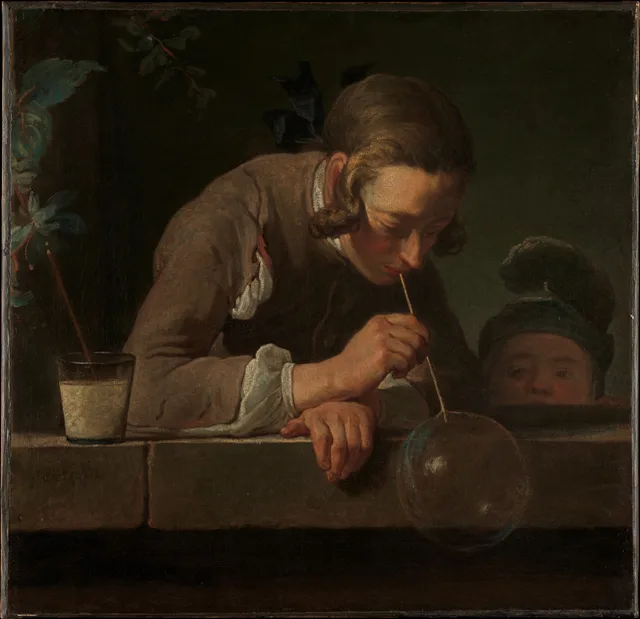
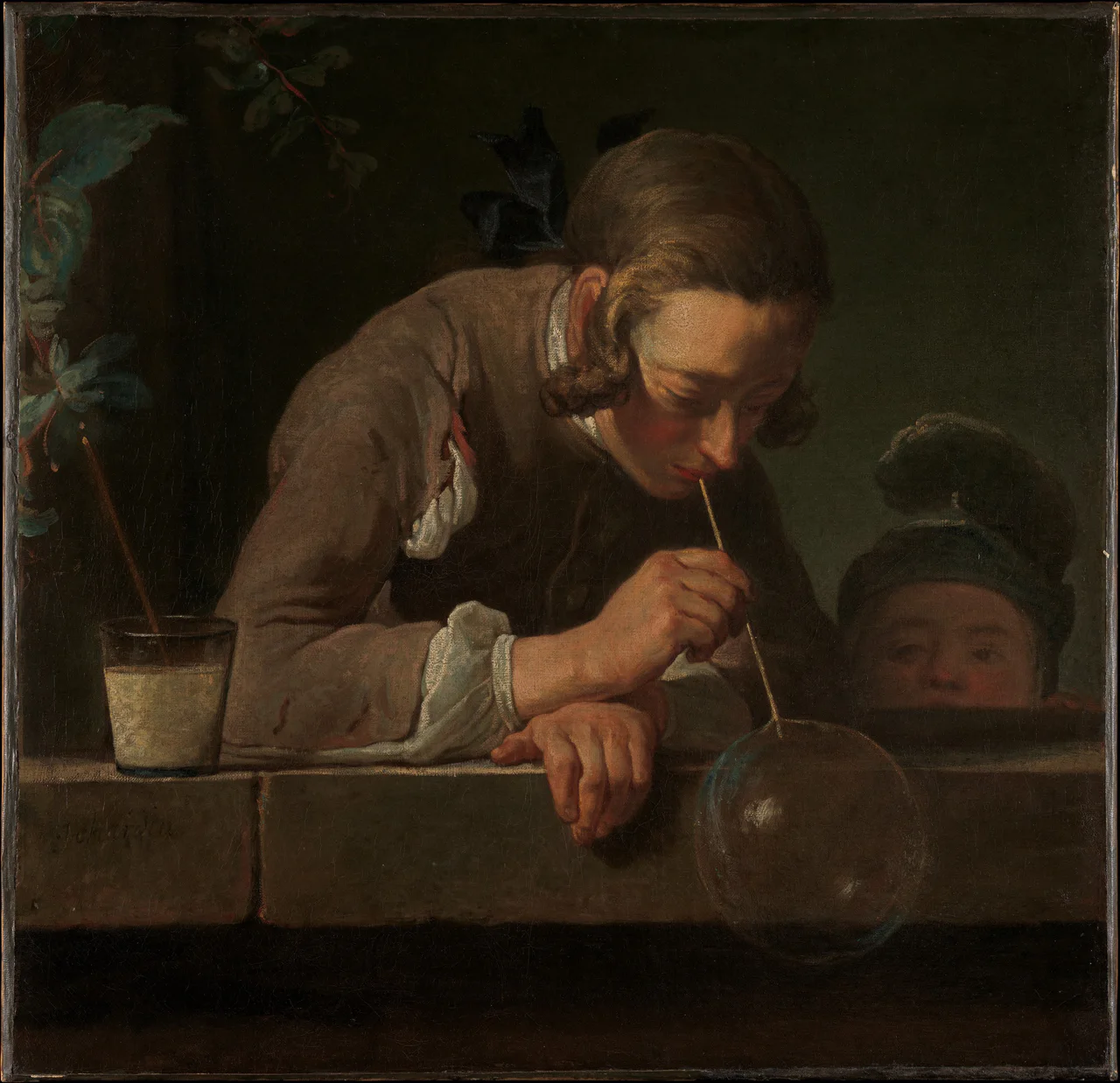
- A young man leans out over a stone window ledge and blows a soap bubble through a thin straw, while a small child peeks over the ledge.
- Jean Siméon Chardin painted it in Paris around 1733–34, in oil on canvas.
- It turns a bubble that will burst in a second into a still, quiet moment you can look at for as long as you like.
Reading the picture
5 places to look closer
Tap a number on the painting to jump to its note, or a close-up to see that spot in the whole picture.
Start with his face. His eyes are lowered and his lips are pursed around the end of the straw. He holds the straw lightly between two fingers. Blow too hard and the bubble pops, so all his attention is gathered at that one point.
Now zoom in on the bubble. Only its rim carries a thin shimmer of blue and white. Inside, you see straight through to the dark wall behind. Two small dabs of white paint, one near the top and one near the bottom, are light caught on its skin.
Look just below his shoulder, where the sleeve meets the body of the coat. The seam of his brown coat has split open, and white cloth and a red lining poke through. Chardin did not hide the tear. He painted it with thick, plain strokes. This is no dressed-up aristocrat, just a young man in a worn coat.
On the left end of the ledge stands a glass. The lower part is filled with cloudy soapy water, and a second straw leans inside it. Through the clear glass you can even see the water line. The supplies for the game wait quietly to one side.
Drop down to the lower right. A child in a cap peers over the ledge, only eyes, nose and pink cheeks showing. The mouth is hidden behind the stone. Is the child waiting for a turn, or just watching to see how big the bubble gets?
When it was painted
Around 1733, Chardin was already known in Paris as a painter of still lifes. When the Royal Academy took him in back in 1728, it was as a painter of animals and fruit. Now he was trying something new. He was starting to paint people.
His home life was changing fast too. In 1731 he married Marguerite Saintard, and their son Jean-Pierre was born that same year. Then in 1735 his wife died, and within a few years their little daughter was gone as well.
The collector Pierre-Jean Mariette, who knew the Paris art world of his day, wrote that Chardin's first figure painting showed a young man blowing bubbles, and that it was studied from a live model. The Met considers its canvas the earliest of the versions that survive. Chardin painted the subject at least three times, and he showed a Soap Bubbles at the Salon of 1739.
The Met's picture has two siblings today, one at the Los Angeles County Museum of Art and one at the National Gallery of Art in Washington. In 1990 and 1991 the three were brought together and traveled to American museums side by side. The Met's version entered the museum in 1949.
Now drop your eyes to the stone ledge at the lower left. Faint dark letters spell out Chardin's name on the stone. Under a bubble that will burst in a second, he left a name meant to last.
Hidden stories in this painting
Questions to think about
- Look for itHow many white specks of light can you find on the surface of the bubble?
- Why?Why do you think Chardin let the torn seam of the coat show so clearly?
- What about you?When did you last put your phone down and give a few whole minutes to something as small as a bubble? Is that kind of time a luxury today, or something we actually need?
Same period
Painted around the same time,
somewhere else
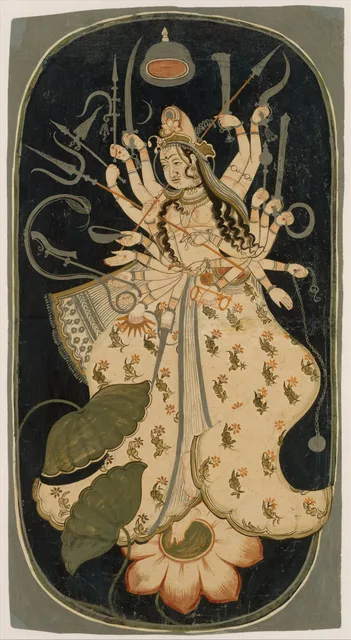 Mahadevi, the Great GoddessUnknown artist · India (Rajasthan, Bikaner)ca. 1725
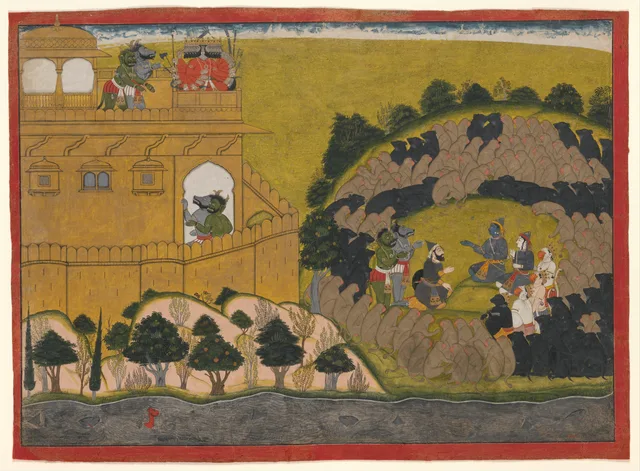 Rama Releases the Demon Spies Shuka and Sarana: Folio from the Siege of Lanka seriesManakuca. 1725
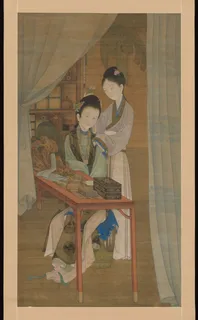 Woman at her dressing tableLeng Meiearly 18th century
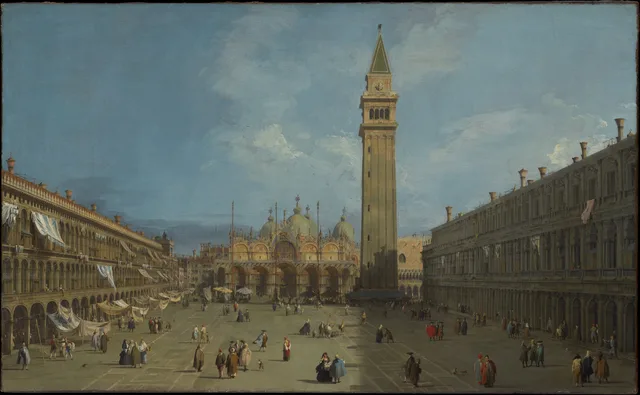 Piazza San MarcoCanalettolate 1720s
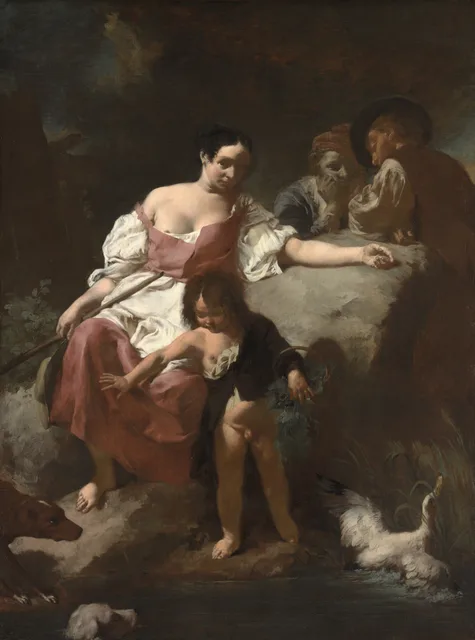 Pastoral SceneGiovanni Battista Piazzetta1740
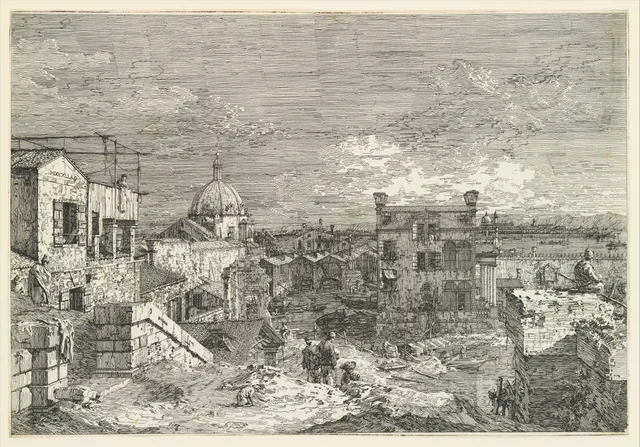 Imaginary View of Venice, houses at left with figures on terraces, a domed church at center in the background, boats and boat-sheds below, and a seated man observing from a wall at right in the foreground, from "Views" (Vedute altre prese da i luoghi altre ideate da Antonio Canal)Canaletto1741
Too good to keep to yourself
This painting,
for someone who comes to mind
They open it at full size
and see every brushstroke.
About this work
- Artist
- Jean Siméon Chardin · 1699–1779
- Date
- ca. 1733–34
- Medium
- Oil on canvas
- Size
- 61 × 63.2 cm
- Collection
- The Metropolitan Museum of Art
- Image
- Original long edge 3901px · shown at 2560px
- Original
- View on the museum's website ↗