Pyeongye
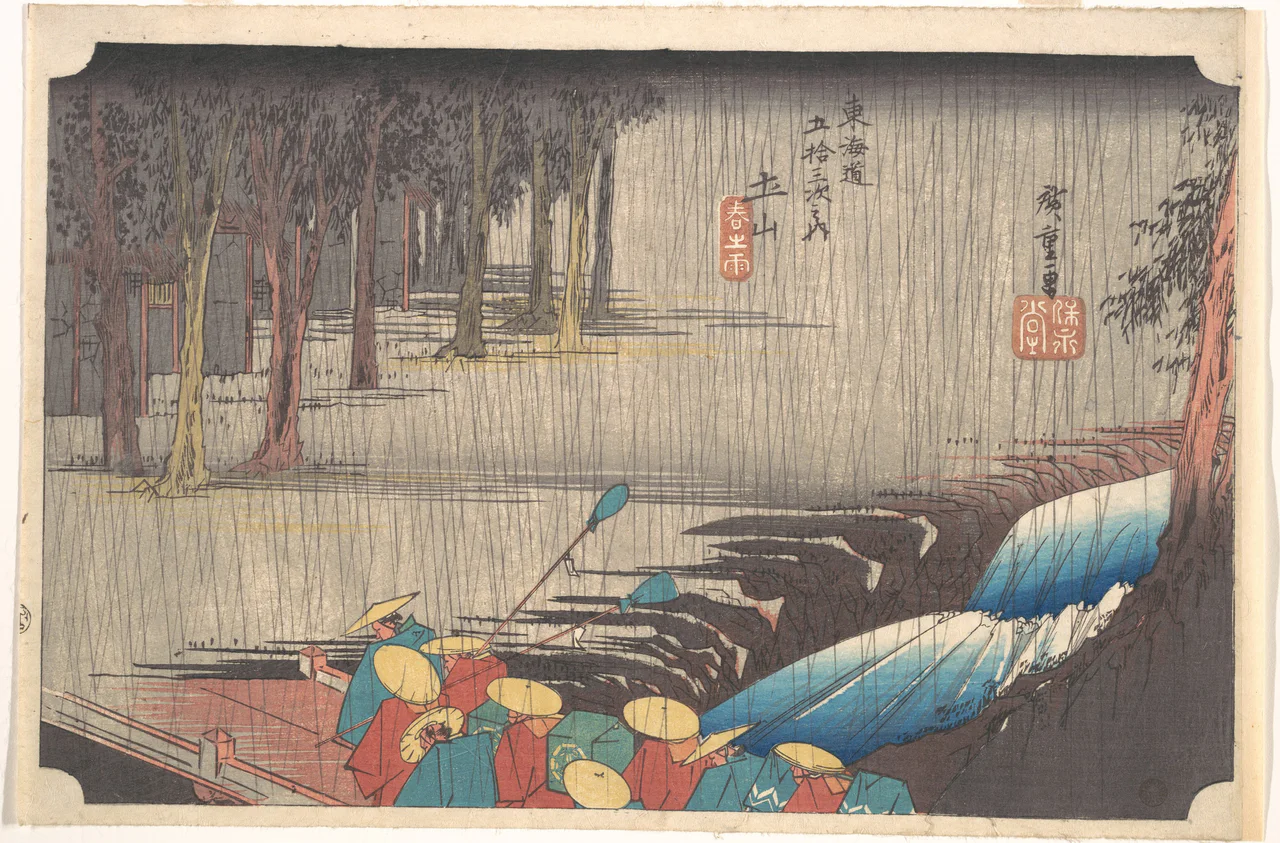
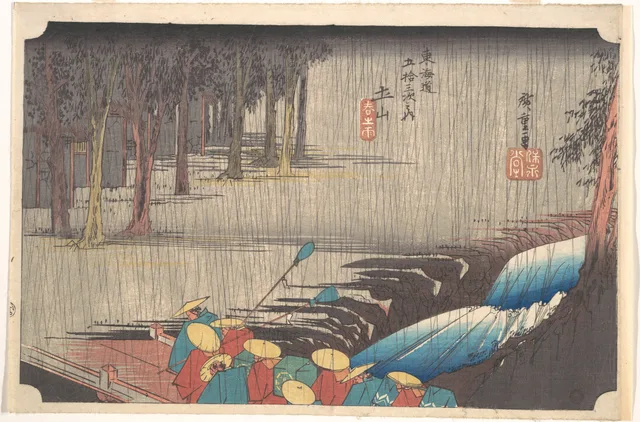
How would you paint a rainy day? Round dots for raindrops? A few blue streaks? Hiroshige filled the whole picture with hair-thin gray lines. And those lines were not brushed on. They were carved into wood and printed.
Utagawa Hiroshige published this sheet, Spring Rain at Tsuchiyama, in 1834–35 as part of his series Fifty-three Stations of the Tōkaidō. The Tōkaidō was the great road between Edo, today's Tokyo, and Kyoto. Hiroshige pictured its fifty-three post stations, plus the start and the end of the road, in fifty-five prints.
Near the top, the title is written out: Tsuchiyama, from the Fifty-three Stations of the Tōkaidō. A small red cartouche adds Spring Rain. To the right is Hiroshige's signature.
Look closely at the rain first.
Thin gray lines run down from top to bottom, packed close together. Some stand straight. Others lean a little, so they cross one another. They change in length and thickness, too. The rain does not fall in one stiff direction. It seems to sway a little in the wind.
A Japanese woodblock print was a team effort. The artist drew the design. A carver cut the blocks. A printer inked a separate block for each color and pressed the paper onto it. To leave a line standing on a block, the carver has to cut away the wood on both sides of it. Every hair-fine raindrop line here had its edges cut out by hand.
Now look at the travelers on the bridge.
People in yellow round straw hats cross the bridge with their heads ducked low. Red coats and teal coats alternate down the line. A teal box carries a round emblem. Long poles tilt above them. And the rain lines pass right over everyone.
We can hardly see a single face. They are all bent forward against the rain. Just a few hats and bowed backs are enough to make us feel the slow, heavy steps of people carrying loads through a downpour.
Then go to the rushing water at the lower right.
On the right, blue water breaks into white foam. Deep blue fades softly into pale blue. To get that effect, the printer did not ink the block evenly but wiped and shaded the color on purpose. In Japan this technique is called bokashi. Look, rain falls slanting across the water as well.
Tsuchiyama was a post station in what is now Shiga Prefecture. Travelers coming from the east reached it after crossing the Suzuka Pass. An old song of the packhorse drivers on that pass even has a line about the rain falling at Tsuchiyama.
Hiroshige's rain traveled overseas. In 1887, Vincent van Gogh made an oil copy of another of Hiroshige's rain prints. Rain drawn as lines caught the eye of European painters, too.