 Pyeongye
Artwork · 19th century · Utagawa Hiroshige
LeoTurn on Magnifier at the lower right and move slowly across the painting.
Full screen opens it edge to edge.Tap the painting to fill the screen.
Spread two fingers to look closer.
Spring Rain at Tsuchiyama, from the series Fifty-three Stations of the Tōkaidō
Utagawa Hiroshige1834–35Woodblock print; ink and color on paper
At a glance
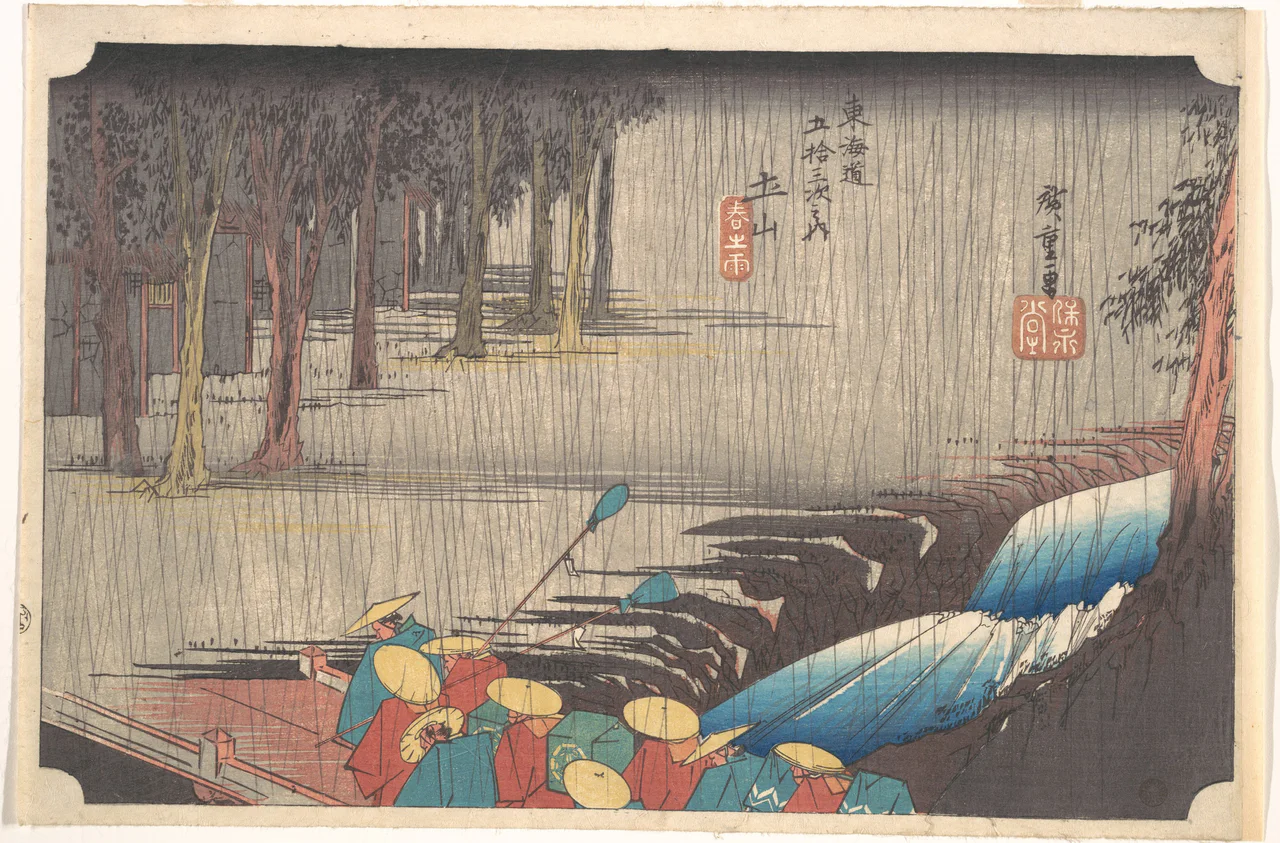
- A pouring spring rain. A huddled procession in straw hats crosses a bridge beside a swollen stream and heads into a wooded village.
- One sheet from Utagawa Hiroshige's woodblock print series Fifty-three Stations of the Tōkaidō, dated 1834–35.
- With nothing but hundreds of thin rain lines and a stream of fading blue, the print lets you feel the wet air and almost hear the water.
Reading the picture
5 places to look closer
Tap a number on the painting to jump to its note, or a close-up to see that spot in the whole picture.
Zoom in on the people along the bottom. Under yellow straw hats, they bend their heads and press forward as one tight group. Red and blue rain capes alternate, and a green box carries a round family crest. Everyone is curled against the rain, so we barely see a face.
Look at the long poles slanting up above the group. They are spears, their tips wrapped in blue covers. Spears carried in front and crested boxes on shoulders suggest the retinue of a daimyo, a feudal lord. The slanting poles cut across the straight, falling rain.
Zoom in on the rushing water at the right. Deep blue fades smoothly into white. Printers made this effect, called bokashi, by wiping the ink unevenly on the woodblock. White foam breaks against the rocks in jagged teeth, showing how high the stream has risen.
Move to the grove on the left. Between thick trunks, a building with red posts and lattice windows fades behind the rain. Short flat streaks on the ground look like spreading puddles. Over everything, fine vertical lines of rain fall from top to bottom.
Look at the writing near the top center. The two right-hand columns read Fifty-three Stations of the Tōkaidō, and the bold characters beside them name this station, Tsuchiyama. Inside the red box is the title, Spring Rain. Further right, find Hiroshige's signature and the red seal of Hōeidō, the firm that published the series.
When it was painted
Edo, the 1830s. Hiroshige was in his late thirties. He came from a low-ranking samurai family whose job was fighting fires for the shogun's government. When he was twelve he lost both parents and inherited his father's post as a fire officer. Even so, he trained under the print artist Utagawa Toyohiro and made his way as an ukiyo-e designer.
Something new was happening in the Edo print shops. Katsushika Hokusai's Thirty-six Views of Mount Fuji had just shown that landscape prints could sell. Hiroshige teamed up with the publisher Hōeidō on a set of fifty-five prints: the fifty-three stations of the Tōkaidō, plus the starting point at Nihonbashi in Edo and the arrival in Kyoto.
A story has long followed this series. In 1832, it goes, Hiroshige walked the highway himself with an official party taking horses from the shogun to the imperial court in Kyoto. Scholars disagree about whether that trip ever happened. Some have shown that a few of his scenes were based on illustrations in an earlier guidebook to the Tōkaidō.
The series was a hit, and it made Hiroshige's name as a landscape artist. He went on to design many more Tōkaidō series over the years. After his death in 1858, his prints traveled as far as Europe. Vincent van Gogh copied two of them in oil paint.
Because prints were pulled from the same blocks again and again, impressions of Spring Rain at Tsuchiyama survive in museums around the world, and this one is at the Met. Look again at the procession. Fine lines of rain keep falling on the bowed straw hats. Whether or not the artist ever walked this road, he set down the hunched backs of people in the rain this clearly.
More by the same painter
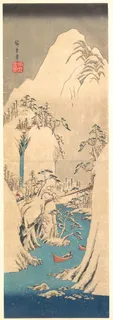
Hidden stories in this painting
Questions to think about
- Look for itHow many straw hats can you count in the procession?
- Why?Why do you think Hiroshige chose a procession caught in heavy rain instead of a sunny day on the road?
- What about you?Like these travelers who had to keep moving in the rain, many people today work outdoors in any weather. Are they protected well enough?
Same period
Painted around the same time,
somewhere else
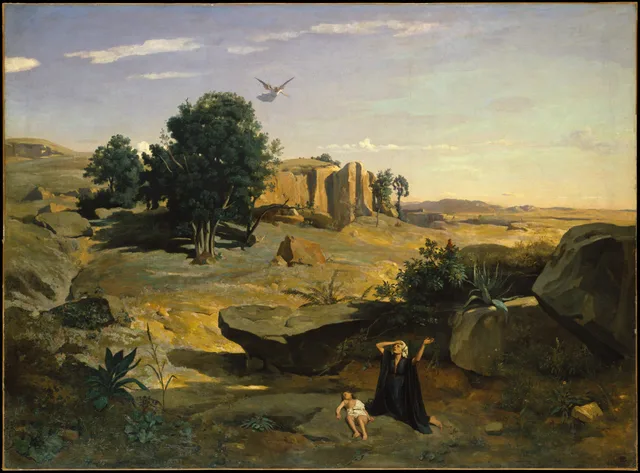 Hagar in the WildernessCamille Corot1835
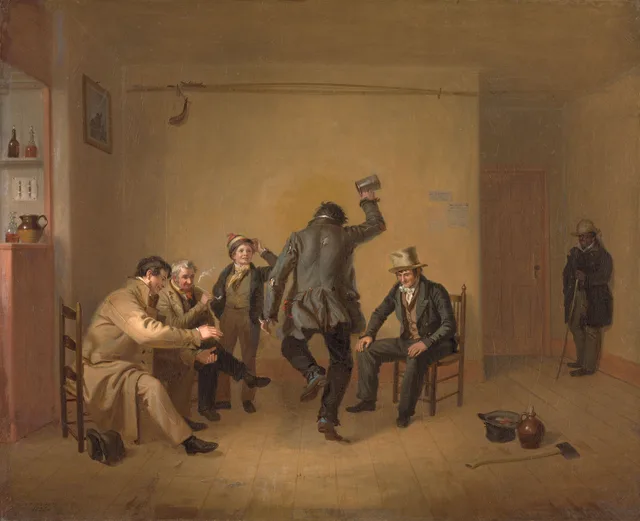 Bar-room SceneWilliam Sidney Mount1835
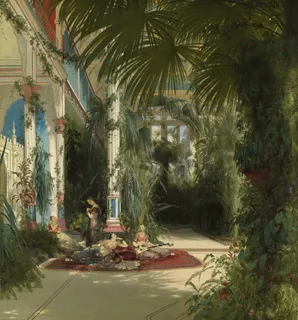 The Interior of the Palm House on the Pfaueninsel Near PotsdamCarl Blechen1834
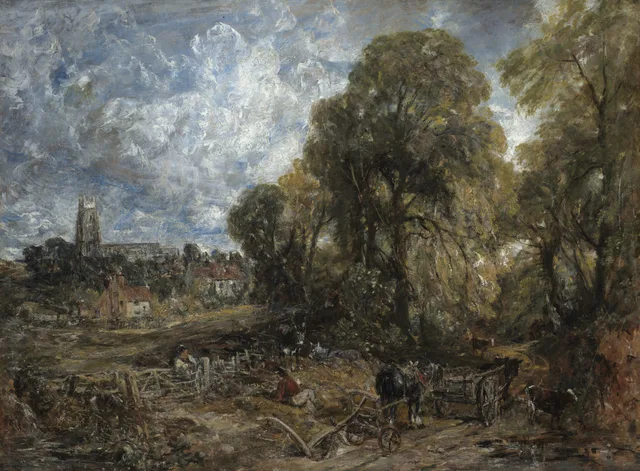 Stoke-by-NaylandJohn Constable1836
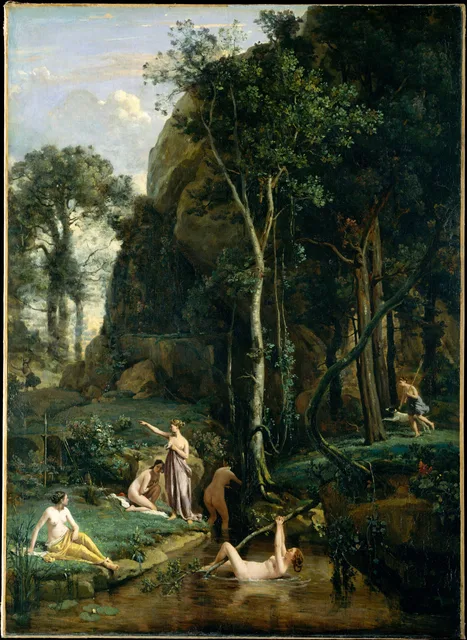 Diana and Actaeon (Diana Surprised in Her Bath)Camille Corot1836
 Saada, the Wife of Abraham Ben-Chimol, and Préciada, One of Their DaughtersEugène Delacroix1832
Too good to keep to yourself
This painting,
for someone who comes to mind
They open it at full size
and see every brushstroke.
About this work
- Artist
- Utagawa Hiroshige · 1797–1858
- Date
- 1834–35
- Medium
- Woodblock print; ink and color on paper
- Culture
- Japan
- Collection
- The Metropolitan Museum of Art
- Image
- Original long edge 3880px · shown at 2560px
- Original
- View on the museum's website ↗