Pyeongye
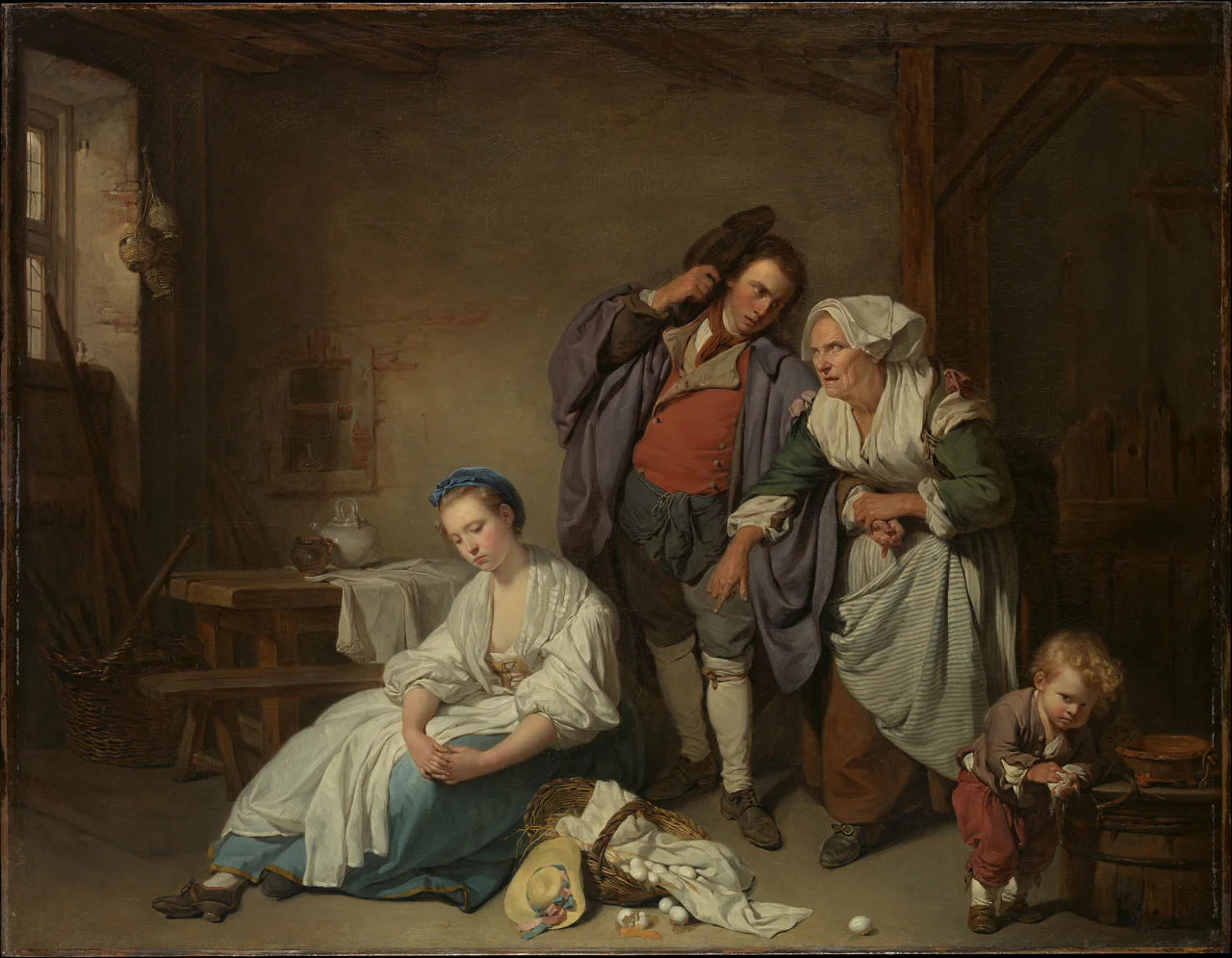
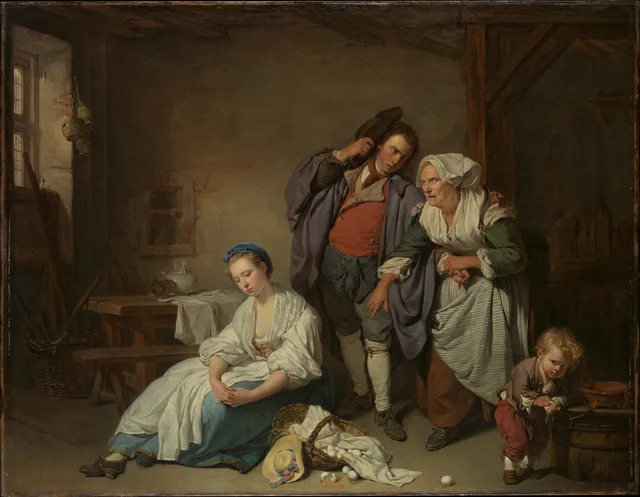
The room feels tense. A young woman in a white dress sits on the floor, head bowed. Behind her, an old woman presses close to a young man and glares to one side. The man has one hand to his head. And the old woman points a finger at the floor. What is she pointing at?
The French painter Jean-Baptiste Greuze made Broken Eggs in 1756. Greuze became known for scenes of ordinary households staged like moments from a play, each one carrying a lesson for the viewer.
Follow her finger down.
A woven basket has tipped over, and eggs have rolled out from under a white cloth. Most are still whole. But the one in front has cracked open, and its yolk has run onto the floor. Next to the basket lies a straw hat trimmed with pink and blue ribbons.
In eighteenth-century French painting, a broken egg was never just a broken egg. Something that cannot be made whole again stood for lost virginity. So the painting tells us what happened between the young woman and the man without a single word. The eggs say it.
Now look at the two figures in the middle.
The old woman has hooked one arm through the man's, and with her other hand she grips his hand tight. It looks as if she is holding him so he cannot slip away. At the end of her hooked arm, her finger points down at the eggs.
Study their faces, too. The old woman's brows are raised and her mouth is open as she glares. The man touches his hatted head and glances sideways, as if checking her mood. His red waistcoat and violet cloak are the brightest clothes in the room.
Do not miss the little boy at the lower right.
A curly-haired child leans beside a wooden tub and peeks out at us. He grips something white in both hands, and something seems to drip from it. A curved stick like a small bow hangs by the tub. While the grown-ups quarrel, what is he up to?
The room is plain and dim. Light from a window on the left falls across the wall, and woven baskets hang on the wall beside it. In this humble country room, Greuze gathers the light on faces and hands.
Greuze spent several years in Italy starting in 1755. He painted this picture in Rome during that stay, and it was shown at the Paris Salon of 1757. The philosopher Denis Diderot, writing about the Salons, praised Greuze's moral scenes again and again.