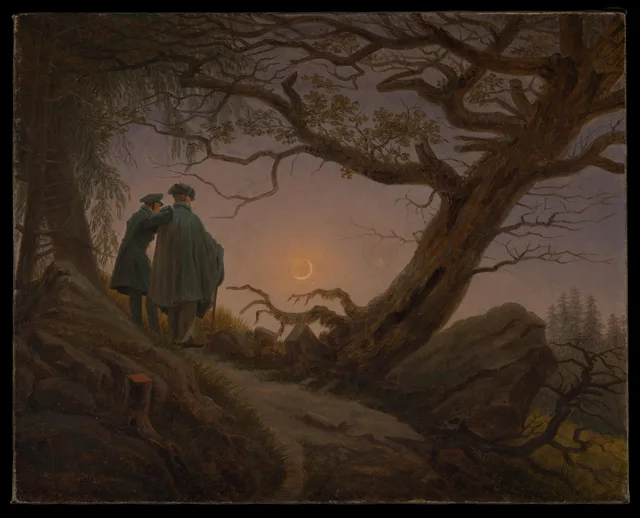
Pyeongye
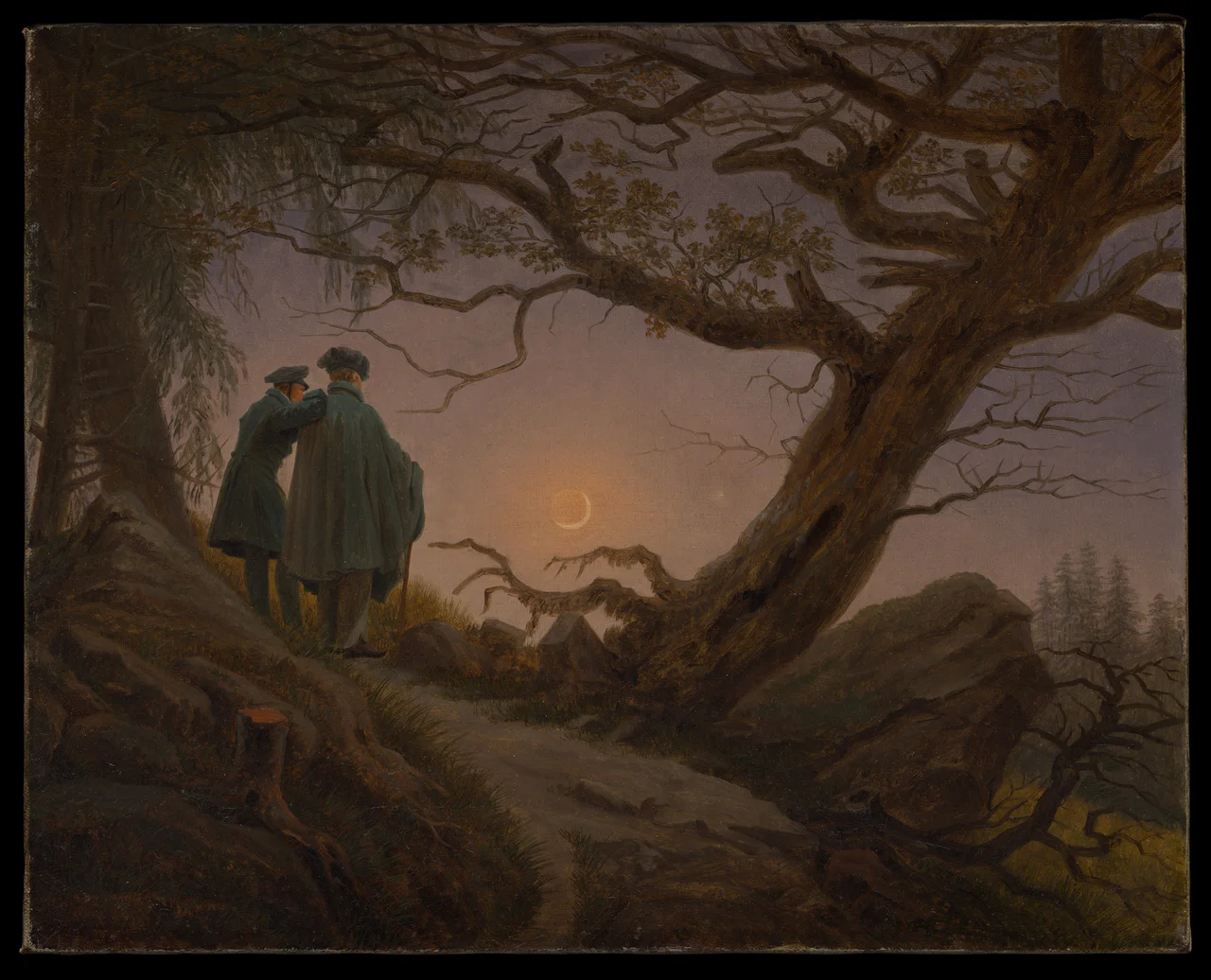
The sun has just gone down behind a wooded hill. Two men stand side by side, gazing at something in the sky. Look as long as you like, though, and you will never see their faces. All we get are their caps, their coats, and their backs.
This is Two Men Contemplating the Moon by Caspar David Friedrich, painted around 1825 to 1830. It is small, just 13 3/4 by 17 1/4 inches. Friedrich was born in Greifswald, on Germany's Baltic coast, and spent his working life in Dresden.
Start by getting close to the two figures.
The man on the left leans in and rests his hand on his companion's shoulder. The man on the right wears a loose cape that falls past his knees, and he leans on a walking stick. Both wear soft, round caps with short brims. Their faces are lost in shadow. We catch only the edge of an ear and a cheek.
Figures seen from behind turn up again and again in Friedrich's work. A wanderer looks down on a sea of fog. People stand on a shore. A woman leans at an open window. Each one shows us only a back. Art historians use the German word Rückenfigur, a figure from behind, for this kind of character.
Why hide the faces? When we see a face, we read it first. Happy or sad? Who is this? Take the face away and those questions fall silent. Our eyes follow the figure's gaze instead. We end up standing just behind their shoulders, looking at the same sky.
So let's look where they are looking.
A thin crescent moon hangs low. Look carefully and you can see the rest of the moon's round body, faint and dim, inside the bright curve. That is how a young moon really looks: sunlight bouncing off the Earth softly lights its dark side. A little to the right, a single small star glimmers.
The sky around the moon glows orange, then cools to a violet gray higher up. A bare branch crosses in front of it, its tips split into fine, rake-like twigs.
Friedrich painted this scene more than once. An earlier version from around 1819 to 1820 hangs in Dresden, and he also painted a man and a woman watching the moon together. The Metropolitan Museum's picture is a later version of the Dresden composition.
The men's clothes carry a message from their time. The round caps and long coats were known as old German dress. After the Napoleonic Wars, young Germans who hoped for a united, reformed country wore them proudly, and after 1819 the authorities cracked down on those movements.
Now step back and take in the whole picture. The men stand where a footpath runs out. Before them a huge tree leans at a steep angle, its trunk bending across the scene. Far to the right, dark pointed firs stand in the dusk. The path ends here. Only their gaze travels on to the moon.
And we follow it too. Because the two men have no faces, anyone who stands in front of this small canvas becomes the third person on the hill.