Pyeongye
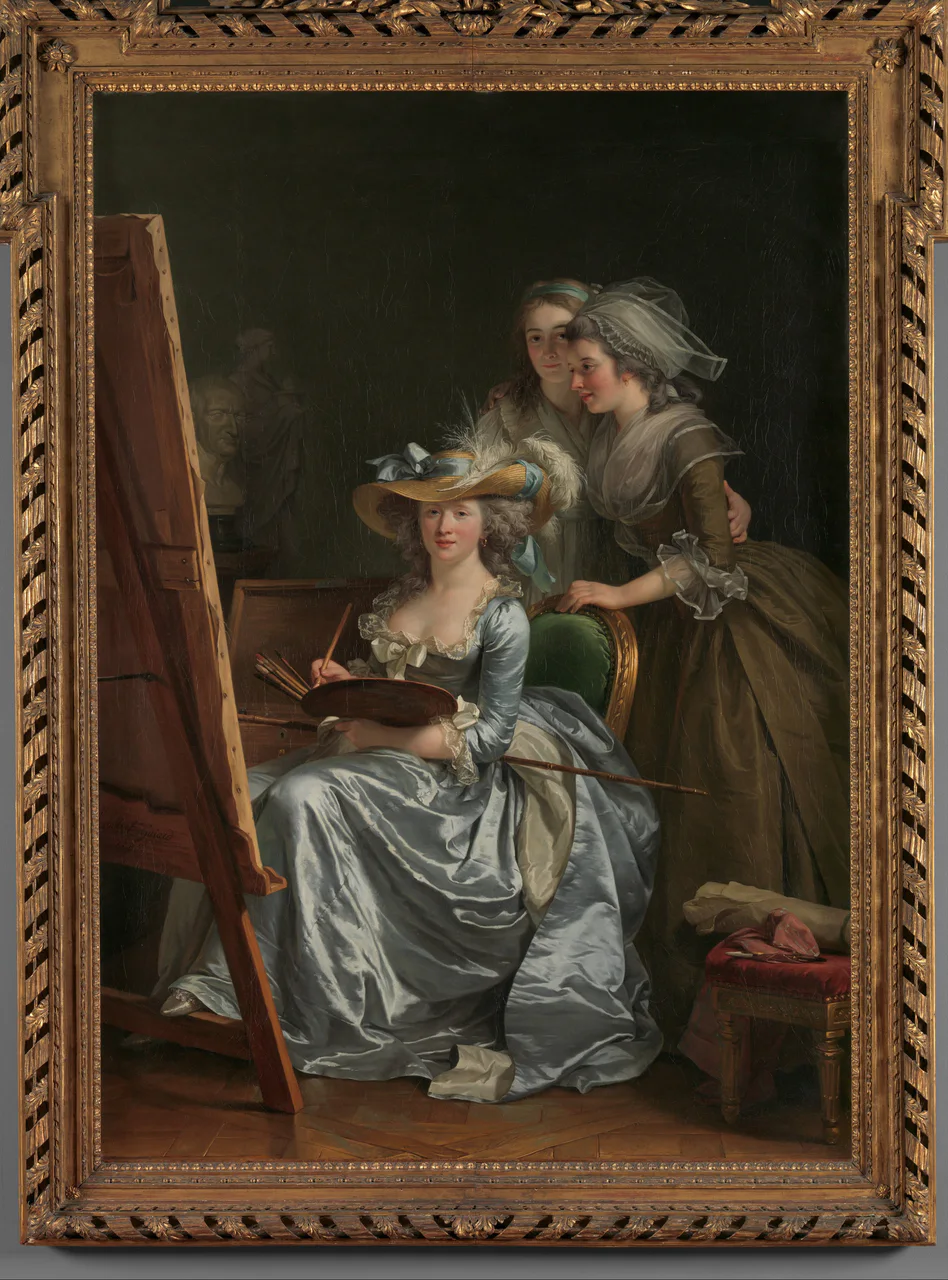
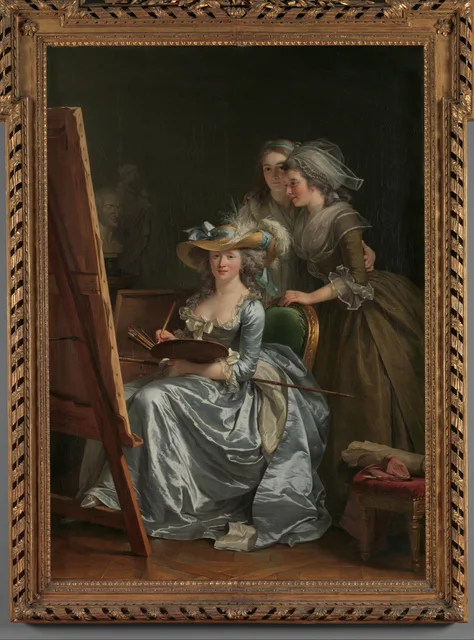
A painter in shimmering blue silk sits at her easel and turns to look at us. She holds a brush and a palette, and she looks completely at ease. But she is not alone. Behind her chair, two young women press close together and peer at her canvas.
This is Self-Portrait with Two Pupils, painted by Adélaïde Labille-Guiard in 1785. It is huge, about 83 inches tall, so the people in it stand at roughly life size. The museum's full title even names the two students: Marie Gabrielle Capet and Marie Marguerite Carraux de Rosemond.
Take a closer look at the pair.
One has her arm around the other's waist. The young woman in back wears a blue band in her hair and looks straight out at us. The one in front wears a sheer lace cap and leans in to study her teacher's canvas. One watches us. The other watches the work.
Two years before this picture, in 1783, Labille-Guiard was admitted to the Royal Academy of Painting and Sculpture in Paris. Élisabeth Vigée Le Brun was admitted on the same day. Membership meant official recognition as a serious artist in France.
That door was very narrow. The Academy allowed no more than four women members at a time. Men faced no such cap. Women were also barred from the Academy school's classes in drawing from the live model, the core of an artist's training.
So a woman who wanted to paint needed someone to teach her privately. Labille-Guiard took on women students and trained them herself. With this canvas, shown at the Salon of 1785, the Academy's own exhibition, she put that fact on full display.
Now look down at the lower part of the easel.
There is small, dark handwriting on the wood, its first letters tucked just behind the frame. It reads Labille, then a short abbreviation, then Guiard, with 1785 below. The abbreviation stands for femme, French for wife. The signature says, in effect, Labille, wife of Guiard. Even after marriage, she kept her own family name first.
Step back and take in the room. In the shadows to the left stand a bust of an older man and a statue. On the red stool at lower right lie rolled papers and cloth. The studio is full of the tools of an artist's training.
What happened to the two students changes how we see them. The dates in the museum's title tell us that Carraux de Rosemond died in 1788, at about twenty-three, just three years after this was painted. Capet lived until 1818 and built a career as a painter, especially admired for her miniature portraits.
Labille-Guiard kept pushing for women artists. In 1790, after the French Revolution had begun, she argued at the Academy that the limit on women members should be dropped.