 Pyeongye
Artwork · 19th century · Caspar David Friedrich
LeoTurn on Magnifier at the lower right and move slowly across the painting.
Full screen opens it edge to edge.Tap the painting to fill the screen.
Spread two fingers to look closer.
At a glance
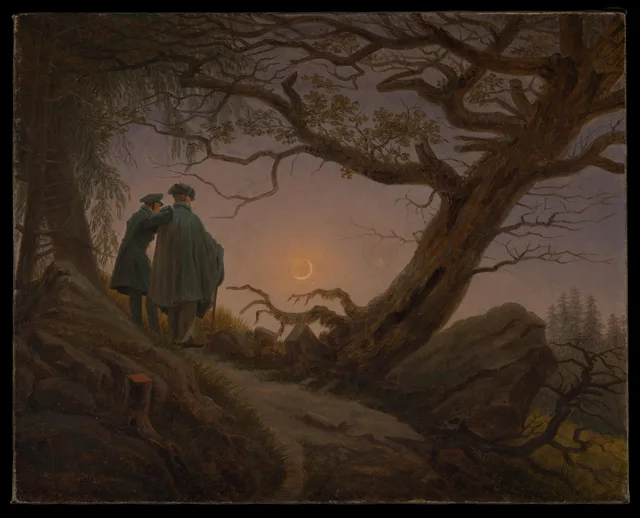
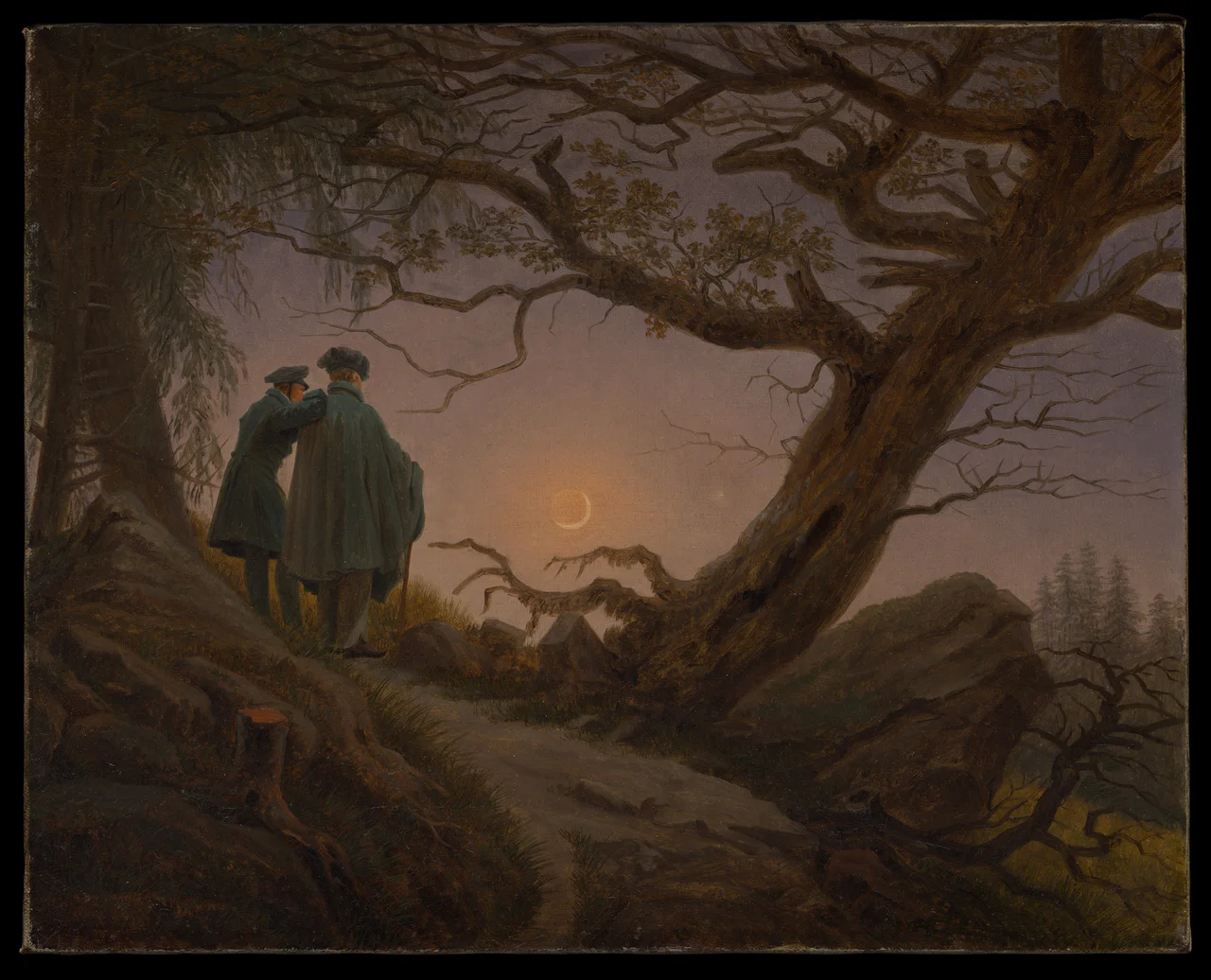
- At dusk, on a wooded slope, two men stand side by side with their backs to us, watching a crescent moon.
- Caspar David Friedrich, who worked in Dresden, Germany, painted it around 1825–30.
- We never get to see their faces. Instead, we stand behind them and look at the same moon.
Reading the picture
5 places to look closer
Tap a number on the painting to jump to its note, or a close-up to see that spot in the whole picture.
Zoom in on the two men. One leans in and rests a hand on the other's shoulder. The man on the right wears a loose, heavy cloak and leans on a walking stick. Both wear caps, and both have turned toward the moon.
Look at the crescent in the middle. Inside the thin rim of light, the rest of the moon's round body shows faintly. Only the sky right around it glows orange, cooling to violet as it rises.
Zoom in on the big tree on the right. Its thick trunk leans at an angle, and its branches bend like crooked fingers across the sky. The bare twigs at their tips are etched as dark lines against the moonlit air.
Look at the slope at the lower left. A single cut tree stump stands there. Only its sawn top catches the light, a small orange patch in the dark.
Now look far off to the right, beyond the boulder. Pointed fir trees stand blurred in the evening mist. Friedrich painted near things dark and far things pale, and that is what makes the forest feel deep.
When it was painted
When he painted this picture in the late 1820s, Friedrich was past fifty. Born in Greifswald, near the Baltic Sea, he had lived in Dresden for close to thirty years. He did not marry until 1818, when he was forty-three, and three children were born in the 1820s.
His fellow painter Georg Friedrich Kersting painted him at work in his studio. The room in that picture is almost empty: a window, an easel, a few tools, and little else. Friedrich drew trees and rocks carefully in pencil outdoors, then rebuilt his landscapes in that quiet room. Again and again he placed figures with their backs to us inside them.
He first painted this scene around 1819–20, and that version is now in Dresden. Another picture shows a man and a woman watching the moon in a similar forest. The Metropolitan Museum describes its painting as the third version of this famous composition. The two men are often identified as Friedrich himself and his student August Heinrich, who died young in 1822.
Their clothes are worth a second look. The loose cloaks and soft caps were what Germans then called old German dress. After 1819 that outfit was treated as a badge of the patriotic student movement the authorities were trying to suppress.
From the late 1820s his work steadily fell out of fashion. After a stroke in 1835 he could hardly paint in oils on any scale, and he died in Dresden in 1840. Largely forgotten for decades, he was rediscovered in the early twentieth century. This painting entered the Met in 2000.
Now look at the bottom of the picture. Below the two men, a pale dirt path climbs the slope at an angle. Follow it up, and you end up standing just behind them, where the moon comes into view.
Hidden stories in this painting
Questions to think about
- Look for itWhere does the tip of the right-hand man's walking stick touch down?
- Why?Why do you think Friedrich chose not to show the two men's faces?
- What about you?These two men watch the moon together without a word. Today, when we see something beautiful with a friend, we often reach for a phone first. What do we gain from simply looking together in silence?
Same period
Painted around the same time,
somewhere else
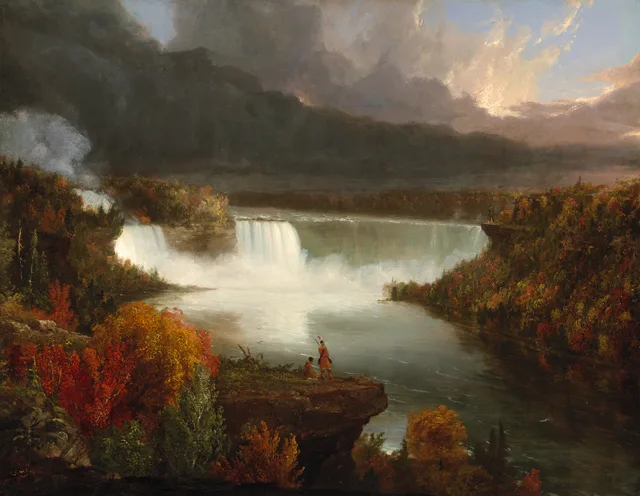 Distant View of Niagara FallsThomas Cole1830
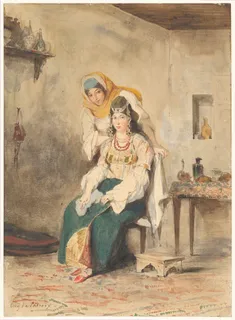 Saada, the Wife of Abraham Ben-Chimol, and Préciada, One of Their DaughtersEugène Delacroix1832
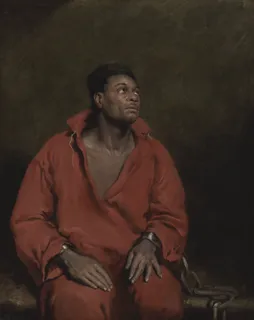 The Captive Slave (Ira Aldridge)John Philip Simpson1827
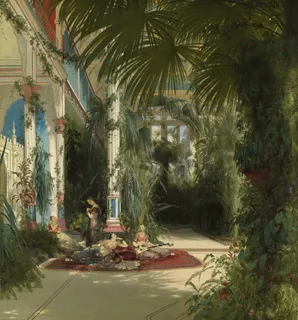 The Interior of the Palm House on the Pfaueninsel Near PotsdamCarl Blechen1834
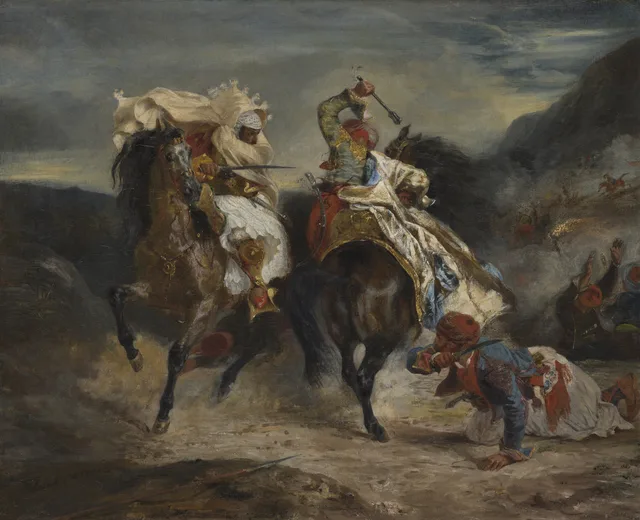 The Combat of the Giaour and HassanEugène Delacroix1826
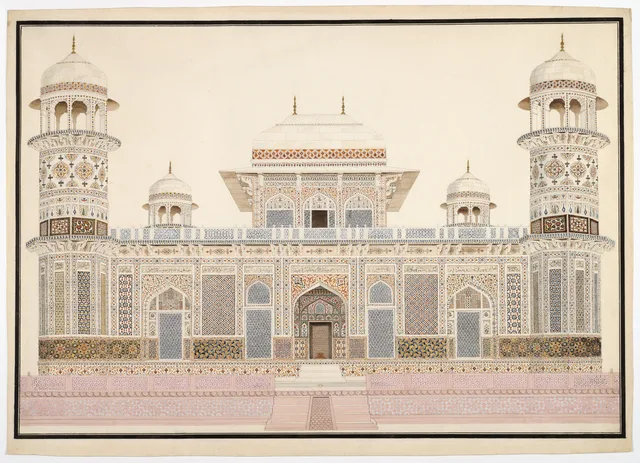 I'timad-ud-Daula's Tomb at AgraUnknown artist · Indiac. 1820
Too good to keep to yourself
This painting,
for someone who comes to mind
They open it at full size
and see every brushstroke.
About this work
- Artist
- Caspar David Friedrich · 1774–1840
- Date
- ca. 1825–30
- Medium
- Oil on canvas
- Size
- 34.9 × 43.8 cm
- Collection
- The Metropolitan Museum of Art
- Image
- Original long edge 4000px · shown at 2560px
- Original
- View on the museum's website ↗