 Pyeongye
The story of this room
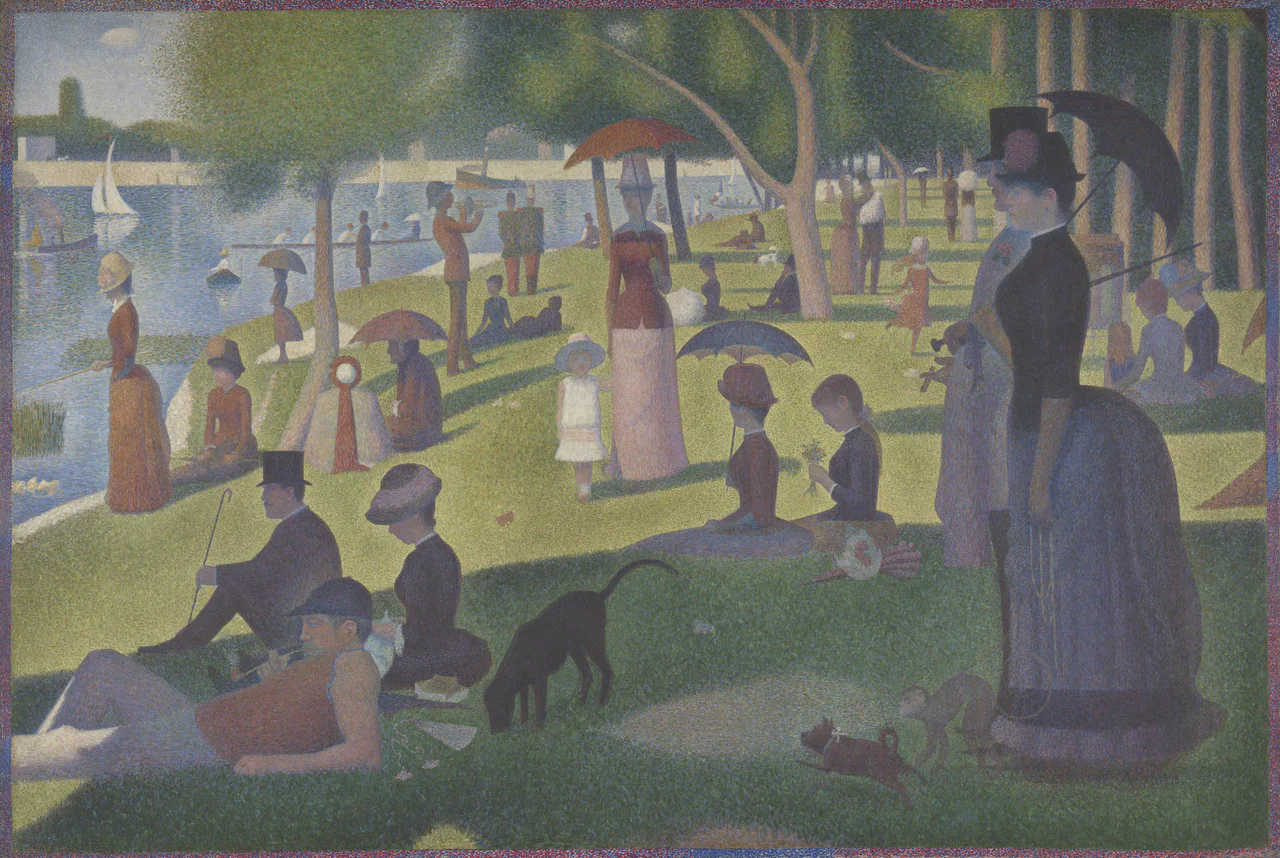
We step out of the rehearsal room into a sunny park by a river. Leo walks right up to the canvas, then jumps back in surprise. From across the room he saw grass and parasols. Up close, it is all tiny dabs of color. Take one step back and the dots quietly turn into people again.
This canvas is about ten feet wide. On La Grande Jatte, an island in the Seine just outside Paris, people are spending a Sunday afternoon. They stroll, lounge on the grass, sail, and fish. They come in every age and from every walk of life.
Look at the lower right. At the feet of the woman holding a dark parasol, a small monkey stands on a leash. The Art Institute of Chicago, which owns the painting, explains that Seurat came back to the canvas about two years after he started it, sharpening some figures and adding new ones. The monkey on its leash was one of those additions, though it now looks as if it had always been there.
Now walk over to the water on the left. A woman in an orange-brown dress stands at the edge of the river, holding out a fishing pole. The reeds and ripples in front of her are made of short strokes and dots too. Then follow the very edge of the picture. A narrow border of red and blue dots runs around it. Seurat painted that border later, in 1888 and 1889.
Georges Seurat began the painting in 1884 and finished it in 1886. Instead of mixing colors on his palette, he set small dabs of different colors side by side. He believed the colors would blend in the viewer's eye and look brighter than paint mixed in advance. This method of building a picture from dots, guided by theories of color and light, is called Pointillism.
Before tackling this huge canvas, he made many smaller painted and drawn studies. Leo dots a few marks into his notebook and shakes his head. Placing all these one by one, with a plan for each? My wrist would give up first, he laughs. Seurat showed the painting at the last Impressionist exhibition in 1886. Five years later he died, at just thirty-one.
In the next room, the dots give way to swirling brushstrokes. A wheat field ripples in the wind, and a dark tree rises like a flame.