 Pyeongye
The story of this room
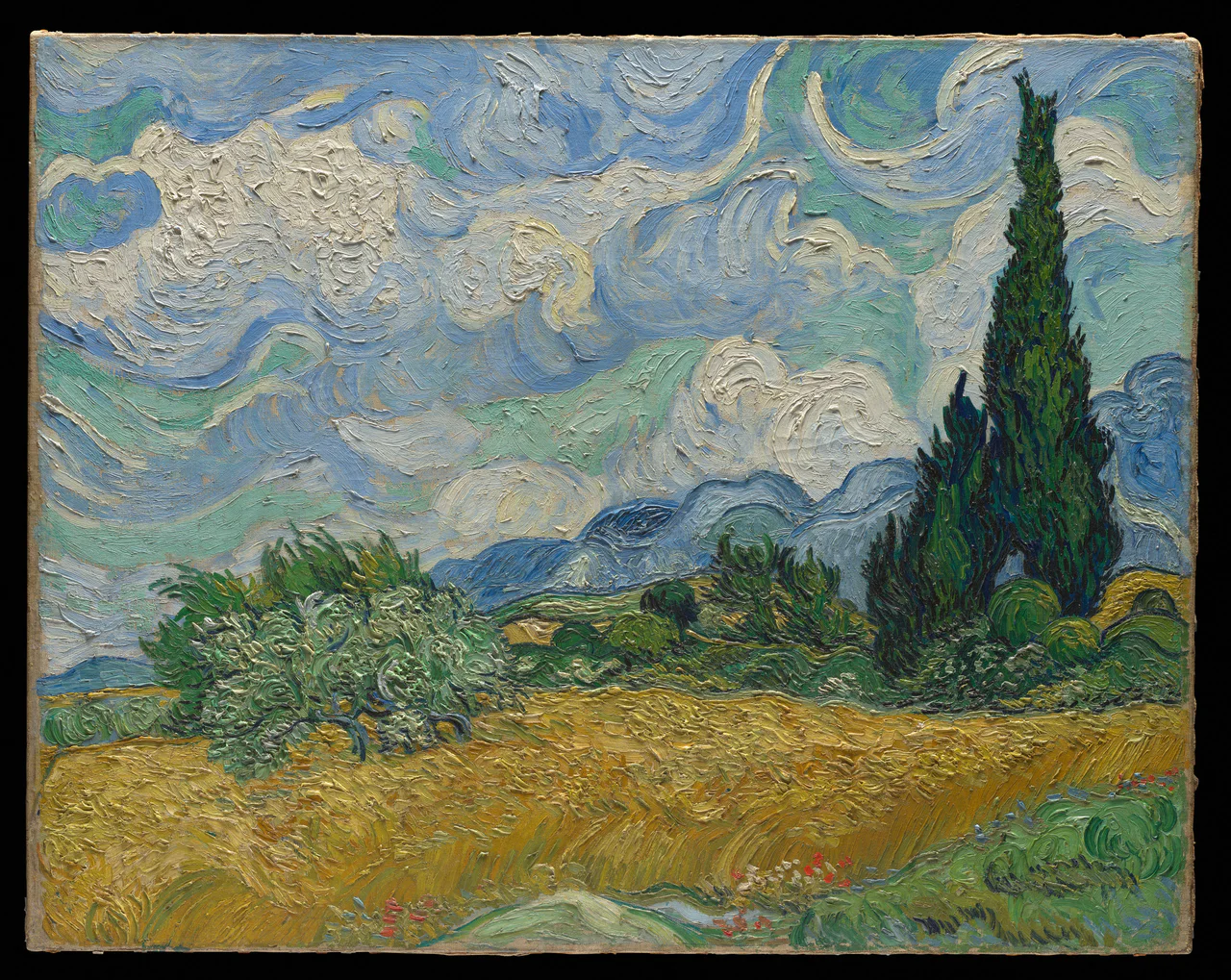
In the last room we counted tiny dots. Step through this doorway and the whole wall seems to move. Leo pushes his red beret back and grins. Nothing in here sits still, he says. The sky, the wheat, the trees are all bending in the same wind.
Start with the tall dark tree on the right. It is a cypress. Look at how the strokes climb from the bottom to the tip, one over another, like a green flame. Leo traces the shape in his notebook with his silverpoint and nods. That tree holds the whole picture up, he says.
Now let your eyes drift up into the sky. The white clouds curl like waves. Lean in a little, as close as the guard allows. The paint is not flat. It stands up in ridges and grooves, so thick that each stroke catches the light and throws its own small shadow.
Then drop down to the very bottom, near the middle. Tucked into the yellow wheat are a few bright red dabs, like poppies hiding in the field. They are tiny. Once you find them, you keep coming back to them.
Vincent van Gogh painted this in 1889. That year he was living at an asylum in Saint-Rémy, in the south of France, where he had gone of his own accord after a hard stretch of illness. Even so, he carried his canvas out to the fields around it. In a letter to his brother Theo, he wrote that the cypresses kept occupying his thoughts, and that he wanted to make something of them the way he had with his sunflowers.
Leo closes his notebook. When I stand here, he says, I can almost hear the wind. Van Gogh died the next year, in 1890. Maybe that is why this field feels so alive.
The next room is the opposite. Everything there is quiet and still. A few men sit around a small table, cards in hand, saying nothing at all.