 Pyeongye
The story of this room
The roar of the sea fades. In here you can almost hear floorboards creak. We are in a ballet rehearsal room with pale green walls. Leo tiptoes in and holds his notebook up to his mouth. Class is in session, he whispers.
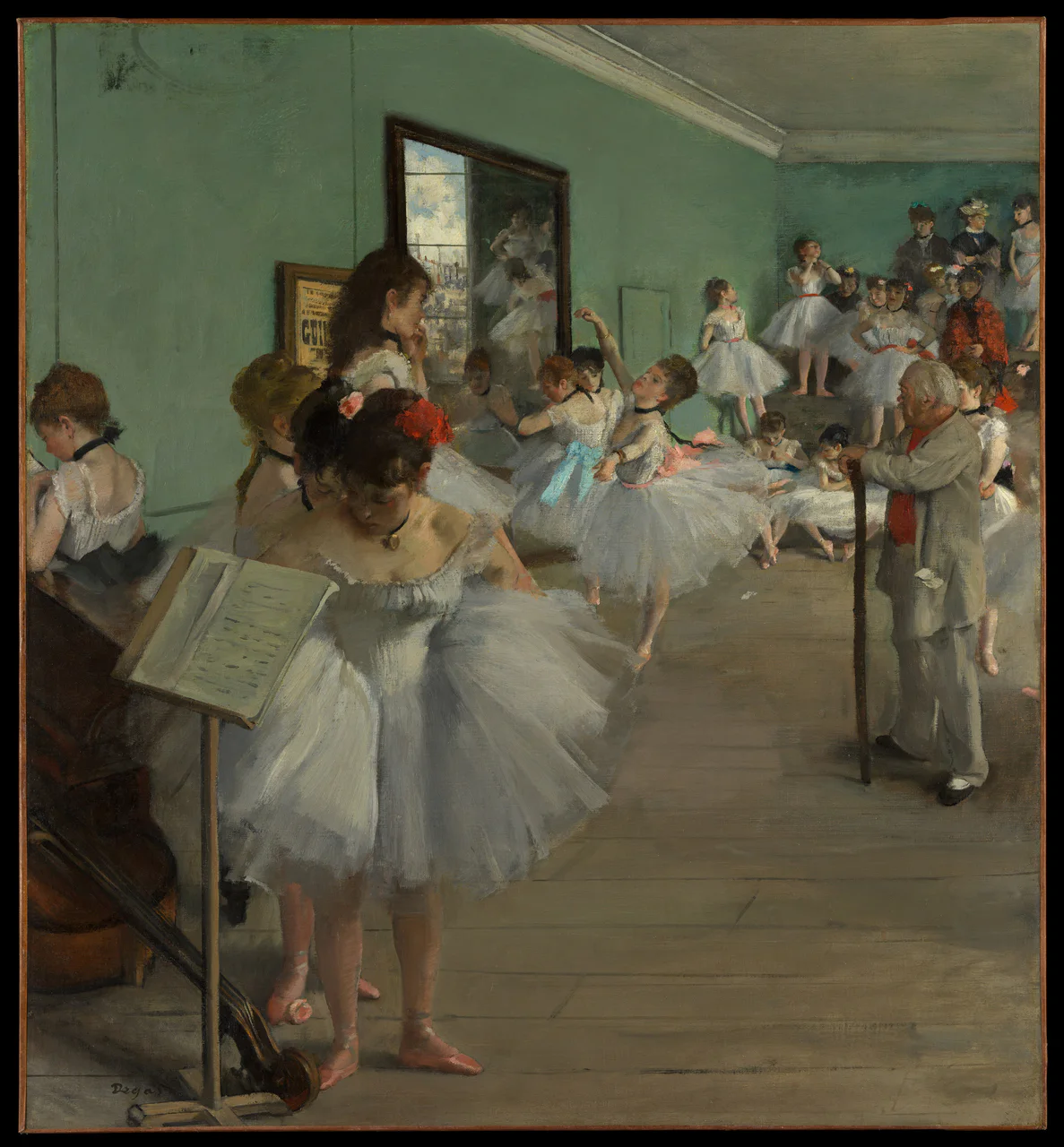
First, find the white-haired man on the right, leaning on a tall stick. He wears a light gray suit with a red shirt underneath. He is identified as Jules Perrot, a well-known ballet master. In front of him, a dancer lifts one arm high and holds her pose. His eyes are on her.
Now move down to the lower left. A big double bass leans at an angle, and near the floor beside it you can read the signature, Degas. The dancer standing in front of it has her head bowed low. She has a red flower in her hair and a black ribbon around her neck. Is she waiting her turn, or just tired?
Next, look to the far back on the right. A few women in dark street clothes, one in a hat, stand watching the class. On the wall hangs a large mirror. In it you can see the sky and rooftops outside a window, along with the reflections of dancers. One room, many layers of looking.
Edgar Degas painted this in 1874. That spring in Paris, a group of artists held the exhibition later known as the first Impressionist show, and Degas exhibited in it. But while many of his friends painted sunlight outdoors, Degas preferred theaters and rehearsal rooms. Over his lifetime he painted, drew, and sculpted ballet dancers again and again.
Leo opens his notebook and sketches the line of a dancer's foot. There is no glittering performance in this picture, he says. There is waiting, fixing a costume, sitting on the floor to rest. Degas painted the long stretch of time before any applause.
The next room takes us back outside. Crowds are spending a Sunday afternoon in a riverside park, and when you get close, every one of them turns into tiny dots.