 Pyeongye
The story of this room
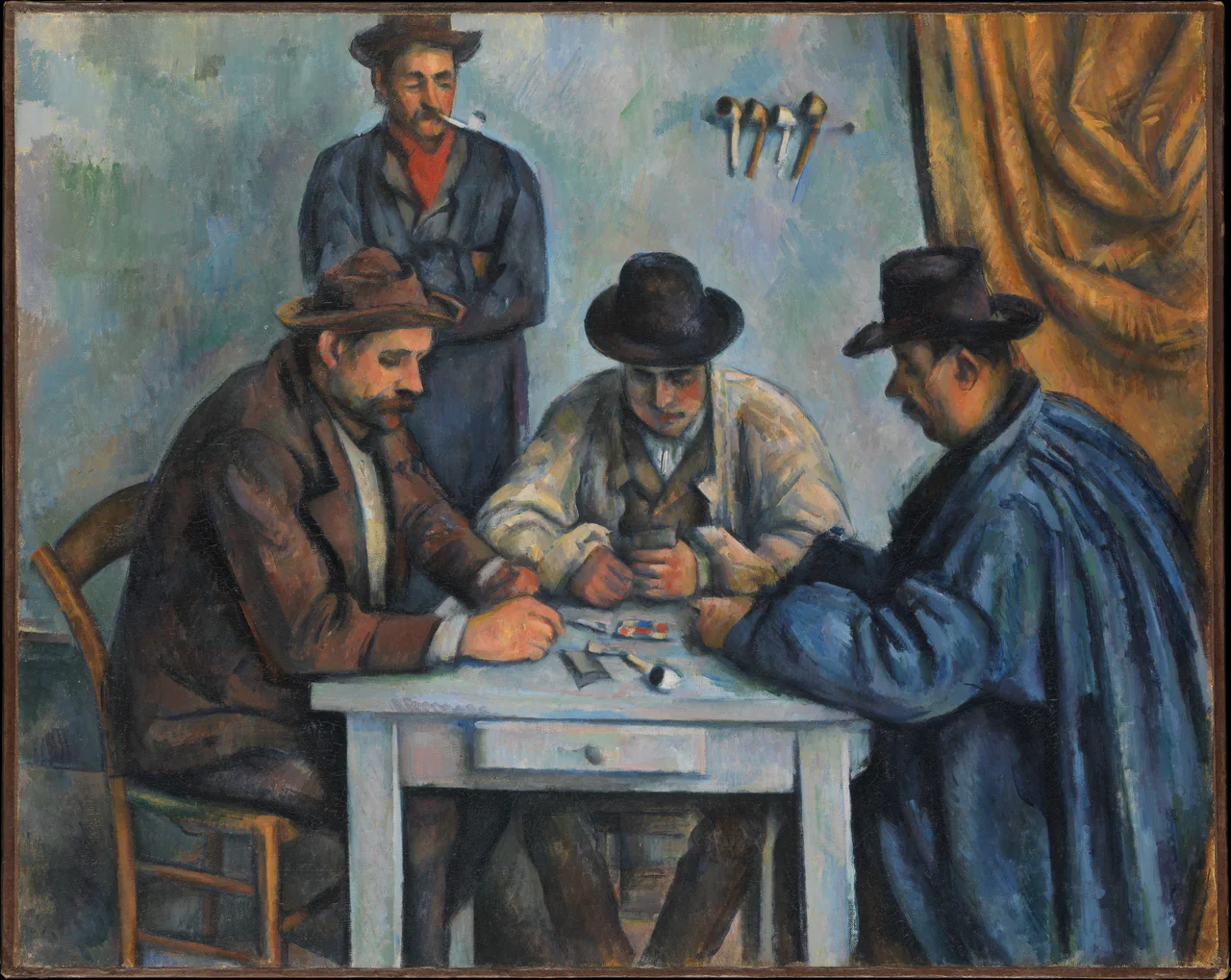
After the windy field, this room feels suddenly hushed. Leo lowers his voice. Shh, he whispers, there is a game on. Three men sit around a small table, cards in hand. A fourth stands behind them, watching.
Notice what is missing. No one is talking. The man in the brown jacket on the left, the man in the black hat in the middle, the man in the big blue coat on the right all keep their eyes down on their own cards. No laughing, no arguing. There is not even any money on the table.
Look high on the back wall, a little right of center. Four pipes hang there in a row. Another white pipe lies on the tabletop. The man standing at the back has one clamped in his mouth, and a red scarf at his neck. Leo counts the pipes in his notebook and chuckles. You can almost smell the tobacco in here, he says.
Now look back and forth between the orange curtain on the far right and the blue coat beside it. Warm against cool, each color makes the other louder. The bodies are built up like solid blocks and columns. You notice their weight before you notice their faces.
Paul Cézanne painted this between 1890 and 1892. In his home region around Aix-en-Provence, in the south of France, he painted local farm workers playing cards again and again. Five paintings of card players survive, and this is one of them.
As a younger man, Cézanne had shown his work alongside the Impressionists. But he wanted something different from a passing flicker of light. He wanted forms that would last. That is why his pictures feel slow and heavy, and why so many painters after him studied them so closely.
The next room takes us back to Impressionism, but not outdoors. We step into a home, very close up, where a woman is washing a small child's feet in a basin.