 Pyeongye
The story of this room
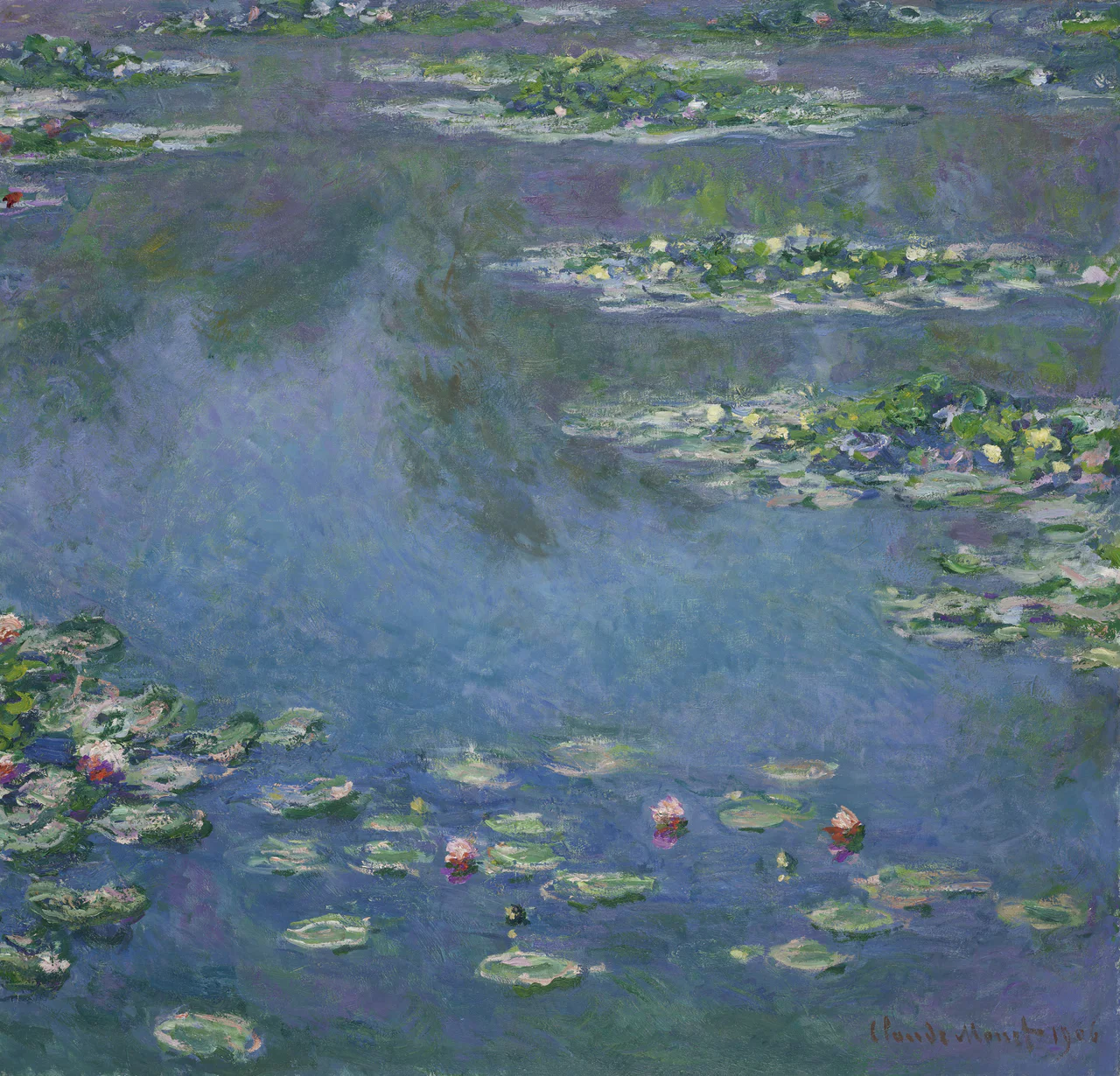
After a room crowded with patterns, this one lets your eyes breathe. Leo stops in front of the canvas and turns to you. Quick question, he says. Where is the sky in this painting? Look up: water. Look down: more water. There is no bank, no horizon, no strip of land anywhere.
And yet the sky is right here. Look at the hazy pale blue on the left side of the middle. Those are clouds, reflected in the pond. The dark green shadows slanting across them are trees on the bank, also seen only as reflections. We are looking down into a pond and up at the sky at the same time.
Now follow the lily pads. They gather in the lower left and the upper right, and between them a path of open water runs on a slant. Near the bottom, a few pink flowers float on their own. Step closer and each flower falls apart into a handful of quick strokes: pink, violet, a touch of orange. Leo lifts his silverpoint, then lowers it again. I can't trace this with a line, he admits.
Check the lower right corner too. The signature is written in reddish brown paint, and it ends with a date: 1906. Claude Monet put the year there himself.
Monet bought his house at Giverny, in France, in 1890. Three years later he made a water garden there. At first he painted the wooden Japanese-style bridge that crosses the pond. Little by little he let the bank and the bridge go, until only the water's surface filled the canvas. Over the next two and a half decades the pond gave him around 250 paintings.
This one belongs to a group of water lily pictures he made between 1903 and 1908. Even the nearly square canvas was part of the plan. With no wide landscape shape, there is no room for land or sky, only water. Monet called this work an obsession. When the Art Institute of Chicago examined the canvas, it found many significant changes he made while painting it.
In 1909 the picture was listed in the catalogue of his water lily exhibition at the Durand-Ruel gallery in Paris. Years later the same pond would grow into the huge water lily murals of the Musée de l'Orangerie.
The next room is the last one on our walk. A girl painted by a Viennese artist is waiting there, feet planted wide, looking straight back at us.