 Pyeongye
The story of this room
Leave the quiet card game behind and open the next door. Suddenly you are standing very close. Leo takes half a step back. I think we walked right into someone's room, he says. It feels as if we are looking down over their shoulders.
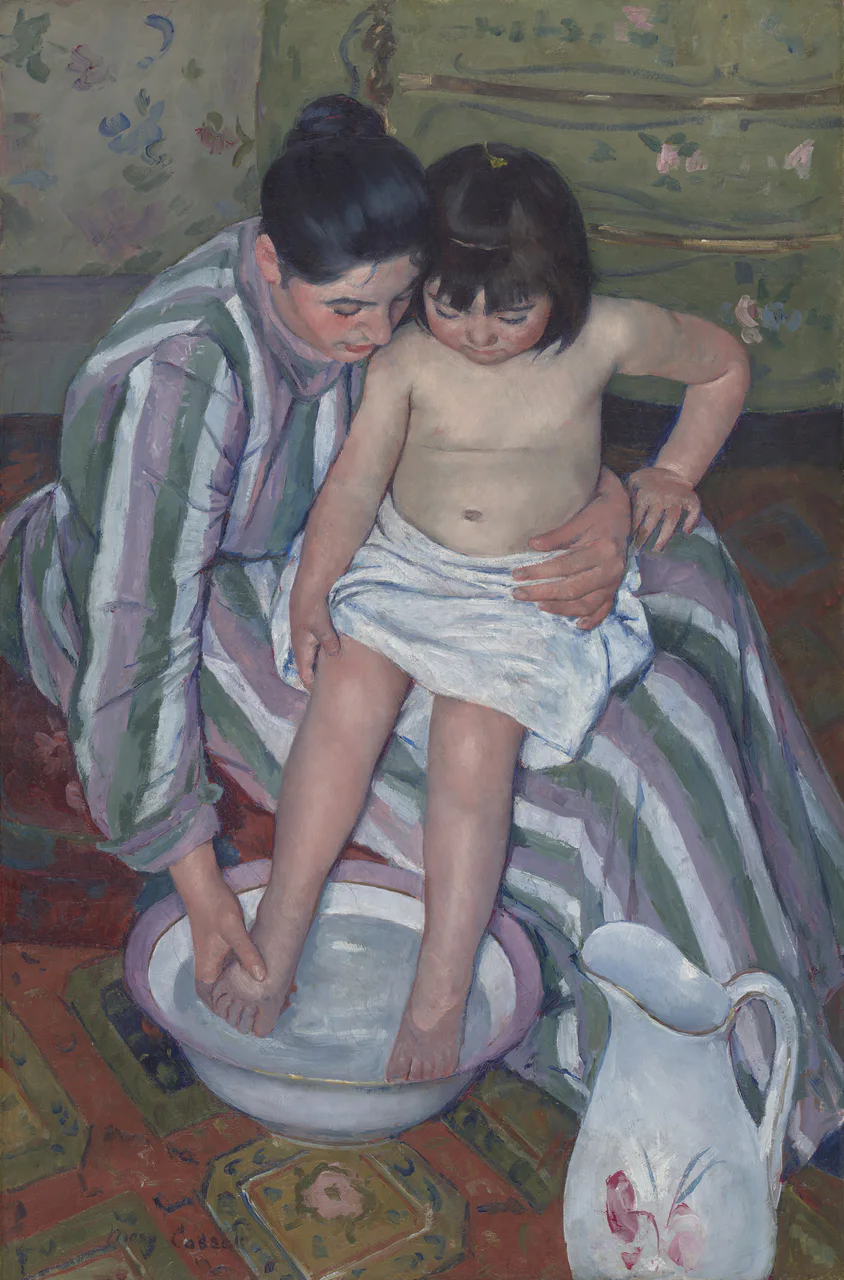
A woman holds a small child on her lap and washes the child's feet in a basin. Both of them are looking down at the same spot, the water. Look at the lower middle of the canvas. Her hand wraps around one small foot. You can count the toes just above the surface.
Now go hunting for patterns. Her dress is striped in green, lavender and white. A red patterned rug covers the floor. Sprigs of flowers are scattered over the green background behind them. Even the white pitcher in the lower right has a pink flower painted on it. Leo starts copying the stripes into his notebook, then gives up and laughs. Too many patterns, he says. My silverpoint can't keep up.
All that pattern, and the steep view from above, make the floor seem to tip up like a wall. The Art Institute of Chicago links this flattened look to Mary Cassatt's close study of Japanese woodblock prints in the 1890s.
Cassatt was born in Pennsylvania and built her career in Paris. She was invited to exhibit with the original group of French Impressionists. Over time she became known for everyday moments between women and children, seen from very near.
She painted this in 1893. That same year it was listed first in the catalogue of her exhibition at the Durand-Ruel gallery in Paris. In 1910 the Art Institute of Chicago bought it, the first work by Cassatt to enter the museum's collection.
Before you go, check the lower left corner. Her signature is written there in dark paint, tucked into the pattern of the rug.
The next room has no people in it at all. Just a pond, floating flowers, and the sky reflected in the water.