 Pyeongye
The story of this room
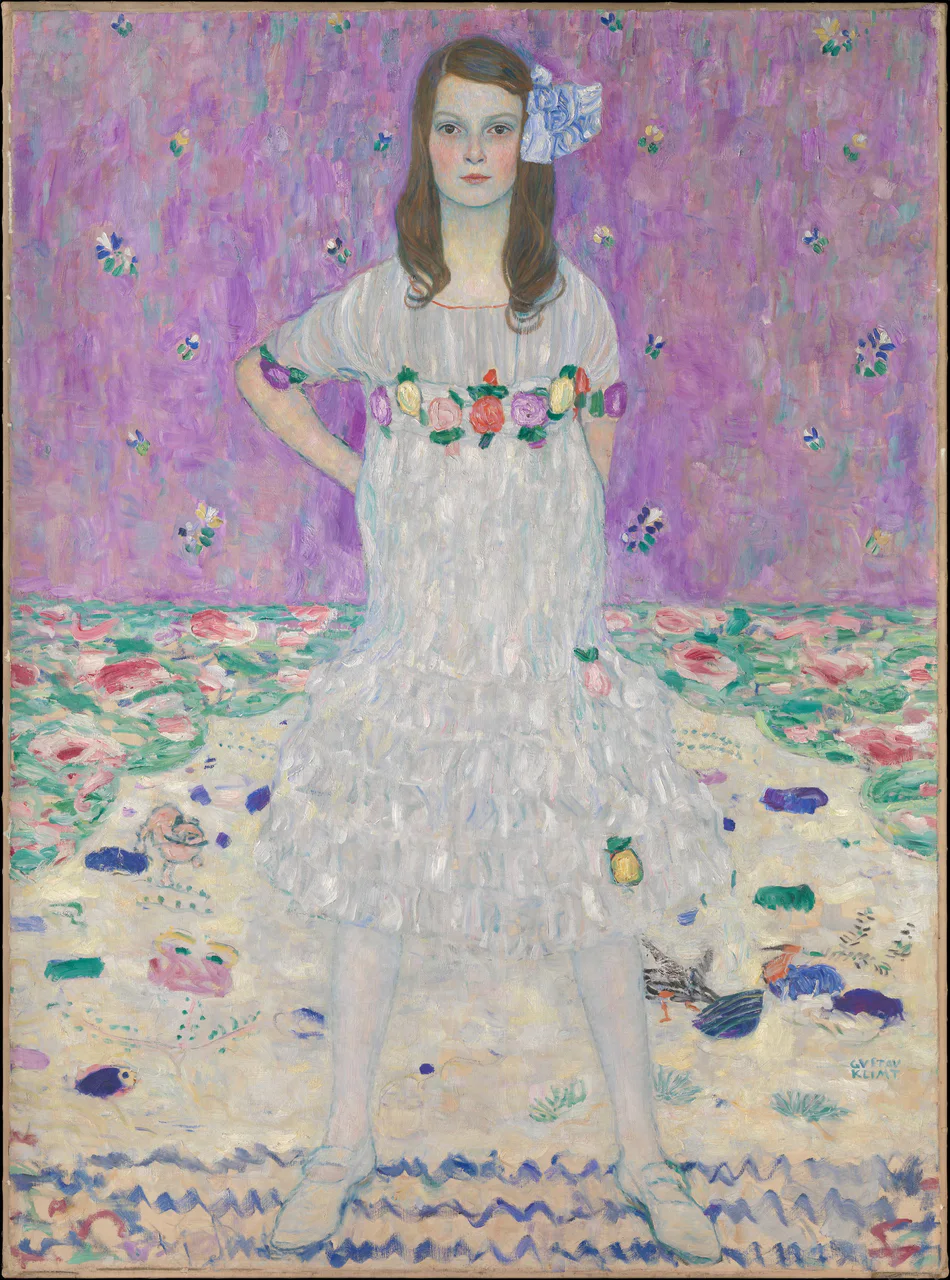
Step out of the pond room, and this time someone is already looking at you. In the middle of a canvas about 150 centimeters tall stands a girl in a white dress, feet planted wide apart. Leo stops and lifts his red beret a little. The last room has a host, he says. We should say hello first.
Start with her face. Her mouth is firmly closed, and she does not look away. On the left side of the picture, her arm is bent with the hand set on her hip. If you were expecting a shy, smiling child, she may surprise you. A big blue bow sits in her hair on the right.
Now let your eyes travel down the dress. Across her chest runs a band of flowers in pink, red, yellow and violet. The skirt is built from layer on layer of white and pale gray strokes, almost like feathers. Behind her, the wall is a strong lilac, with small sprigs of flowers floating on it.
Look at the lower right. Beside her legs, to the right, are two birds, one gray and speckled with orange legs, the other pushing forward an orange head. Below and to the right of them, on the pale ground, the name GVSTAV KLIMT is painted in two stacked lines. Along the very bottom, blue zigzags run across the floor like waves. Leo copies them into his notebook and grins. Finally, one I can draw.
The painter is Gustav Klimt of Vienna. In 1897 he joined other artists in breaking away from the city's conservative artists' association, and they founded the Vienna Secession. Klimt was its first president. Around 1907 and 1908 he painted The Kiss, glowing with gold leaf. Here there is no gold at all. Bright color, flowers and birds take its place.
The girl is Mäda Primavesi. She was born in 1903, so she was about nine when Klimt began this portrait in 1912. Her father, Otto Primavesi, was a banker in Olmütz, today Olomouc in the Czech Republic. Klimt died in 1918. Mäda lived until 2000.
Thank you for walking all fifteen rooms with us. Leo closes his notebook. Pick just one painting from today, he says, and think of it again on your way home.