 Pyeongye
Artwork · 20th century · Gustav Klimt
LeoTurn on Magnifier at the lower right and move slowly across the painting.
Full screen opens it edge to edge.Tap the painting to fill the screen.
Spread two fingers to look closer.
At a glance
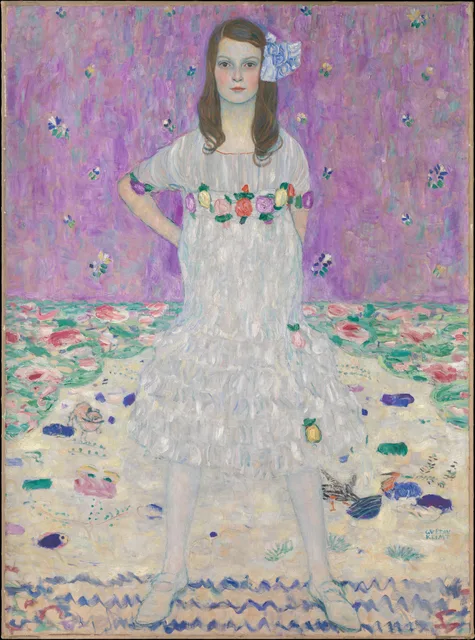
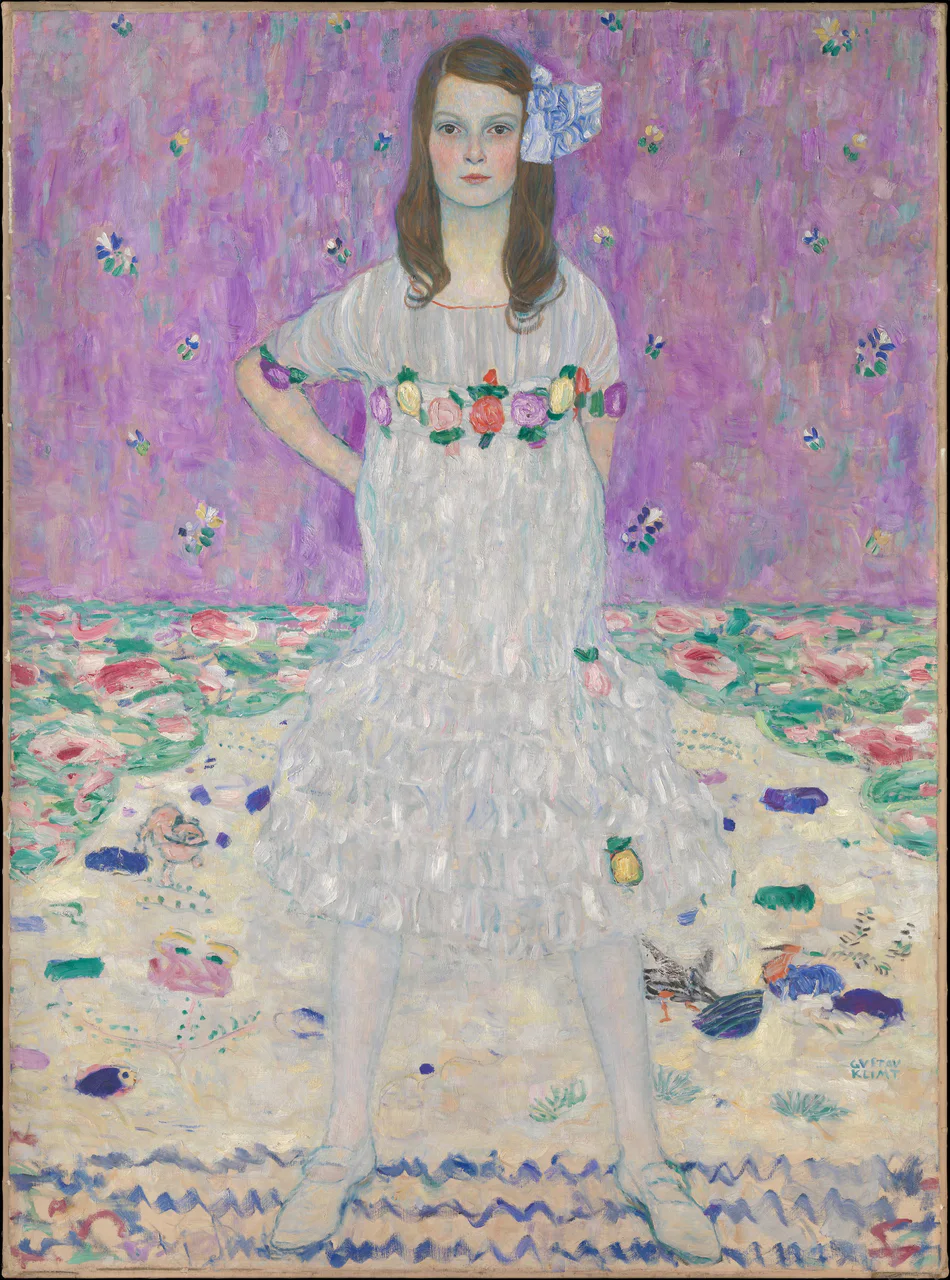
- A nine-year-old girl in a white dress stands with her feet planted wide apart and looks straight back at us.
- Gustav Klimt painted this portrait of Mäda Primavesi in oil on canvas in 1912–13.
- The canvas is about 150 centimeters tall, nearly life size, and a violet wall and flower-strewn floor surround the child on every side.
Reading the picture
5 places to look closer
Tap a number on the painting to jump to its note, or a close-up to see that spot in the whole picture.
Start with Mäda's face. She is not smiling and not frowning. Her brown eyes look directly out at you. A big blue and white bow sits on one side of her long brown hair, and it is painted in thick, scrubbed strokes, much rougher than her smooth face.
Zoom into the garland of flowers below her chest. Pink, orange-red, violet and yellow roses run in a line with green leaves between them. Each flower is a few round, swirling strokes. Against the white dress, the colors seem to float forward.
Look at the floor at the lower right. Next to Mäda's feet are shapes that look like birds. One has a gray striped body and orange legs, another an orange head and a blue body. With the patches of blue and green scattered around, the floor feels like a garden in a storybook.
Move down to her feet. Her legs, in white stockings, are set wider than her shoulders, and her shoes point outward. Under her feet, three rows of blue zigzags run across the bottom of the canvas. This is not a shy, polite pose. She is holding her ground.
Zoom in below the birds and you will find blue-green capital letters. Klimt signed in two lines, GVSTAV KLIMT, using a V in place of the U. The paint matches the floor pattern, so at first the name looks like part of the decoration.
When it was painted
In 1912 Gustav Klimt was fifty when he began a portrait of a little girl. His sitter was Mäda Primavesi, born in 1903. Klimt made a large number of preparatory sketches for this portrait. He tried out different poses, different outfits and different backgrounds before he settled on the one you see.
Mäda remembered those sessions as an adult. She recalled trying many poses and many outfits. Out of all those attempts came this one: a girl standing her ground and looking straight at you.
Her father, Otto Primavesi, was a banker from Olomouc in Moravia. Otto and his wife, Eugenia, bought Klimt's paintings and supported him. Otto also put serious money into the Wiener Werkstätte, the Vienna design workshop run by Klimt's circle. Around the same time, Klimt painted a portrait of Eugenia too.
The painting's later life was not easy. It came to belong to Jenny Pulitzer Steiner in Vienna, and in 1938 the Nazis seized it from her there. Only in 1951, after the war, was it returned to her. In 1964 André and Clara Mertens gave it to the Metropolitan Museum in her memory.
Klimt died in Vienna in 1918, but Mäda lived until 2000. Look again at her feet at the bottom of the canvas. After all those sketches, those wide-set feet are what Klimt finally chose.
Questions to think about
- Look for itWhere can you find roses, birds and zigzag waves in this picture?
- Why?Why might Klimt have shown a nine-year-old standing with her feet wide apart, instead of sitting quietly?
- What about you?When adults take photos or make portraits of children, should they ask the child first how they want to look and stand?
Same period
Painted around the same time,
somewhere else

Too good to keep to yourself
This painting,
for someone who comes to mind
They open it at full size
and see every brushstroke.
About this work
- Artist
- Gustav Klimt · 1862–1918
- Date
- 1912–13
- Medium
- Oil on canvas
- Size
- 149.9 × 110.5 cm
- Collection
- The Metropolitan Museum of Art
- Image
- Original long edge 3877px · shown at 2560px
- Original
- View on the museum's website ↗