 Pyeongye
The story of this room
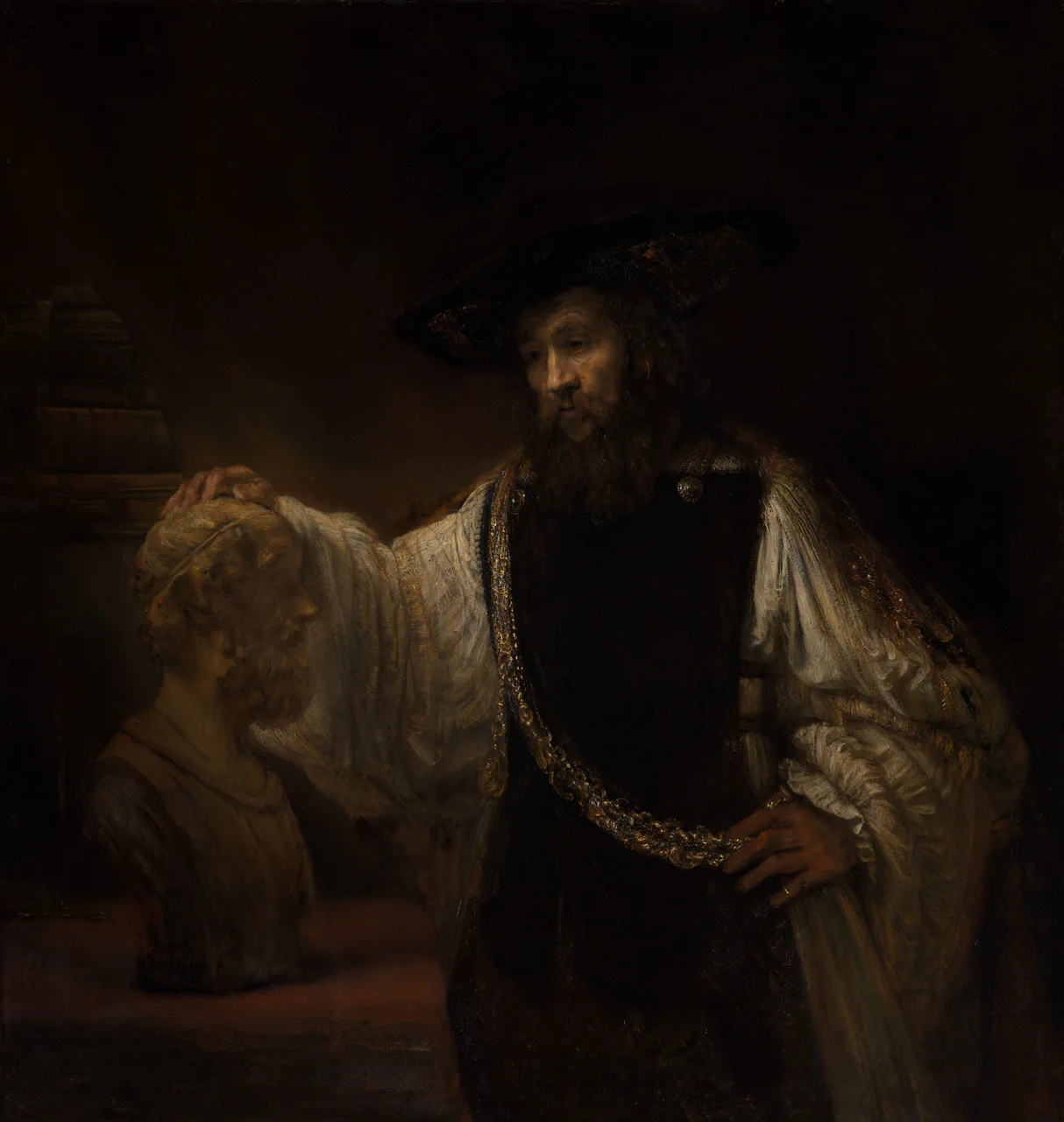
This room is dark. Give your eyes a moment. Slowly, a man in a wide black hat rises out of the shadows. Leo drops his voice to a whisper. You keep quiet around someone who is thinking.
The man is Aristotle, the philosopher of ancient Greece. Look to the left first. His right hand rests on the head of a stone bust. The bust is Homer, the poet of the Iliad and the Odyssey. The fingers lie lightly on the carved hair, almost like a pat. What could a philosopher be asking a poet?
Now move up to his face. Light lands on the forehead, the nose, and the creases around the eyes. And the eyes are not really on the bust. They drift a little lower, somewhere far off. Whenever I stand here, I find myself closing my notebook.
Drop down to the right. A heavy gold chain hangs from his shoulder to his waist. His left hand holds it at the hip, and a gold ring catches the light on one finger. Rembrandt built that chain out of thick, lumpy paint. Step closer and you can see the light snag on every ridge. The medal at the end of the chain is usually read as a portrait of Alexander the Great, who had been Aristotle's pupil.
Do not miss the base of the bust. On the dark surface, faint letters spell out Rembrandt's name and the year 1653.
Rembrandt van Rijn painted this in Amsterdam in 1653. It was ordered by Antonio Ruffo, a nobleman in Messina, on the island of Sicily. At the time Rembrandt was deep in debt from buying a large house. In 1656 he would be declared insolvent. The Baroque loved strong contrasts of light and dark. In Rembrandt's hands, that drama turns very quiet.
The painting was sold at auction in 1961 for 2.3 million dollars and came to The Met in New York.
The next room stays in Holland, and in the Baroque. But this time a window is open, and daylight is waiting.