 Pyeongye
The story of this room
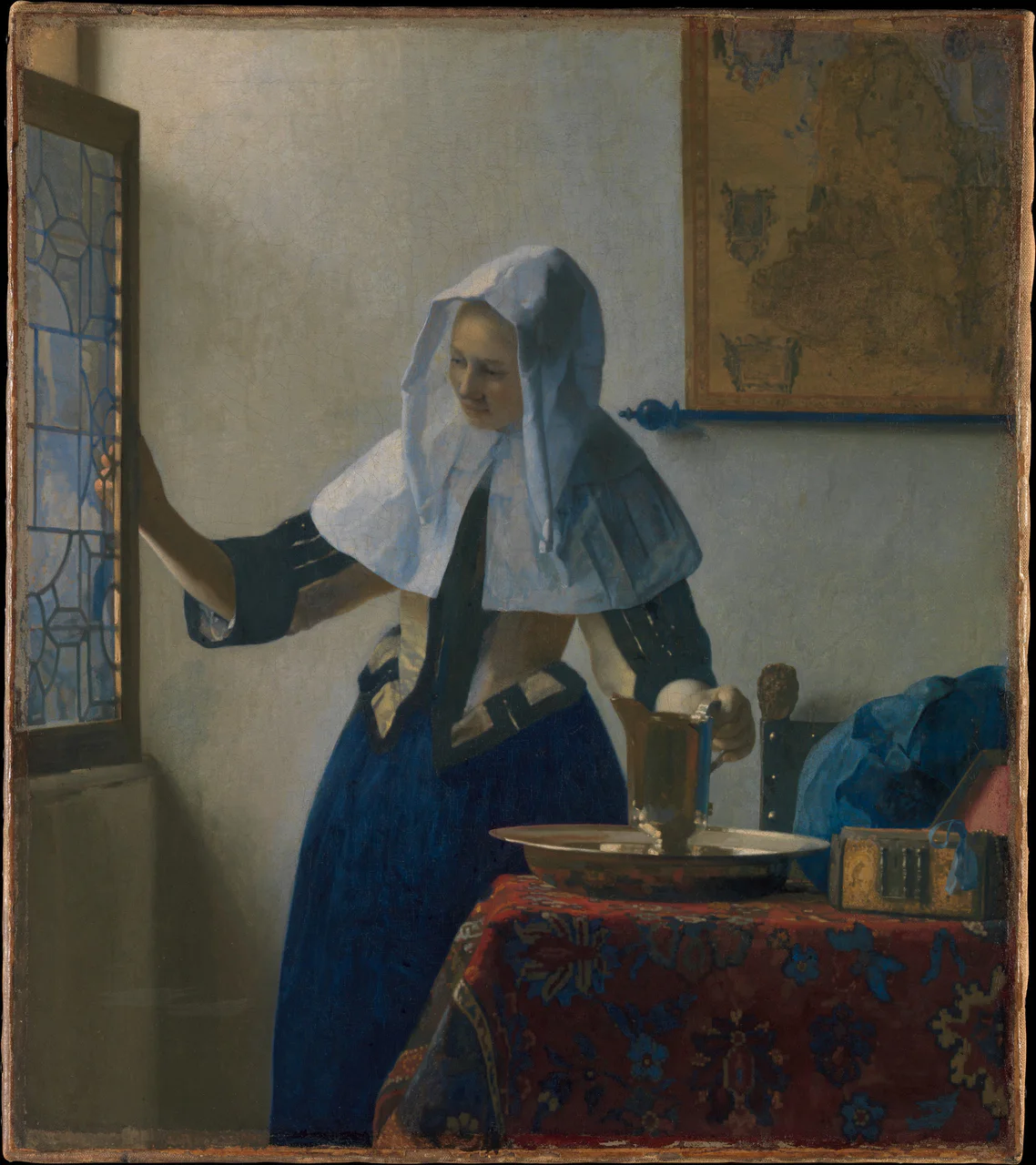
After the darkness of the last room, this one feels bright. It is also small. The painting is only about sixteen inches wide, so Leo waves you a step closer. We both hold our breath. One sound, and the woman might turn around.
Start on the left. She holds a window with one hand. Each small pane, joined with lead, holds a piece of blue sky. Where the sun reaches her fingertips, they glow a warm pink. Now look at the white cloth over her head. It is white, but not simply white. In the shadows it turns bluish, and where the light hits it, it is a soft warm gray. Every time I look, I am surprised by how many colors are hiding inside one white. Leo lifts his silverpoint, then lowers it again with a sigh.
Her other hand holds a gold-colored pitcher on the table. It stands in a wide basin. Get close to the shiny rim of the basin. The red pattern of the carpet below is reflected in it, blurred, like in a mirror. To the right sits a box with a blue ribbon trailing over it. On the back wall, a large map hangs from a blue rod.
Johannes Vermeer painted this around 1662. He was born in the Dutch city of Delft and worked there all his life. Only about thirty-five of his paintings survive. Most show quiet rooms beside a window, like this one. He is known for his love of ultramarine, a very expensive blue pigment.
In the Dutch Republic of his day, merchants and ordinary citizens bought paintings to hang at home. So instead of saints and kings, daily life at home became the subject. Vermeer died in 1675, at forty-three, leaving his family in debt.
Next, we leave this calm window behind and step into a prison cell. A philosopher is about to take a cup of poison, and he is still talking.