 Pyeongye
The story of this room
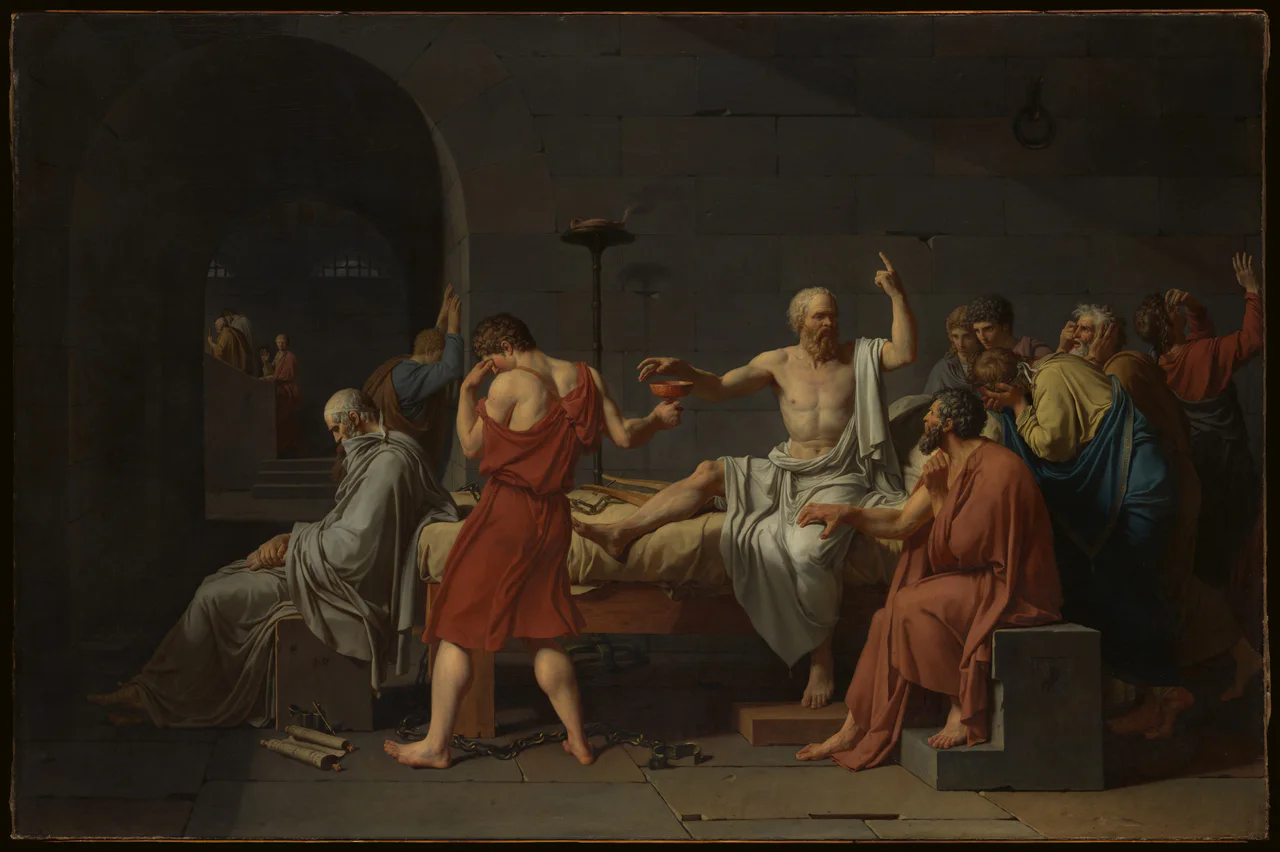
After the soft window light of the last room, this one is all cold stone. It is a prison cell. Leo takes off his red beret and holds it in both hands. A man is about to die in here, he says quietly. And the calmest person in the room is the man himself.
That is Socrates, sitting up on the bed in the middle, bare-chested, with a white beard. He was a philosopher in ancient Athens. In 399 BC a jury condemned him for failing to honor the city's gods and for corrupting the young. His sentence was to drink a cup of poison hemlock.
Look at his hands. His right hand reaches toward the cup, but it has not closed around it yet. The young man in red who holds the cup out is turning away, his other hand pressed over his eyes. Meanwhile Socrates raises his left hand and points one finger upward. Leo traces that finger with his silverpoint. He is still talking, Leo says. Right to the end.
Now drop your eyes to the floor. Under the bed, a loosened chain lies across the stone. On the right, the man in red who rests his hand on Socrates' leg sits on a stone block. Look closely at its side and you will find a small owl carved there. The owl was the emblem of Athens.
At the far left, at the foot of the bed, an old man sits with his back turned and his head bowed. He is usually identified as Plato. Plato told the story of this last day in a dialogue called the Phaedo. In that text, Plato himself is said to have been ill and absent. David put him in the room anyway.
Jacques Louis David painted this in 1787 and showed it at the Paris Salon that same year. He told stories from Greece and Rome with crisp outlines and solid, sculptural bodies. Instead of decoration and charm, he wanted to show restraint and duty. That approach is what we call Neoclassicism. Two years later the French Revolution broke out, and David threw himself into its politics.
In the next room the stone walls are gone. A huge wave is waiting, printed from carved wooden blocks across the sea in Japan.