 Pyeongye
The story of this room
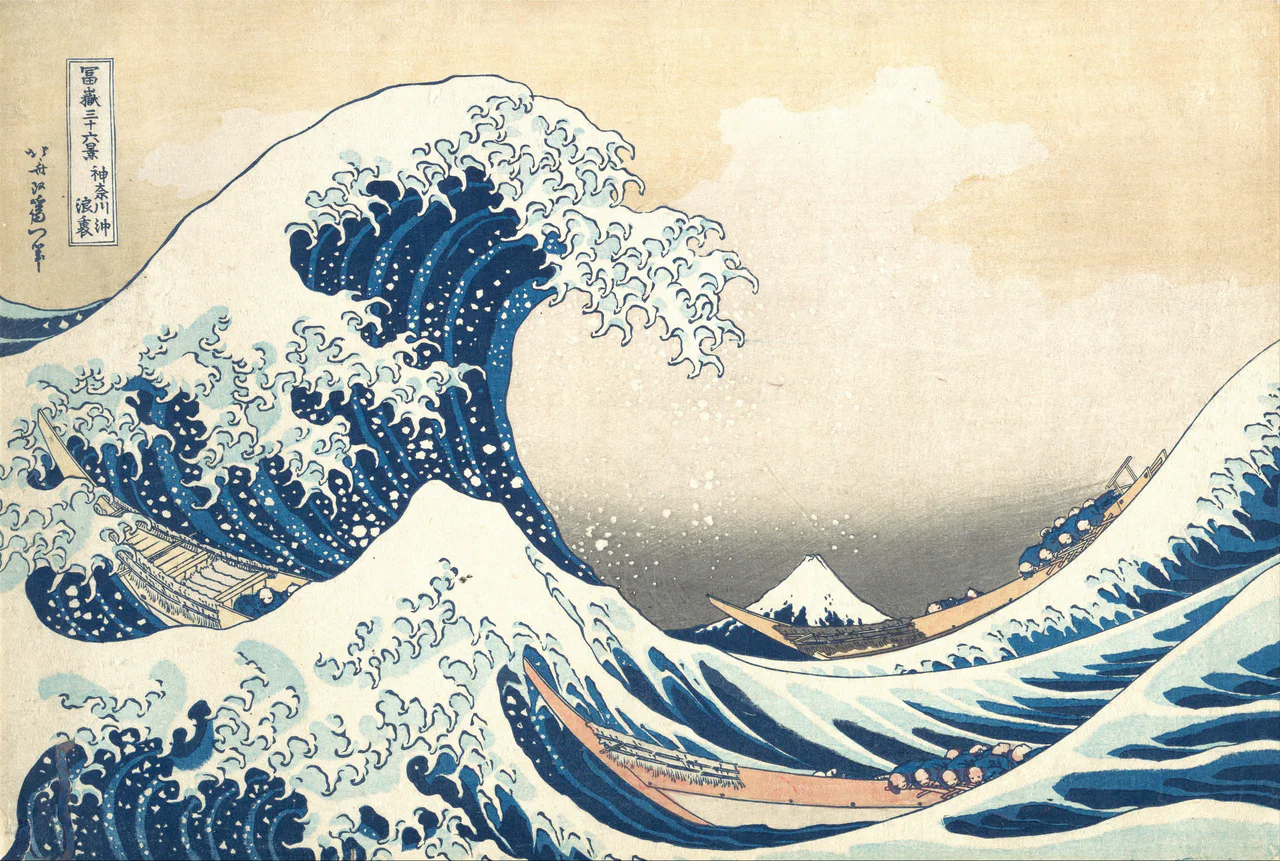
Step out of the dark prison cell and the light suddenly changes. A wall of water rears up over us. Leo jumps back a step and clutches his notebook. Don't worry, he says. It is smaller than it looks. This is a woodblock print on a sheet of paper about 38 centimeters wide, roughly 15 inches.
Start at the crest of the wave. The white foam splits into curling hooks, like the fingers of a hand bent and ready to grab. Underneath, dark blue, pale blue, and the bare color of the paper are stacked in bands. That layering is what gives the wave its weight.
Now let your eyes drop below the wave. There are three long, narrow boats. Look closely at the one in the lower right. The people aboard are bent low, heads down, pressed flat against the boat. Not a single face is looking up.
Then find the middle of the picture, down in the trough between the waves. A small white peak sits there. That is Mount Fuji. It looks tiny, yet it is the real subject. The label in the box at the upper left names the series this sheet belongs to, Thirty-six Views of Mount Fuji.
Katsushika Hokusai published the series around 1830 to 1832, when he was about seventy. To make a print like this, the design was carved into wooden blocks, with a separate block for each color, and each sheet was printed by hand. That is why many copies of this picture exist. This impression belongs to the Metropolitan Museum of Art in New York. In its day, a print like this was sold in shops in Edo, the city now called Tokyo, for ordinary buyers.
Leo traces the curve of the wave with his silverpoint. This wave really did cross the ocean, he says. Decades later, when Japanese prints reached Europe, Monet collected them and Van Gogh copied them in paint. A cheap sheet of paper changed how painters on the other side of the world looked at things.
The next room has the sea in it too. But this time there is not one sharp line. Something huge is thrashing in the mist and spray.