 Pyeongye
The story of this room
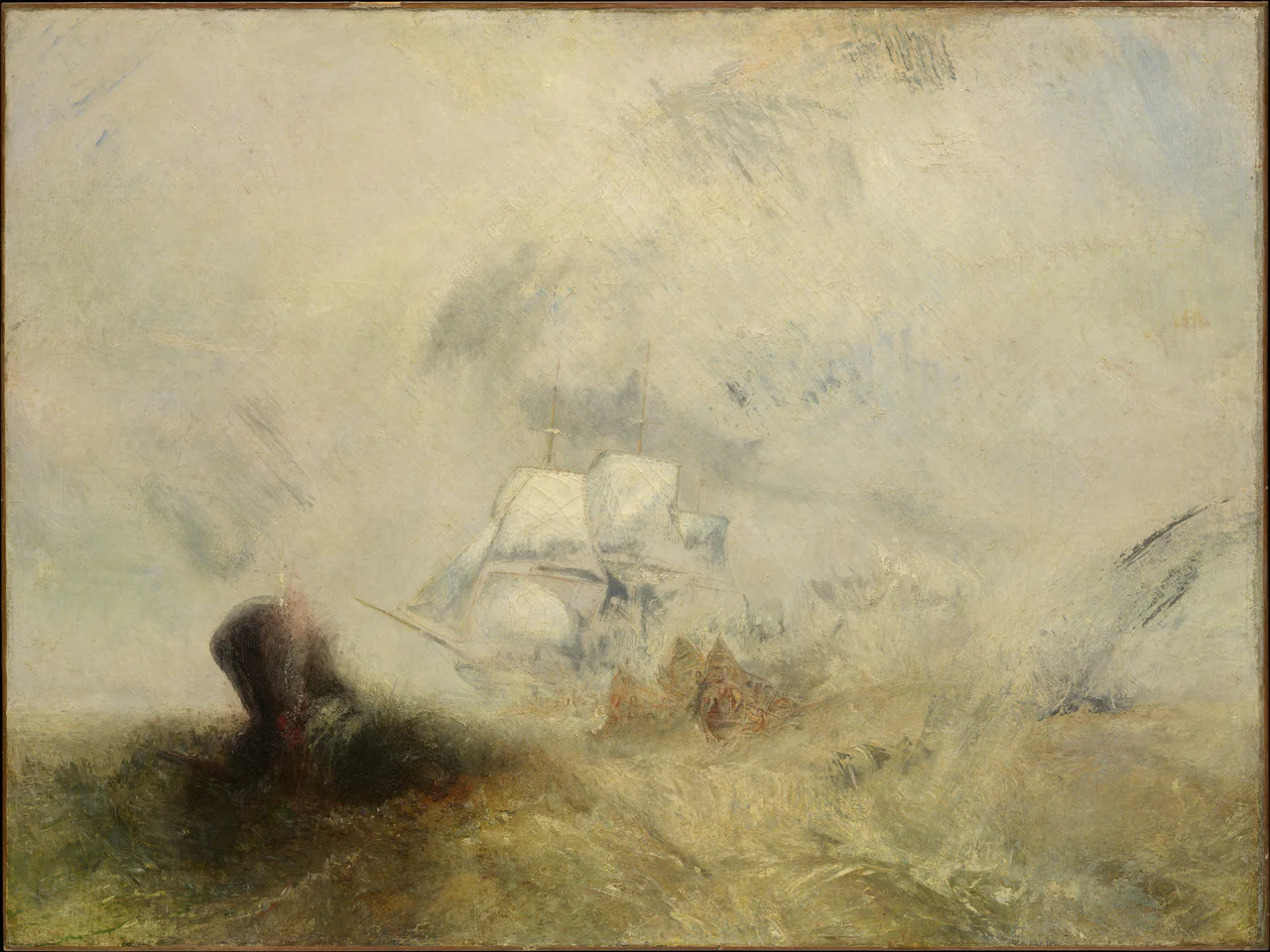
The wave in the last room was cut in sharp, clean lines. Walk in here and everything has melted into haze. Leo squints and leans in close. At first there is only a yellowish fog, he says. Give it a moment. Things come out of it one by one.
Look at the lower left. A dark, rounded mass rises out of the water. That is a whale. Red seeps through the middle of its body, and white spray shoots up above it. You can still see where the brush swept and scraped, so the line between whale and sea never quite settles.
Now move a little right of center and down. A small boat is caught in the spray. The boat and the men in it are made from just a few strokes of brown and red. No clear faces, no clear hands. Somehow that makes the moment feel even more rushed and chaotic.
Behind them, a large sailing ship hangs in the mist with its white sails spread. Get close to those sails. The white paint sits thick on the canvas, and over the years a fine web of cracks has spread across it. Leo lifts his silverpoint, then lowers it again. You can't trace this with a line, he admits.
Joseph Mallord William Turner painted this around 1845, when he was about seventy. In those years whale oil lit lamps and greased machinery. Whaling was a big industry that sent ships on long voyages far out to sea.
Turner had painted the sea, storms, and sunlight since he was young. As he grew older, the solid shapes in his pictures dissolved more and more into light and air. Some viewers at the time thought pictures like this looked unfinished. Yet that blur is exactly what lets us feel the confusion of being caught in the middle of the ocean. Art that puts the raw power of nature and strong feeling ahead of calm order is what we call Romanticism.
In the next room we leave the sea behind and go indoors. Dancers in white skirts are waiting for their turn in a rehearsal room.