 Pyeongye
Artwork · 16th century
LeoTurn on Magnifier at the lower right and move slowly across the painting.
Full screen opens it edge to edge.Tap the painting to fill the screen.
Spread two fingers to look closer.
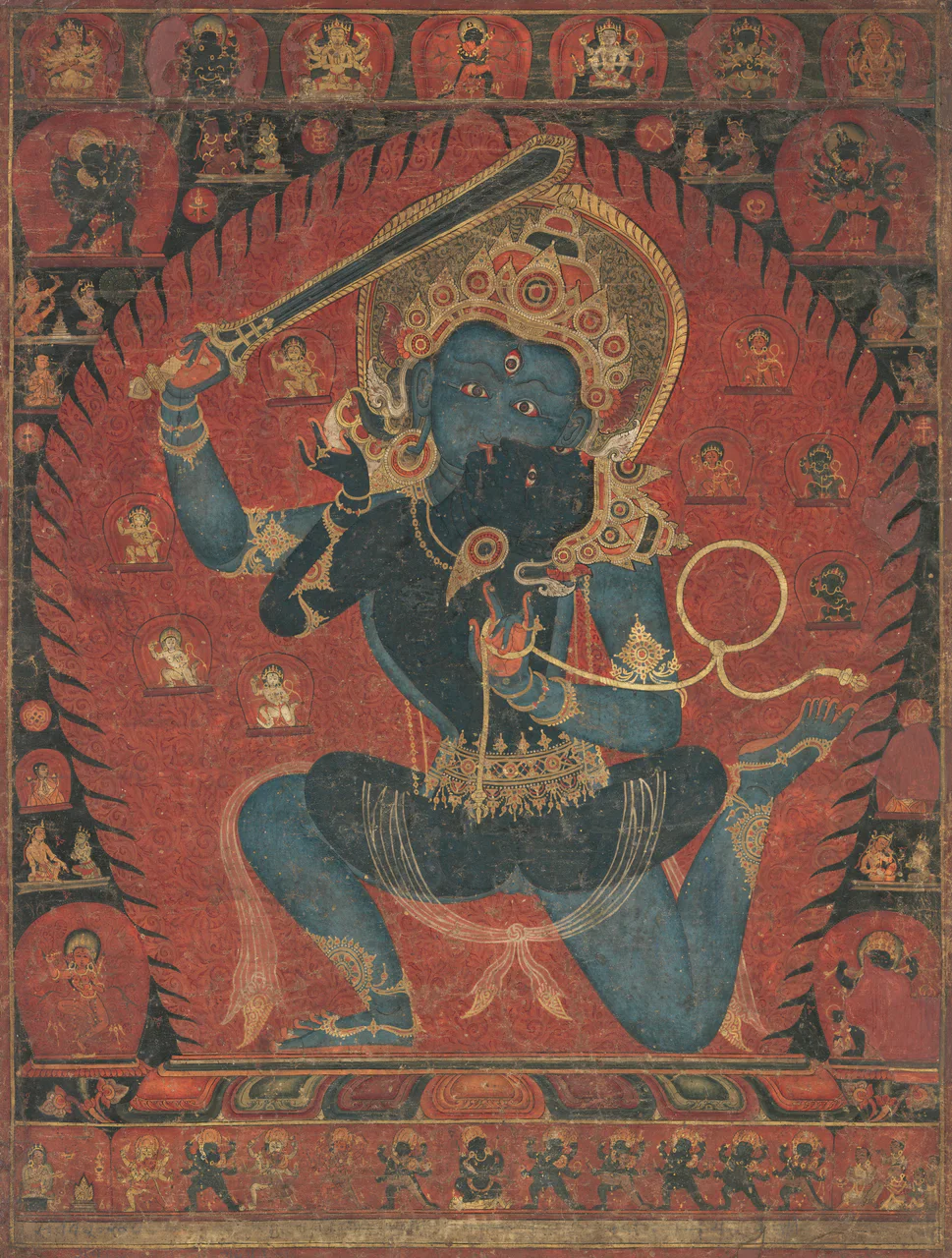
Achala with His Consort Vishvavajri
Unknown artist · Nepal, Kathmandu Valley1525–50Distemper on cloth
At a glance
- Achala, a blue protector god, kneels on one knee with a sword raised, holding his dark-blue consort Vishvavajri close in front of a wall of flames.
- An unnamed artist in Nepal's Kathmandu Valley painted it in distemper on cloth around 1525–50.
- The two gods merge into one shape at the center, while dozens of small deities fill the niches and bands around them.
Reading the picture
5 places to look closer
Tap a number on the painting to jump to its note, or a close-up to see that spot in the whole picture.
Start with the face. Achala has a third eye standing upright in the middle of his forehead, so he glares out with three red-rimmed eyes. Just under his chin, a darker blue face presses close. That is his consort, Vishvavajri, wrapped in his embrace.
Follow the sword he swings above his head. The black blade has a gold edge, and the hilt ends in an ornate guard. Right under the hilt, a tiny yellow figure sits in an arched niche, one arm raised and a looped cord in the other hand. Its pose looks like a small echo of the big god.
Now find the gold ring on the right. A cord held in front of his chest swings out into a wide circle and ends in a knot. It is a noose. The sword and the noose are Achala's usual tools: the sword is read as cutting through ignorance, the noose as catching and binding harmful forces.
Look below the waist. A few thin white lines hang over the legs and gather in a knot at the center. It is a sheer scarf. The painter drew it in outline only, with no color, so the blue legs show straight through it.
Drop down to the bottom band. Small dark-bodied figures stand in a row on a red ground, arms up and knees bent, as if dancing. Their hair rises like orange flames. The fierce energy of the main god seems to run all the way to the bottom edge.
When it was painted
He glares, he swings a sword, he is blue and fierce. So why would anyone want him close by? According to the museum, Achala was popularly linked with magic, with healing, and with protection from disease. For the people who prayed to him, that terrifying face was a guardian's face.
His name means the immovable one in Sanskrit, and in East Asia he is known as Fudo. The museum describes him as a wrathful form of Manjushri, the bodhisattva of wisdom. In the Buddhism of Nepal, he is also understood as a manifestation of Chakrasamvara.
The painter did not make up this image. The museum explains that it is a visualization of the Chandamaharoshana Tantra, a meditation text devoted to Achala. In Tantric practice, a meditator builds up the deity in the mind piece by piece, following the description in the text. The museum reads the embrace of the two gods as the union of wisdom and compassion.
The painting dates from about 1525 to 1550, when the Kathmandu Valley was ruled by the Malla kings. Newar painters from the valley were known for this kind of work and painted for patrons in neighboring Tibet as well as at home.
It came to the Metropolitan Museum in 2012 from the Zimmerman Family Collection. The painting with the accession number just before it, acquired at the same time, is also on this site: Ushnishavijaya Enthroned in the Womb of a Stupa.
Now look at Achala's legs once more. One knee is planted on the ground, and the other is raised, braced hard. He swings his sword, yet his body does not budge. The immovable one lives up to his name right there, in that knee.
Questions to think about
- Look for itCan you find the third eye on Achala's forehead, the sword over his head, and the gold noose on the right?
- Why?Why do you think the painter left only the scarf at his waist without color, drawn in white lines?
- What about you?Achala looks terrifying, yet his job is to protect. Have you ever judged someone as dangerous from a fierce first look, and later found out you were wrong?
Same period
Painted around the same time,
somewhere else
Too good to keep to yourself
This painting,
for someone who comes to mind
They open it at full size
and see every brushstroke.
About this work
- Artist
- Unknown artist · Nepal, Kathmandu Valley
- Date
- 1525–50
- Medium
- Distemper on cloth
- Culture
- Nepal, Kathmandu Valley
- Collection
- The Metropolitan Museum of Art
- Image
- Original long edge 4000px · shown at 2560px
- Original
- View on the museum's website ↗