 Pyeongye
Artwork · 16th century · Giovanni Battista Moroni
LeoTurn on Magnifier at the lower right and move slowly across the painting.
Full screen opens it edge to edge.Tap the painting to fill the screen.
Spread two fingers to look closer.
At a glance
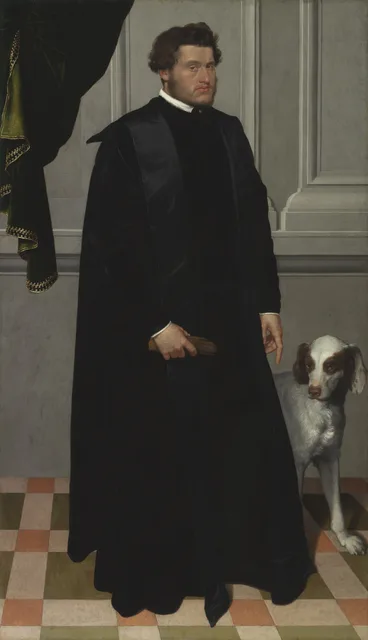
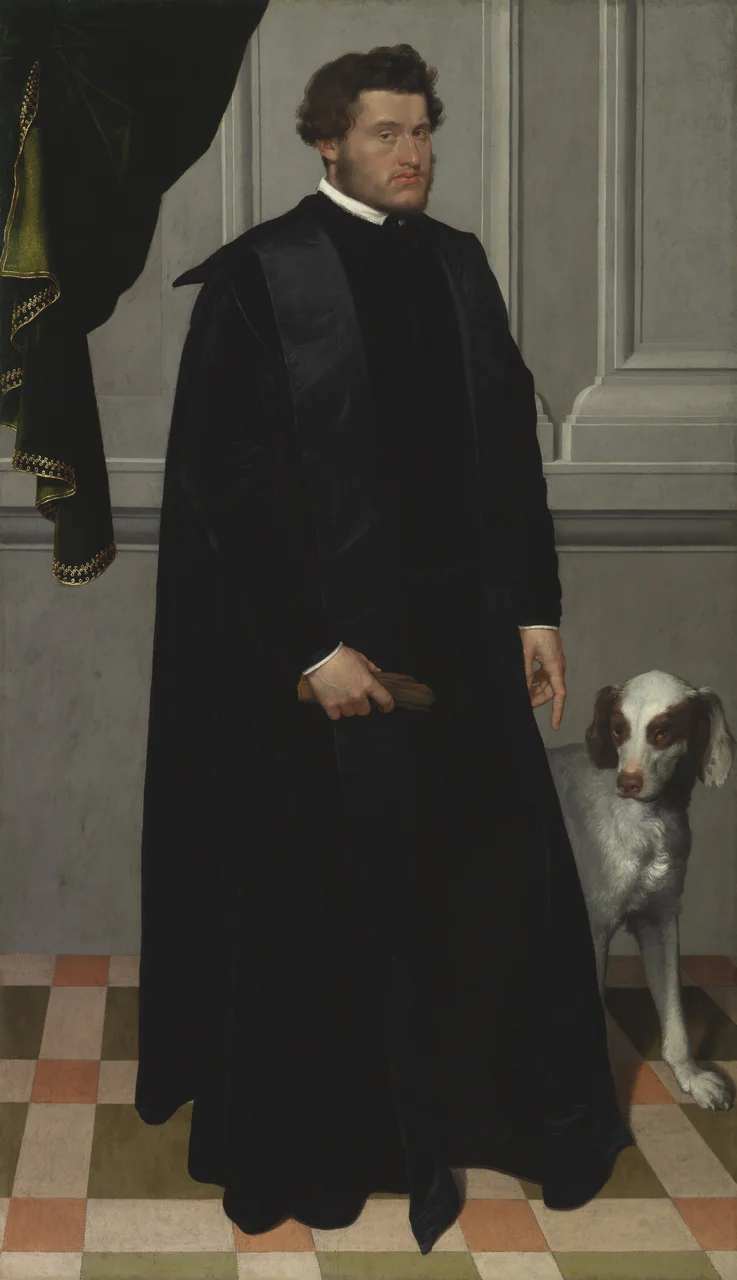
- A young nobleman in a long black velvet robe stands full length, with a dog at his side.
- Giovanni Battista Moroni, a portrait painter from Lombardy in northern Italy, painted it in 1551–52.
- The canvas is almost two meters tall, so the nephew of the family that ruled Trent during its famous church council stands close to life size.
Reading the picture
5 places to look closer
Tap a number on the painting to jump to its note, or a close-up to see that spot in the whole picture.
Zoom in on the face. Curly brown hair, a beard tracing the jaw, a full lower lip. His eyes meet ours, but there is no smile. Moroni does not flatter him. He paints the face that was in front of him.
Look at his right hand. He holds a pair of brown leather gloves, rolled up after taking them off. A thin band of white lace edges his cuff. Moroni paints the knuckles and even the veins, so the hand glows against all that black.
Now the dog in the lower right. It is white with brown ears and brown patches around the eyes. Its master's fingers hang just beside its head, pointing down. The dog lowers its head a little and looks up and out at us.
Zoom in on the curtain at the upper left. Its dark green cloth is edged with looping gold embroidery. Between the black robe and the gray wall, this bit of gold is one of the very few decorations in the picture.
Look down at the floor. Pink, olive green and pale tiles form a checkerboard. The heavy hem of the robe settles on top of it.
When it was painted
In 1551 the small Alpine city of Trent was crowded with visitors. The Council of Trent, the great meeting the Catholic Church called to answer the Protestant Reformation, had opened again. The city's ruler was its prince-bishop, Cardinal Cristoforo Madruzzo. The young man in this picture, Gian Lodovico, was his nephew.
Moroni was around thirty. He came from Albino, near Bergamo, and had trained in Brescia with the painter Moretto. During the council years he worked in Trent and painted members of the Madruzzo family.
According to the Art Institute of Chicago, Moroni painted this portrait together with one of Gian Lodovico's brother, Gian Federico. That picture now hangs in the National Gallery of Art in Washington. Around the same time, the Venetian painter Titian made a full-length portrait of their uncle Cristoforo.
The young man went on to a powerful career in the church. He became a cardinal in 1561, and in 1567 he succeeded his uncle as prince-bishop and ruler of Trent. Moroni went back toward his home region and became known for sharp, plain-spoken portraits such as The Tailor.
The painting stayed in Trent for a long time. From the 1700s into the early 1900s it kept turning up in guidebooks and articles about the city. It crossed the Atlantic in the early twentieth century, went on loan to Chicago in 1927, and was given to the museum by the Chicago collectors Mr. and Mrs. Charles H. Worcester.
Look again at that hand hanging beside the dog's head. One day this young man would rule a city. Here he simply stands beside his dog.
Questions to think about
- Look for itCan you find every spot where gold glints between the black robe and the gray wall?
- Why?Why do you think Moroni painted this young noble with a dog beside him?
- What about you?The Madruzzo family passed the rule of Trent from uncle to nephew. How do you feel when you see powerful positions handed down within a family today?
Same period
Painted around the same time,
somewhere else
Too good to keep to yourself
This painting,
for someone who comes to mind
They open it at full size
and see every brushstroke.
About this work
- Artist
- Giovanni Battista Moroni · 1520–1578
- Date
- 1551–52
- Medium
- Oil on canvas
- Size
- 199.8 × 116 cm
- Culture
- Italy
- Collection
- The Art Institute of Chicago
- Image
- Original long edge 11727px · shown at 2560px
- Original
- View on the museum's website ↗