 Pyeongye
Artwork · 16th century · Sesson Shūkei 雪村周継
LeoTurn on Magnifier at the lower right and move slowly across the painting.
Full screen opens it edge to edge.Tap the painting to fill the screen.
Spread two fingers to look closer.
At a glance
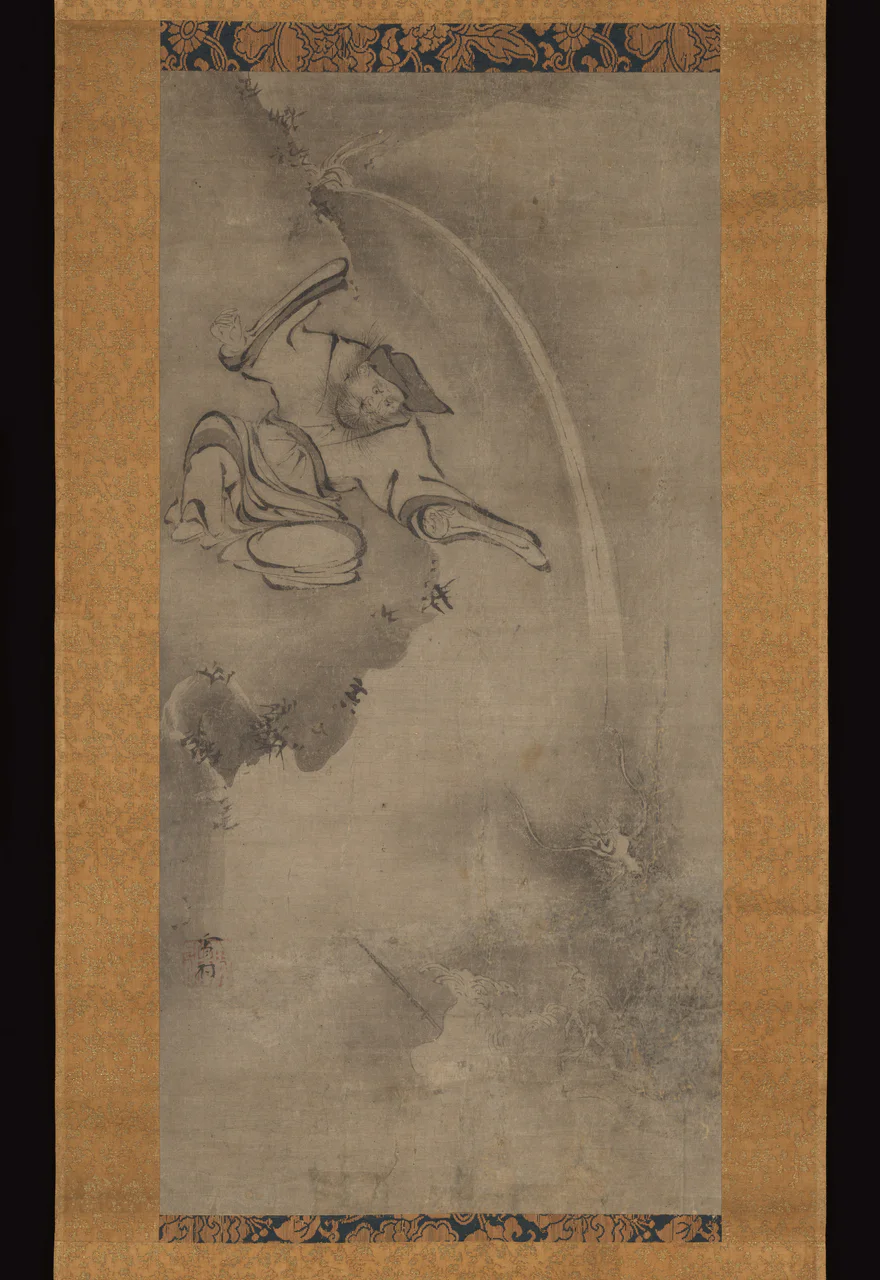
- Fei Zhangfang, a Daoist master from Chinese legend, leans out from the edge of a rock and stares down, painted in ink on a hanging scroll.
- The Japanese Zen monk-painter Sesson Shūkei made it around 1555 to 1561, in ink on paper.
- Flapping sleeves, bristling hair, a bamboo stick plunging into spray: with ink alone, he catches the turning point of the story.
Reading the picture
5 places to look closer
Tap a number on the painting to jump to its note, or a close-up to see that spot in the whole picture.
Take a good look at the figure up top. He perches on the edge of the rock, leaning far forward with both arms flung wide. His sleeves whip back as if a gust just hit them. The folds of his robe are quick ink lines, thick and thin, snapped at sharp angles.
Zoom in on the face. Hair and beard bristle out in every direction in fine lines. The eyes glare downward, and he wears a wide, flat cap. What has he seen that startles him so much?
Drop down to the bottom center. A bamboo stick, its joints clearly marked, slants down into a burst of spray. The spray is barely inked at all. It is a cluster of thin curves with the paper left white.
Zoom in on the mist at lower right. There is a hazy shape tangled with lines like whiskers and claws. A pale band curves all the way down from the rock above and runs into it. This is the spot that brings to mind the dragon in Fei Zhangfang's story.
Find the writing at lower left. Two characters, 雪村, are brushed in ink, with the faint trace of a red seal around them. This is the name Sesson left on the painting.
When it was painted
By the late 1550s, Sesson Shūkei was a Zen monk past fifty. Japan was in its Warring States period, carved up among feuding lords. Sesson spent those restless years moving around the eastern provinces, painting as he went.
He was born in Hitachi Province, today's Ibaraki Prefecture, into the Satake, a warrior clan. Instead of carrying on the family line, he entered a temple and became a monk. He deeply admired the earlier ink painter Sesshū. Even his name shows it: the first character of Sesson, 雪, meaning snow, is the same one that begins Sesshū's name.
His travels took him to places like Aizu, Odawara, and Kamakura, and he kept painting all along the way. Chinese tales of immortals and Daoist masters were among his favorite subjects. His picture of the immortal Lü Dongbin riding a dragon through the sky is well known.
Fei Zhangfang steps out of one of those tales. In the market he spotted an old medicine seller who, at closing time, hopped into a gourd hanging at his stall. Fei became the old man's student. Later he rode home on a bamboo staff his teacher gave him, and when he tossed the staff into a pond, it turned into a dragon. Sesson shows the staff plunging into the spray.
Sesson lived into his eighties. He spent his last years in a small hermitage in the lands of the Tamura lords of Miharu, in today's Fukushima Prefecture. Later painters, including Ogata Kōrin and artists of the Kano school, were strongly influenced by his ink work. This scroll entered The Met's collection in 2022.
Now follow the old man's stare down the paper. The white spray where the staff strikes is waiting there, and beside it, that hazy shape in the mist. The moment the staff becomes a dragon has been held still on this sheet for more than four centuries.
More by the same painter
Questions to think about
- Look for itHow many little tufts of grass, dabbed in ink around the rock, can you find?
- Why?Why do you think Sesson left the dragon blurred in the mist instead of drawing it clearly?
- What about you?Fei Zhangfang followed a strange old man everyone else ignored and found a new path. How open are we today to people who seem odd or out of place?
Same period
Painted around the same time,
somewhere else
Too good to keep to yourself
This painting,
for someone who comes to mind
They open it at full size
and see every brushstroke.
About this work
- Artist
- Sesson Shūkei 雪村周継 · 1504–1589
- Date
- ca. 1555–61
- Medium
- Hanging scroll; ink on paper
- Size
- 69.2 × 34 cm
- Culture
- Japan
- Collection
- The Metropolitan Museum of Art
- Image
- Original long edge 4000px · shown at 2560px
- Original
- View on the museum's website ↗