 Pyeongye
At a glance
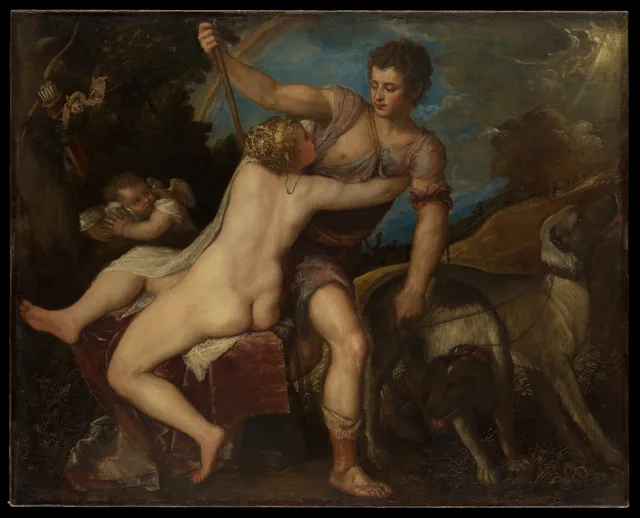
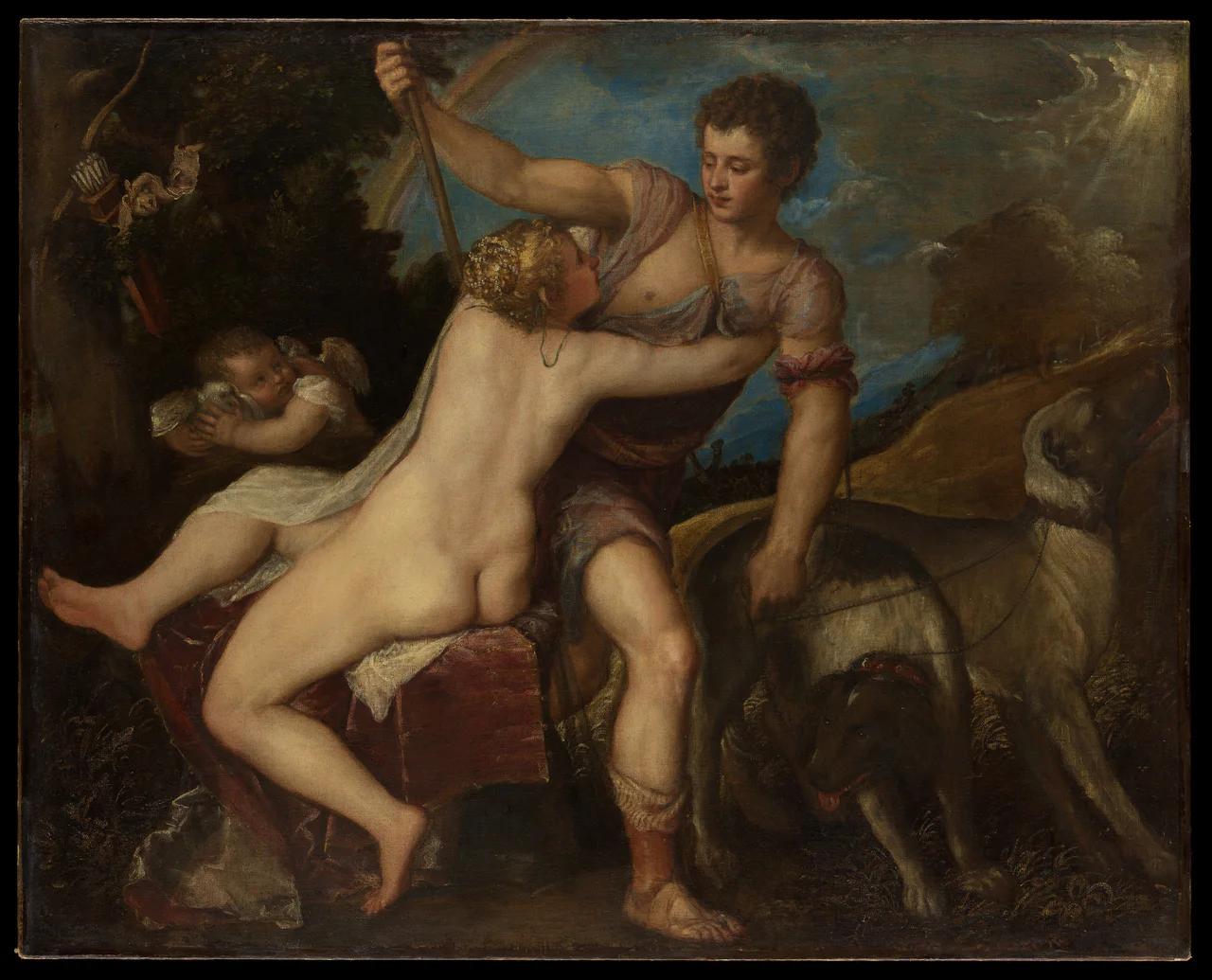
- Venus, goddess of love, throws her arms around the young hunter Adonis from behind to keep him from leaving.
- The Venetian painter Titian painted it in oil on canvas in the 1550s.
- One body pulls away and the other holds on, twisting in opposite directions, so a split-second struggle is frozen in place.
Reading the picture
5 places to look closer
Tap a number on the painting to jump to its note, or a close-up to see that spot in the whole picture.
Zoom in on the two faces. Venus presses her face close to his chest and wraps both arms around him. Adonis bends his head to look down at her, but his body is already turned toward the dogs on the right. Beads gleam in her blond hair, and his thin pink tunic shimmers.
Look at the baby in the shadows on the left. A winged Cupid hugs a white dove tight. The dove is Venus's bird. Cupid watches the two grown-ups with wide eyes.
Zoom in on the branches at the upper left. A bow and a quiver of arrows hang in the tree. Cupid, who shoots the arrows of love, has set his weapons aside. A white cloth hangs beside them like a ribbon.
Look at the hunting dogs at the lower right. Adonis grips their leashes in one hand and holds back several dogs. The one in front has its mouth open and its tongue out. The dogs are already straining toward the hunt.
Zoom in on the sky above. Behind the hunting spear Adonis holds up, a faint rainbow arches across the blue. Its colors are thin and soft. In the far upper right corner, light pours down through the clouds.
When it was painted
Late in 1550, Titian, already around sixty or older, crossed the Alps to Augsburg in Germany. He had been called to the court of the emperor Charles V. While there, he painted the emperor's son, Prince Philip of Spain, the future King Philip II. For years afterward, Philip would be one of his most important patrons.
Through the 1550s Titian sent Philip a run of paintings drawn from ancient myths, which he called poesie, or poems. The first Venus and Adonis went to Philip in 1554, when the prince was in London. That summer he had married Mary I, queen of England.
Titian's letter with the painting reveals a clever plan. The Danaë he had sent earlier showed a woman from the front, so this time he showed Venus from the back, to give the room more variety. That first version now hangs in the Prado Museum in Madrid.
The story itself comes from Ovid's Metamorphoses. Venus warns Adonis not to chase dangerous animals, but he goes hunting anyway and is killed by a wild boar. Ovid never describes Venus clinging to him as he leaves. That moment is Titian's own invention.
Titian's workshop painted the composition again and again. The Met believes this version was painted by Titian himself, and it came to the museum in 1949 with the Jules Bache Collection. Unlike in the Prado picture, Cupid here stays close to the couple. Look again at the shady left side, where he hugs a white dove and watches with wide-open eyes.
Questions to think about
- Look for itCan you find the red cloth Venus is sitting on, and the white cloth on top of it?
- Why?Why do you think Titian chose a moment of holding on that is not in the original story?
- What about you?When someone you love wants to do something dangerous, which shows more care: trying to stop them, or letting them go?
Same period
Painted around the same time,
somewhere else
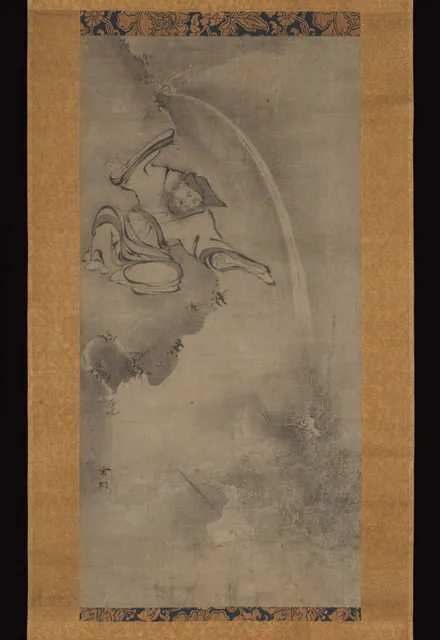 Daoist Master Fei ZhangfangSesson Shūkei 雪村周継ca. 1555–61
 The Martyrdom of Saint PaulTaddeo Zuccaroca. 1557–58
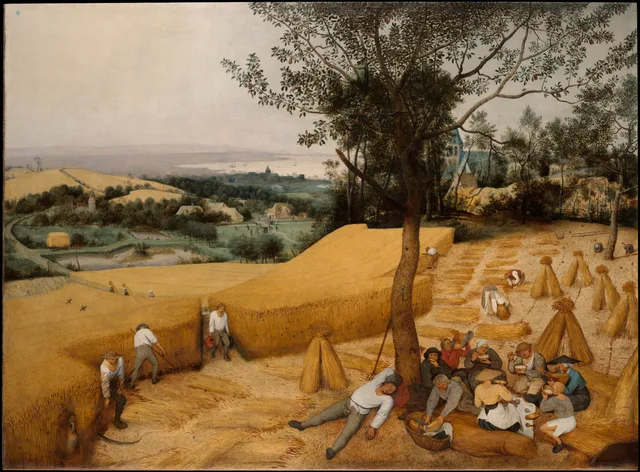 The HarvestersPieter Bruegel the Elder1565
 Gian Lodovico MadruzzoGiovanni Battista Moroni1551–52
 Achala with His Consort VishvavajriUnknown artist · Nepal, Kathmandu Valley1525–50
 Fish MarketJoachim Beuckelaer1568
Too good to keep to yourself
This painting,
for someone who comes to mind
They open it at full size
and see every brushstroke.
About this work
- Artist
- Titian · 1485–1576
- Date
- 1550s
- Medium
- Oil on canvas
- Size
- 106.7 × 133.4 cm
- Collection
- The Metropolitan Museum of Art
- Image
- Original long edge 4000px · shown at 2560px
- Original
- View on the museum's website ↗