 Pyeongye
Artwork · 16th century · Jan Brueghel the Elder
LeoTurn on Magnifier at the lower right and move slowly across the painting.
Full screen opens it edge to edge.Tap the painting to fill the screen.
Spread two fingers to look closer.
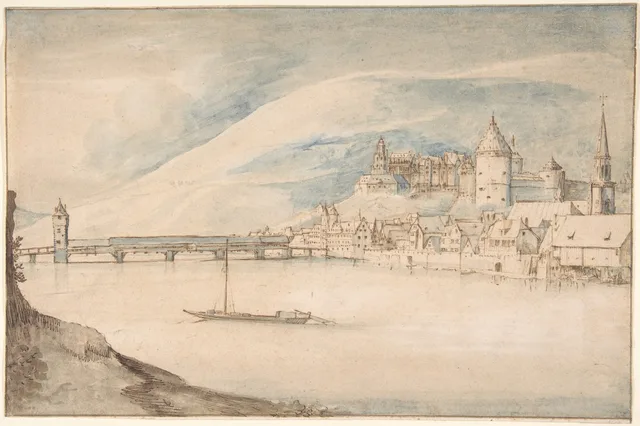
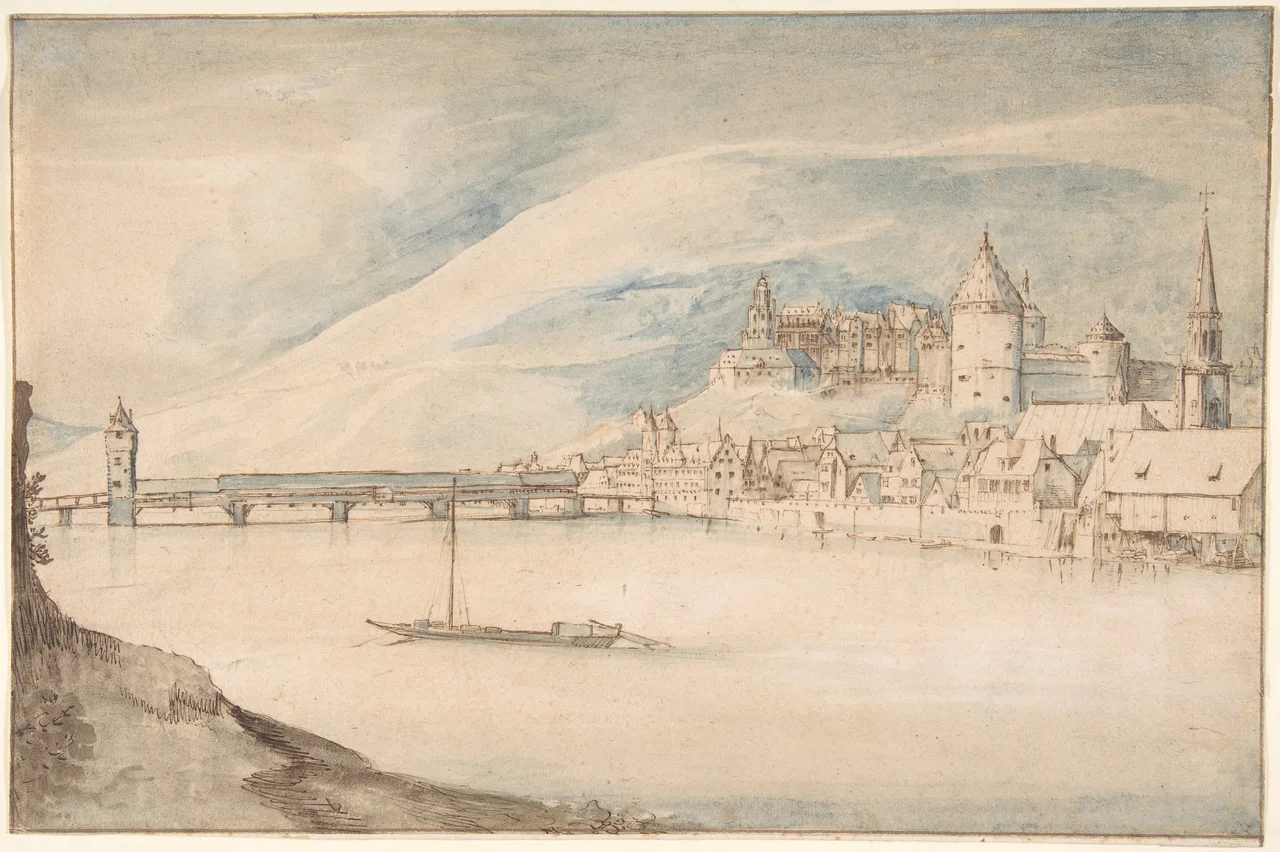
View of Heidelberg
Jan Brueghel the Elderca. 1588–89Pen and brown ink, brush and blue and brown wash, heightened with white; framing lines in pen and brown ink20.0 × 30.5 cm
At a glance
- The German city of Heidelberg seen across the Neckar River: a castle on the hill, houses along the bank, and a long covered bridge.
- The Flemish artist Jan Brueghel the Elder drew it around 1588–89, when he was about twenty, in brown ink with washes of blue.
- The Metropolitan Museum of Art considers it the earliest drawing by him that we know of.
Reading the picture
4 places to look closer
Tap a number on the painting to jump to its note, or a close-up to see that spot in the whole picture.
Zoom in on the castle on the hill. Towers and steep gabled roofs crowd together, and the windows are tiny dabs and dashes of brown ink. Behind it, a quick sweep of blue wash makes the shadowed slope of the hill. This is the castle as it looked before new buildings were added in the early 1590s.
Look at the tower at the left end of the bridge. A square tower wears a pointed cap, and blue shadow touches only its right edge and its base. Next to it, a roofed wooden bridge stretches across the river. A handful of horizontal lines is enough to give you the railing, the roof, and the supports.
Find the boat in the middle of the river. It is long and flat, with a single mast and what look like crates or bundles on deck. Near the stern, a row of slanted hatching lines darkens the hull. On all that empty water, this one boat tells you how wide the river is.
Go to the far right bank. A building with a huge roof juts out over the water on posts and braces. In the bottom corner you can just make out a curved line, like part of a wheel. Even the reflections are only a few short vertical strokes of the pen.
When it was painted
When Jan Brueghel made this drawing, he was only about twenty. He was born in Brussels in 1568, the son of the painter Pieter Bruegel the Elder. His father died in 1569, when Jan was barely a year old.
So Jan never really knew his famous father. One of the people who taught him was his grandmother, Mayken Verhulst, an artist who worked in watercolor. He grew up to start his own career in Antwerp.
Around the age of twenty, he set out on a long journey from Antwerp to Italy. By 1590 he had reached Naples. This view of Heidelberg is thought to come from that trip, drawn from the west side of the city, looking across the Neckar.
In Italy, Jan spent time in Rome, where Cardinal Federico Borromeo became his patron. Back in Antwerp by about 1596, he made his name with finely detailed flowers and landscapes, and he collaborated with Peter Paul Rubens on a number of paintings.
This small sheet waited more than four hundred years before it entered the Metropolitan Museum in 1995. Take one last look at the boat on the river. A twenty-year-old far from home, standing on a riverbank in a strange city, did not let even a passing boat slip by without catching it in ink.
Questions to think about
- Look for itAmong the houses along the river, can you find the tallest pointed spire?
- Why?Why do you think Brueghel washed the sky and hillside with blue, but left the wide river almost the color of the bare paper?
- What about you?On trips, many of us take hundreds of photos. If you spent a long time drawing a single view with just a pen, what would you remember differently?
Too good to keep to yourself
This painting,
for someone who comes to mind
They open it at full size
and see every brushstroke.
About this work
- Artist
- Jan Brueghel the Elder · 1568–1625
- Date
- ca. 1588–89
- Medium
- Pen and brown ink, brush and blue and brown wash, heightened with white; framing lines in pen and brown ink
- Size
- 20.0 × 30.5 cm
- Collection
- The Metropolitan Museum of Art
- Image
- Original long edge 3887px · shown at 2560px
- Original
- View on the museum's website ↗