 Pyeongye
Artwork · 16th century · Caravaggio
LeoTurn on Magnifier at the lower right and move slowly across the painting.
Full screen opens it edge to edge.Tap the painting to fill the screen.
Spread two fingers to look closer.
At a glance
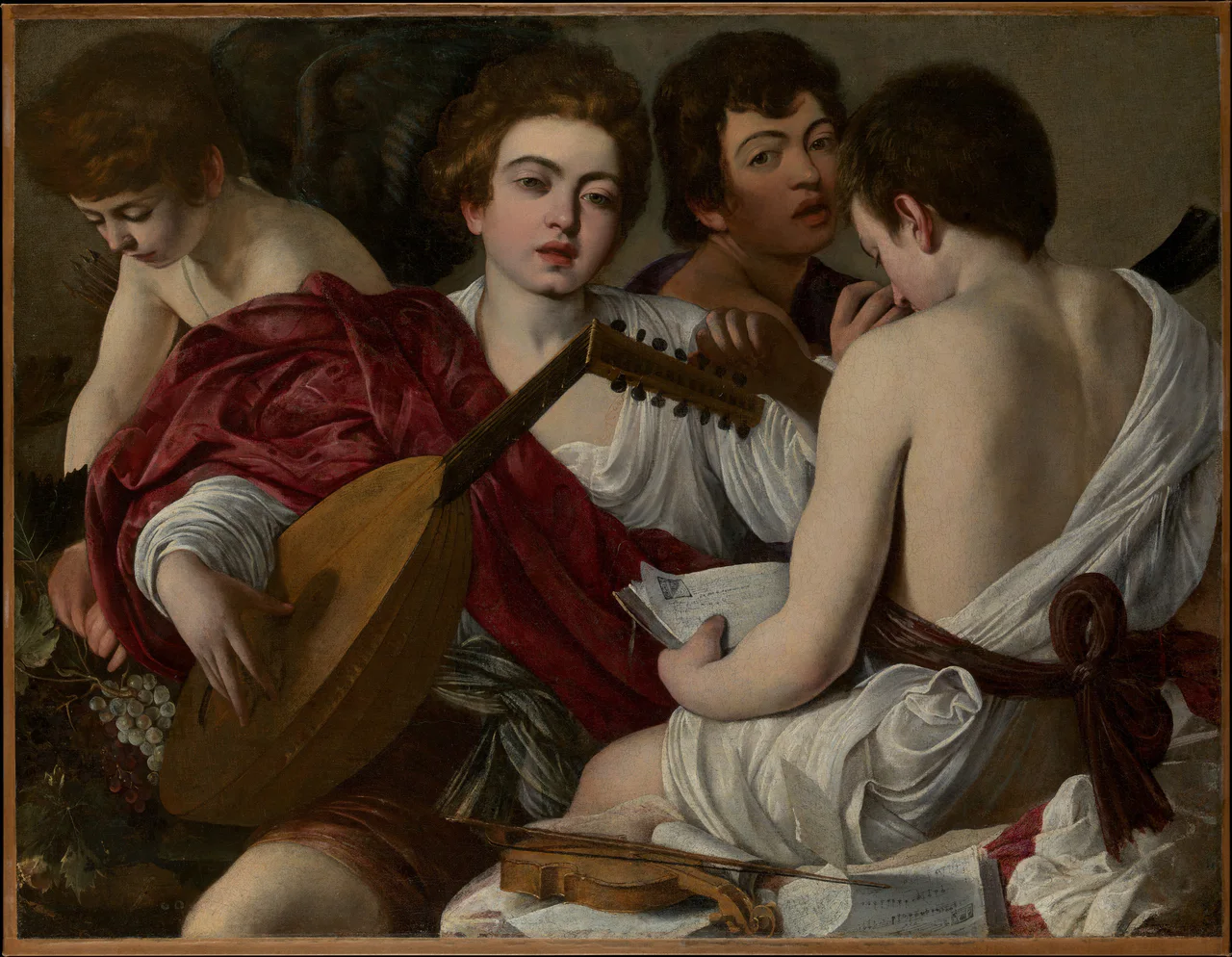
- Four boys crowd together, getting ready to make music: one holds a lute, one reads a score, one looks out at us, and a winged boy reaches for grapes.
- Caravaggio painted it in Rome in 1597.
- He left the background empty and pushed the figures right up to the front edge, so it feels as if we are sitting in on the rehearsal.
Reading the picture
5 places to look closer
Tap a number on the painting to jump to its note, or a close-up to see that spot in the whole picture.
Zoom in on the face of the lute player. His red lips are slightly parted, and the rims of his eyes look red and moist. His gaze is turned toward us, but it seems far away. Is he about to start singing, or already lost in the song?
Look at the boy behind him who turns his head to look at us. He has dark curls, heavy brows, and a half-open mouth. He sits a little deeper in the shadow than the others, so half his face is in darkness. Many scholars see this face as Caravaggio's own.
Zoom in on the lower left. A boy's hand reaches toward a bunch of grapes. Each pale green grape holds a point of white light, and a broad vine leaf hangs beside them. Now follow him up to his face. Dark wings rise behind his back, and a bundle of arrows pokes out beside his shoulder, just under his chin. He is Cupid, the god of love.
Zoom in on the paper held by the boy with his back to us. The score curves in his hand, with a square design and lines of writing near the top. Fine cracks run all over its surface, a reminder that this canvas is more than 400 years old.
Go down to the very bottom. A violin lies there with its bow. Its curled scroll is sharp and clear, and white cloth and sheet music spread out beside it. It looks as if someone is about to pick it up and join in.
When it was painted
In the early 1590s, Caravaggio arrived in Rome from Lombardy, barely past twenty and with very little to his name. He found work in the busy studio of the painter Giuseppe Cesari, where he was set to painting flowers and fruit. His luck turned when Cardinal Francesco Maria del Monte began buying his pictures.
The cardinal took the young painter into his own household at the Palazzo Madama in Rome. Caravaggio lived and worked there. Del Monte was a patron with a deep love of music, and this picture, painted when Caravaggio was about twenty-six, was made for him. In these years he painted several half-length pictures of young men with instruments or fruit.
Later, the painter Giovanni Baglione wrote a short life of Caravaggio. He recorded that Caravaggio painted for the cardinal a group of young musicians, done from life and done very well. That praise is worth noticing. In 1603 Baglione had taken Caravaggio to court for libel. Even a rival had to give this picture its due.
In 1599 Caravaggio won the commission for large paintings in the Contarelli Chapel of San Luigi dei Francesi, and Rome took notice. But he had a violent temper. In 1606 he killed a man in a fight and fled the city. He spent his last years on the run and died in 1610, at thirty-eight.
The painting had a rough road too. Del Monte died in 1627, and his collection was sold the following year. For a long time no one knew where the picture was. It was identified again only in 1952, and The Met bought it that same year.
Look once more at the boy who turns to face us. Across all that time, his eyes are still fixed on the same spot.
The painter
Caravaggio
1571–1610
When painting this, the artist was about 26 years old
All paintings by Caravaggio →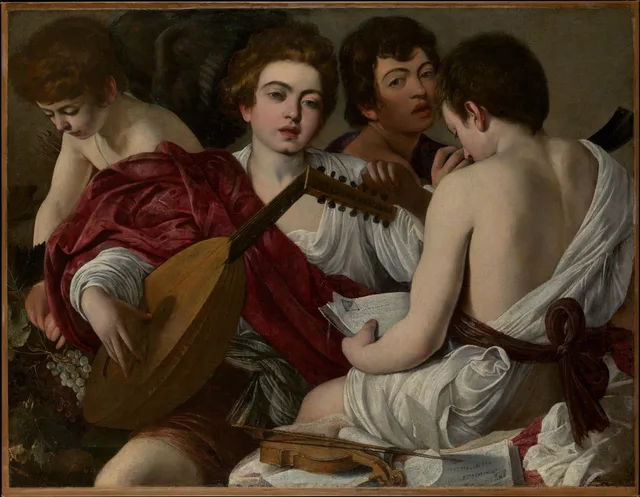
Questions to think about
- Look for itCan you find the lute, the violin, the sheet music, and the grapes in the picture?
- Why?Why do you think Caravaggio chose the moment of getting ready, rather than the performance itself?
- What about you?The music in this picture played only in one cardinal's private rooms. What would it take today for everyone to be able to enjoy good music and art?
Same period
Painted around the same time,
somewhere else
Too good to keep to yourself
This painting,
for someone who comes to mind
They open it at full size
and see every brushstroke.
About this work
- Artist
- Caravaggio · 1571–1610
- Date
- 1597
- Medium
- Oil on canvas
- Size
- 92.1 × 118.4 cm
- Collection
- The Metropolitan Museum of Art
- Image
- Original long edge 4000px · shown at 2560px
- Original
- View on the museum's website ↗