 Pyeongye
Artwork · 19th century · Carl Blechen
LeoTurn on Magnifier at the lower right and move slowly across the painting.
Full screen opens it edge to edge.Tap the painting to fill the screen.
Spread two fingers to look closer.
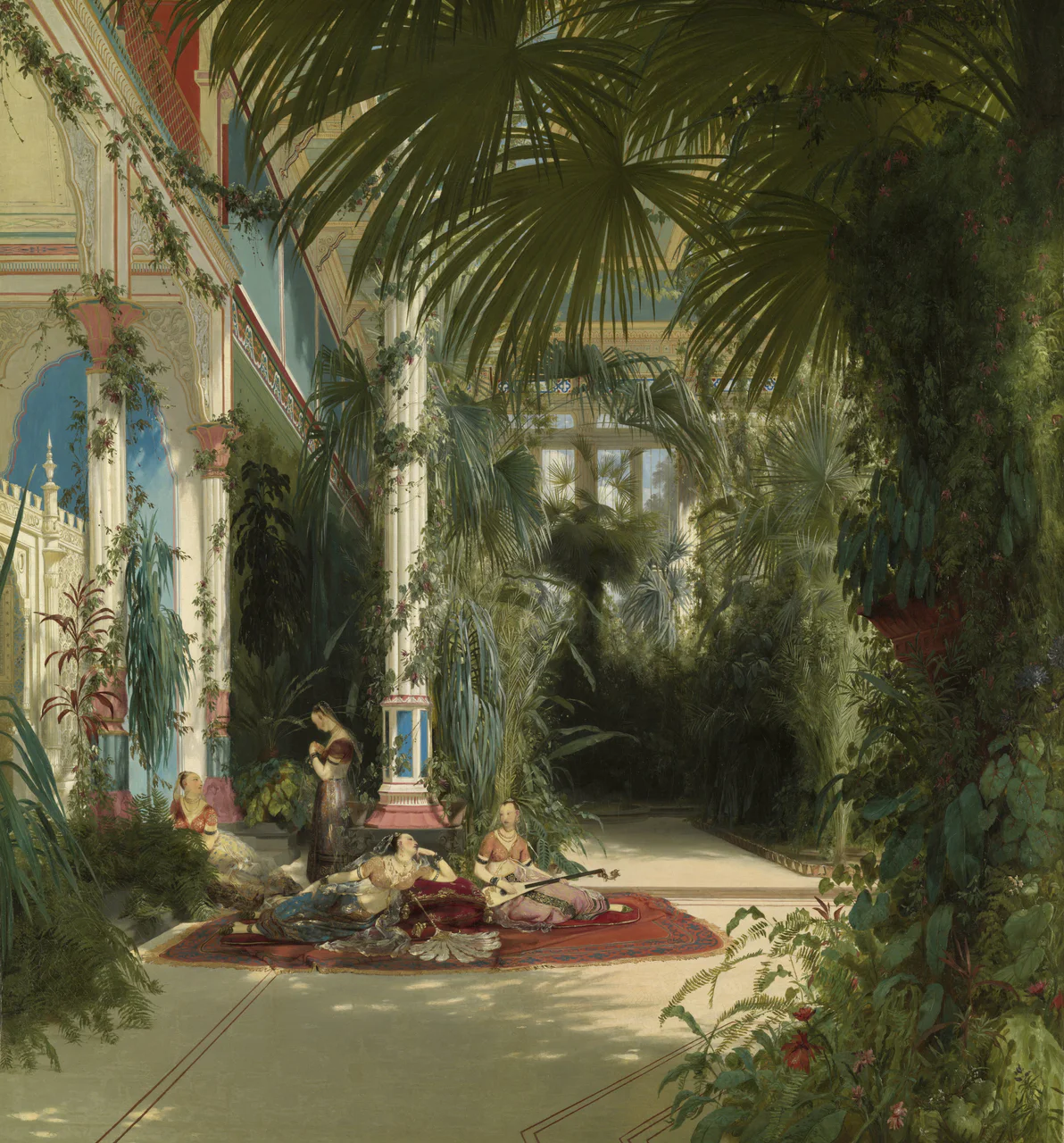
The Interior of the Palm House on the Pfaueninsel Near Potsdam
Carl Blechen1834Oil on canvas135 × 126 cm
At a glance
- The inside of a glass palm house on an island near Potsdam, Germany, where women lounge on a carpet beneath towering palms.
- The German painter Carl Blechen painted it in oil on canvas in 1834.
- On a canvas more than four feet tall, he recorded a royal greenhouse designed by Karl Friedrich Schinkel, down to single leaves. The building no longer exists.
Reading the picture
5 places to look closer
Tap a number on the painting to jump to its note, or a close-up to see that spot in the whole picture.
Zoom in on the carpet at the bottom center. One woman leans on a red cushion, propped on her elbow. Another rests a long-necked stringed instrument across her lap. A white feather fan lies on the rug. Their red, pink, and gold clothes pick up the colors and patterns of the building around them.
Look at the arch in the upper left. Its scalloped edge frames a patch of blue sky, and a pink, vase-shaped capital sits on top of the slender column. Vines climb that column and let red flowers hang down. Here it gets hard to tell where architecture ends and plants begin.
Zoom in on the base of the white column in the middle. It stands on an eight-sided pedestal set with blue panels, and vines wind up its shaft. To its left a woman stands with her head bowed and her hands gathered at her chest. A sheer veil falls from her hair to her shoulders.
Look deep into the room. Through tall windows you can see sky and the trees outside. In front of the glass, fan palms spread their leaves in layer after layer. This is the detail that tells you the jungle is indoors.
Drop down to the bushes at the lower right. Deep red and pink flowers bloom among the ferns. Even the sharp, split petals are picked out with the tip of the brush.
When it was painted
In 1830, King Frederick William III of Prussia bought a famous collection of palms from Paris on the advice of the naturalist Alexander von Humboldt. To house them, the Berlin architect Karl Friedrich Schinkel built a glass palm house on the Pfaueninsel, an island near Potsdam. It became the king's tropical garden under glass.
In 1832 the king asked Carl Blechen to paint the palm house as a pair of pictures. Blechen was in his mid-thirties and taught landscape painting at the Berlin Academy. He had started out as a bank clerk before turning to art, and he had painted stage scenery for a Berlin theater.
A trip to Italy around 1828 or 1829 changed his work. After the southern light, he developed a fluid touch for catching passing effects of light and air. You can see it in the scattered patches of sun on the floor here.
In 1834 this canvas hung in the Berlin Academy exhibition and was reviewed in the press. The Art Institute of Chicago notes that the women come from colonial-era European fantasies about non-European women, dressed almost as if they were part of the decor.
A few years later Blechen fell mentally ill, and he died in 1840 at forty-one. The palm house itself burned to the ground on a night in May 1880. The painting came to the Art Institute in 1996. Look again at the tall windows at the back. The light of a building that is gone now survives only on this canvas.
The painter
Carl Blechen
1798–1840
When painting this, the artist was about 36 years old
All paintings by Carl Blechen →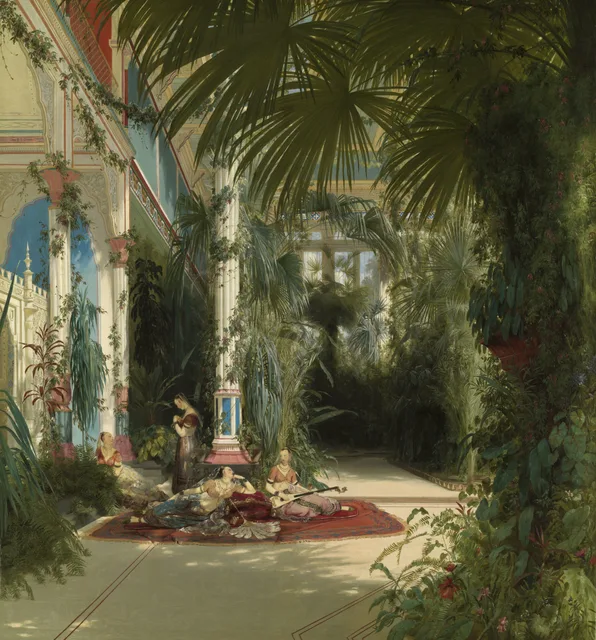
Questions to think about
- Look for itHow many women can you find in the picture, including any half hidden among the plants?
- Why?Why do you think Blechen placed these imagined women inside a real royal greenhouse?
- What about you?Critics point out that the women are painted almost as decoration. Have you noticed ads or videos today that use people from other cultures mainly as exotic background?
Same period
Painted around the same time,
somewhere else
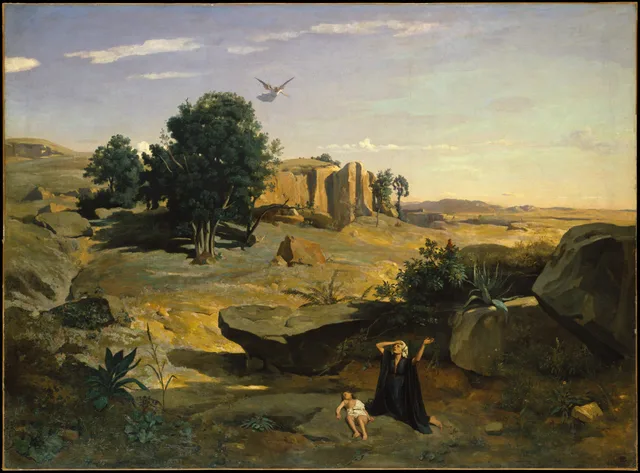 Hagar in the WildernessCamille Corot1835
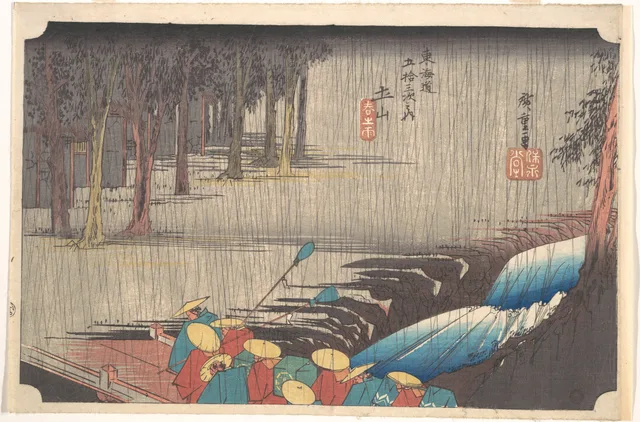 Spring Rain at Tsuchiyama, from the series Fifty-three Stations of the TōkaidōUtagawa Hiroshige1834–35
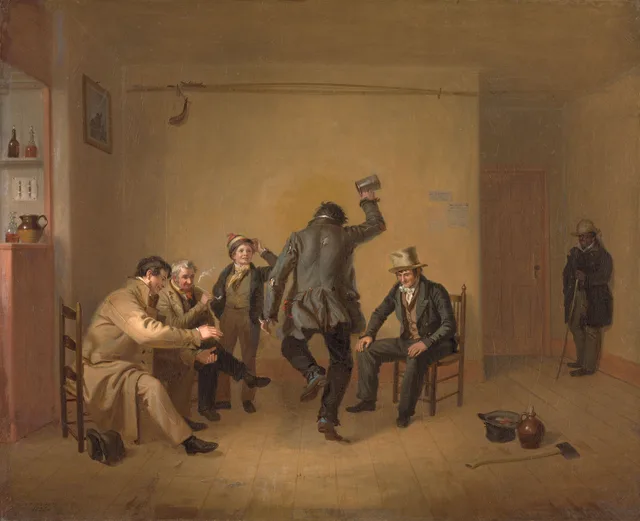 Bar-room SceneWilliam Sidney Mount1835
 Stoke-by-NaylandJohn Constable1836
 Diana and Actaeon (Diana Surprised in Her Bath)Camille Corot1836
 Saada, the Wife of Abraham Ben-Chimol, and Préciada, One of Their DaughtersEugène Delacroix1832
Too good to keep to yourself
This painting,
for someone who comes to mind
They open it at full size
and see every brushstroke.
About this work
- Artist
- Carl Blechen · 1798–1840
- Date
- 1834
- Medium
- Oil on canvas
- Size
- 135 × 126 cm
- Culture
- Germany
- Collection
- The Art Institute of Chicago
- Image
- Original long edge 6497px · shown at 2560px
- Original
- View on the museum's website ↗