 Pyeongye
Artwork · 19th century · Camille Corot
LeoTurn on Magnifier at the lower right and move slowly across the painting.
Full screen opens it edge to edge.Tap the painting to fill the screen.
Spread two fingers to look closer.
At a glance
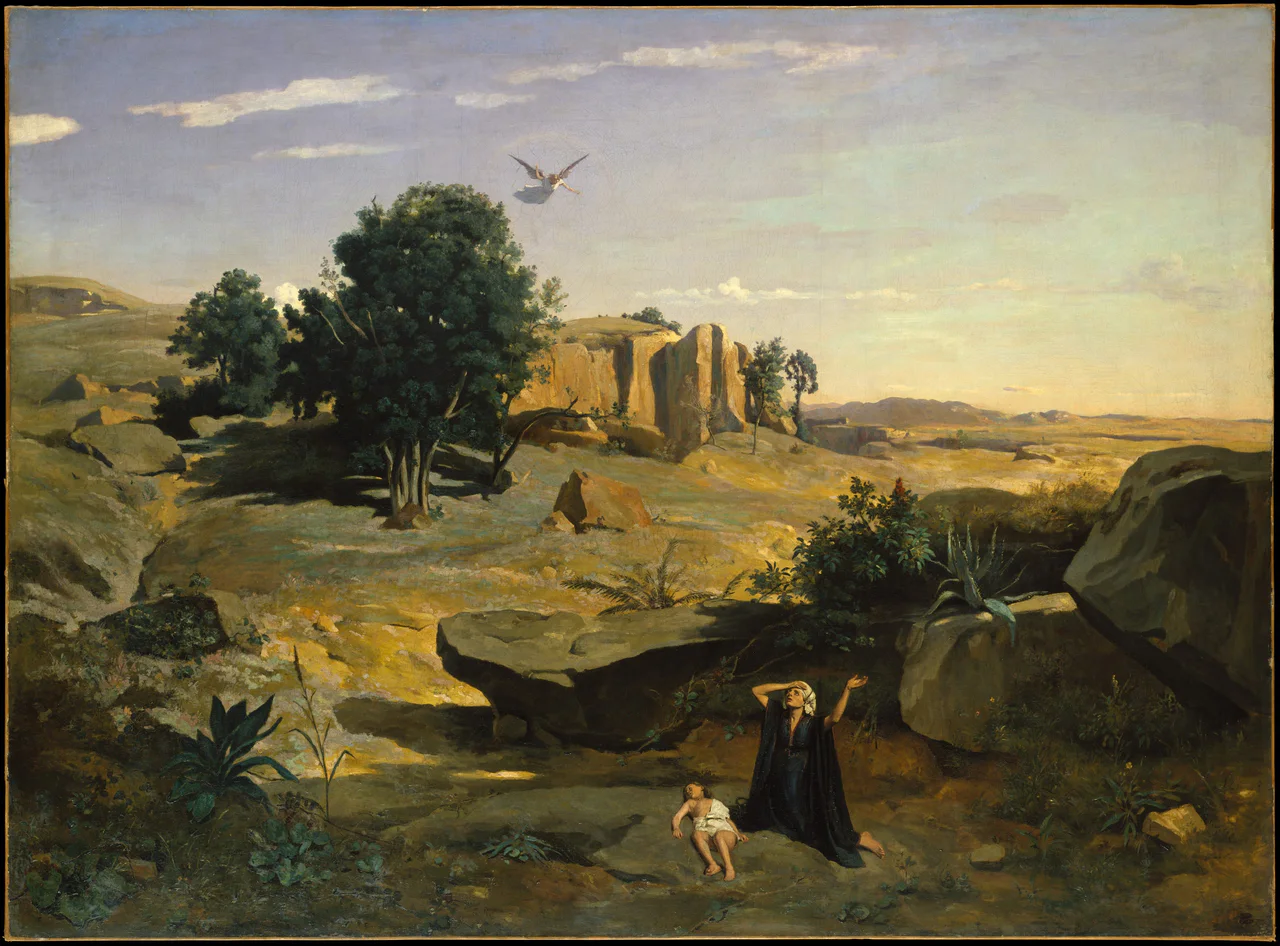
- In a dry, rocky wilderness, a woman kneels beside a collapsed child while an angel swoops down from the sky. It is the story of Hagar and Ishmael from the Book of Genesis.
- The French painter Camille Corot painted it in 1835.
- The canvas is more than 2.7 meters wide, yet the people in it are tiny. Rocks, trees and sunlight take up almost all the space.
Reading the picture
5 places to look closer
Tap a number on the painting to jump to its note, or a close-up to see that spot in the whole picture.
Zoom in on the lower right. Hagar, wrapped in a dark blue-black robe, presses one hand to her forehead and throws the other up toward the sky. Beside her, a boy in a white tunic lies on the bare ground with his eyes closed. This is her son Ishmael, worn out by thirst.
Now look up to the sky at the upper left. Just right of the big tree, an angel with spread wings glides down, one arm stretched forward. It is so small against all that sky that at first glance you might take it for a bird.
On the rock behind Hagar grows a single agave, its pointed leaves fanning out in every direction. Corot dotted the tiny spines along the leaf edges with bright touches of paint. A plant that survives without water tells you how dry this place is.
Zoom in on the cliffs in the middle distance. The yellow rock is split into vertical columns, and the sunlit faces and shaded faces are divided as cleanly as if cut with a knife. Only a few bushes cling to the top.
Look out to the horizon on the right. Yellow plains stretch away to low hills. The rocks and bushes in front are painted dark and sharp, the far plain pale and soft, and that difference opens up the distance.
When it was painted
In 1835, Corot was still a little-known landscape painter. As a young man he had worked in the cloth trade in Paris, as his father wished. Only at twenty-six did he start out as an artist, living on an allowance from his parents.
From 1825 to 1828 he stayed in Italy, painting the fields and hills around Rome outdoors, straight from what he saw. According to the Met, he reused an earlier tree study of his own in this big canvas. What he had learned outside found its way into a large picture made in the studio.
At the Paris Salon in those years, a landscape that told a story from the Bible or ancient myth ranked above a plain view of nature. So Corot chose a moment from Genesis. Abraham has sent Hagar away with her son. In the wilderness the water runs out, and she sits apart because she cannot bear to watch the boy die. Then an angel calls to her from heaven.
Corot sent this canvas to the Salon of 1835. The Met calls it the earliest of four large biblical paintings he showed at the Salon in the 1830s and 1840s. That year the magazine L'Artiste praised it.
About a century later, in 1938, the Met bought the painting through its Rogers Fund. Look again at Hagar's arm raised toward the sky. Between her hand and the angel there is still a wide stretch of empty air. Help is on the way, but Corot leaves that distance open.
The painter
Camille Corot
1796–1875
When painting this, the artist was about 39 years old
All paintings by Camille Corot →More by the same painter
Questions to think about
- Look for itBesides the agave, what other plants can you find growing near the rock where Hagar kneels?
- Why?Why do you think Corot painted the angel so small, and so far from Hagar?
- What about you?Hagar was sent away and left alone in the desert with her child and no water. When a mother and child suddenly lose everything they relied on today, what kind of well can a community be for them?
Same period
Painted around the same time,
somewhere else
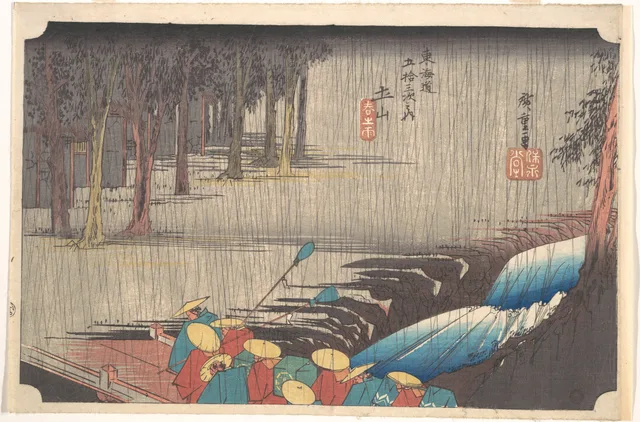 Spring Rain at Tsuchiyama, from the series Fifty-three Stations of the TōkaidōUtagawa Hiroshige1834–35
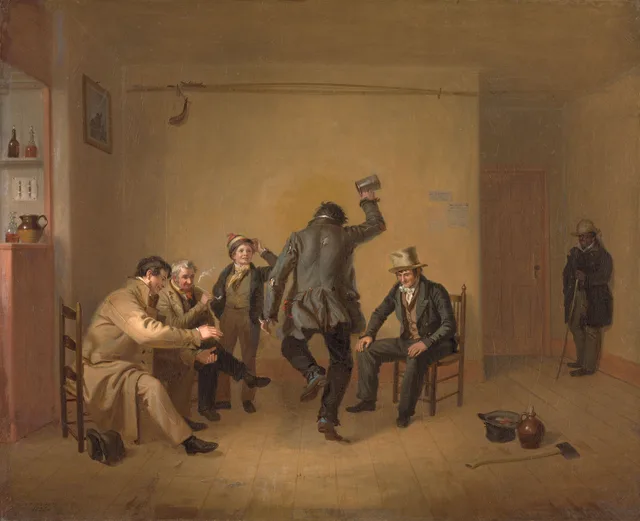 Bar-room SceneWilliam Sidney Mount1835
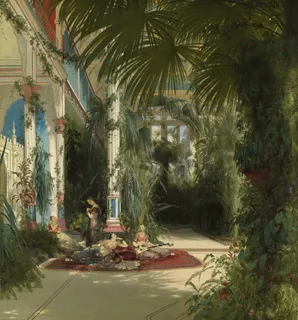 The Interior of the Palm House on the Pfaueninsel Near PotsdamCarl Blechen1834
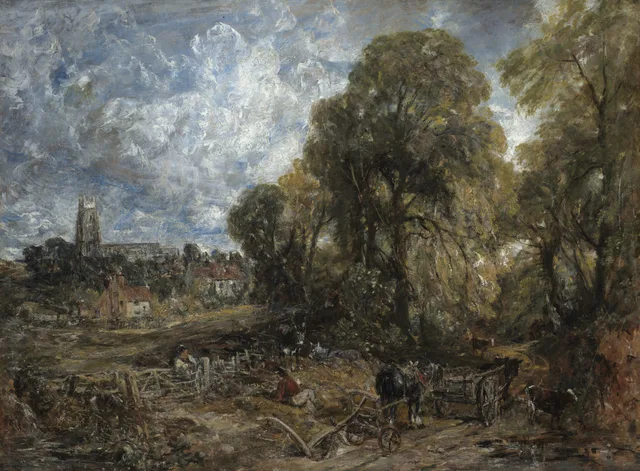 Stoke-by-NaylandJohn Constable1836
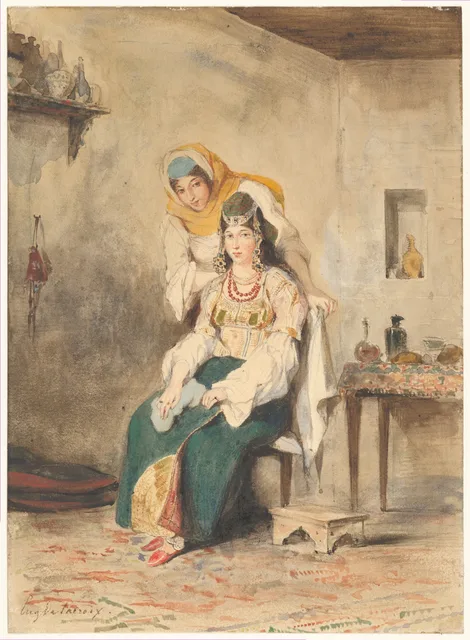 Saada, the Wife of Abraham Ben-Chimol, and Préciada, One of Their DaughtersEugène Delacroix1832
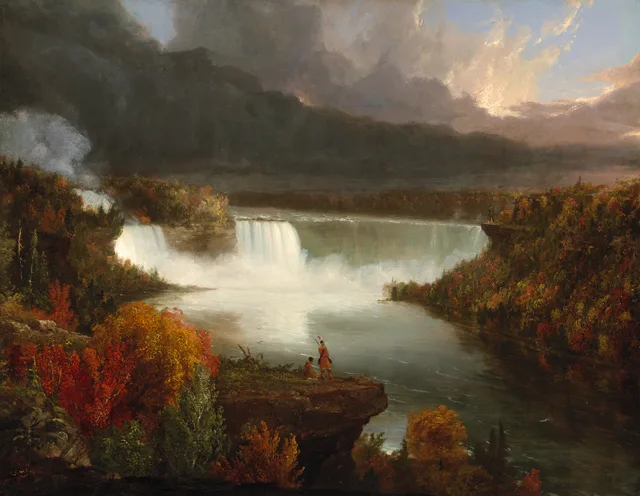 Distant View of Niagara FallsThomas Cole1830
Too good to keep to yourself
This painting,
for someone who comes to mind
They open it at full size
and see every brushstroke.
About this work
- Artist
- Camille Corot · 1796–1875
- Date
- 1835
- Medium
- Oil on canvas
- Size
- 180.3 × 270.5 cm
- Collection
- The Metropolitan Museum of Art
- Image
- Original long edge 3811px · shown at 2560px
- Original
- View on the museum's website ↗