 Pyeongye
Artwork · 19th century · Thomas Cole
LeoTurn on Magnifier at the lower right and move slowly across the painting.
Full screen opens it edge to edge.Tap the painting to fill the screen.
Spread two fingers to look closer.
At a glance
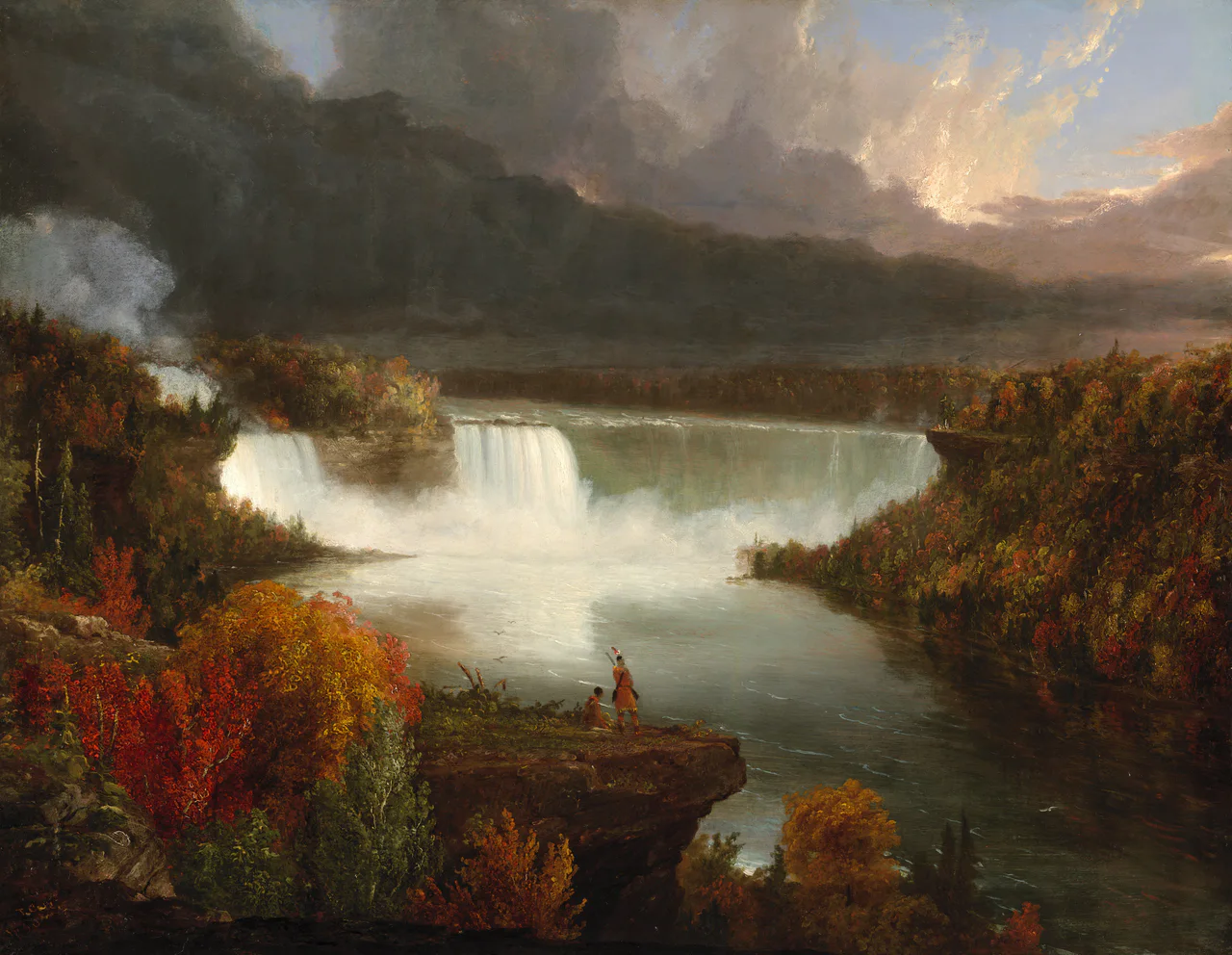
- Niagara Falls throws up white spray beyond a blazing autumn forest, while two Native American figures stand and sit at the edge of a cliff.
- Thomas Cole, an English-born painter working in America, visited the falls in May 1829 and painted this on a wood panel the following year, 1830.
- What makes it worth a long look is what is missing: the factories, hotels, and lookout points that already crowded the falls in his day.
Reading the picture
5 places to look closer
Tap a number on the painting to jump to its note, or a close-up to see that spot in the whole picture.
Zoom in on the two people at the end of the cliff. One stands in orange clothing with an arm raised high; the other sits close by on the grass. A row of yellow fringe hangs from the hem of the standing figure's garment. Against the whole view, they are no bigger than a fingertip.
Move to the falls in the center. The water slides over the long rim and drops like a white curtain. At the bottom it boils up into spray that blurs the line between river and sky. Notice the pale green Cole used for the water just above the edge.
Look to the upper left. A tall column of white rises over the trees and melts into the dark clouds. It is the mist thrown up by the falls. Cole dragged a fairly dry brush across the panel here, so the mist has a rough, scratchy texture.
Now the trees at the lower left. Crimson, orange, and yellow leaves are set down one small dab at a time. Between them, thin white branches are drawn in quick strokes. The Art Institute describes the scene as autumnal, and this corner is where you feel it most.
End in the upper right sky. On the left, a heavy storm cloud hangs over the forest. Here, under patches of blue, the clouds catch the sun and glow, painted with thicker strokes of light paint. Dark and light meet in the same sky.
When it was painted
In May 1829, Thomas Cole, twenty-eight years old, went to see Niagara Falls. He had been born in Lancashire, England, and came to the United States with his family as a teenager in 1818. A few years before this trip, his paintings of the Hudson River valley had suddenly made his name.
That break came through a shop window. In 1825, the painter John Trumbull saw Cole's landscapes for sale in a New York shop and bought one. Two other artists, Asher B. Durand and William Dunlap, bought the rest. A young unknown was suddenly the talk of New York's painters.
The month after he saw Niagara, Cole sailed for Europe. He wanted to see the old masters in England and Italy with his own eyes, and he did not come home until 1832. He finished this painting in 1830, while that trip was underway.
By then the land around the falls was already busy with mills, hotels, and viewing platforms for tourists. Cole left all of it out. Years later he wrote an essay on American scenery in which he mourned the forests being cut down for profit.
The Art Institute points out another absence. This was the homeland of Haudenosaunee and other Native nations. The museum notes that painting Native people so small, and only two of them, fed the false idea that they were a vanishing people, rather than nations whose land had been taken.
The painting entered the Art Institute in 1946. Look again at the two figures on the cliff. The falls they gaze at is a Niagara with no hotels and no mills, made only from what the painter chose to keep.
The painter
Thomas Cole
1801–1848
When painting this, the artist was about 29 years old
All paintings by Thomas Cole →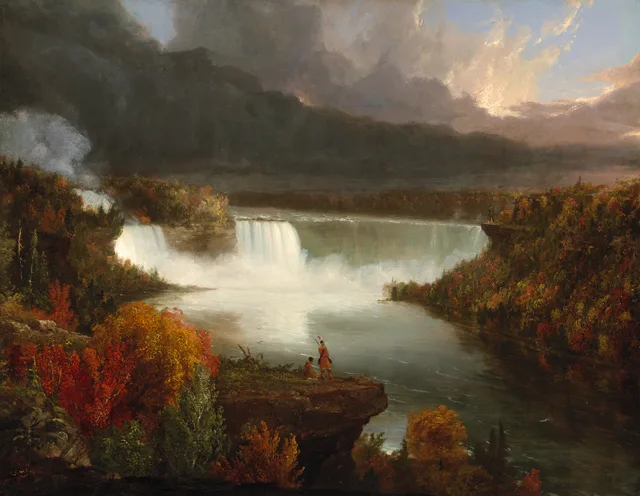
Questions to think about
- Look for itCan you find the small birds flying over the water below the falls?
- Why?Why do you think Cole chose to leave out the hotels and mills that were really there?
- What about you?We often edit power lines, signs, and other tourists out of our travel photos. How much of a place's real story does a cleaned-up picture still tell?
Same period
Painted around the same time,
somewhere else
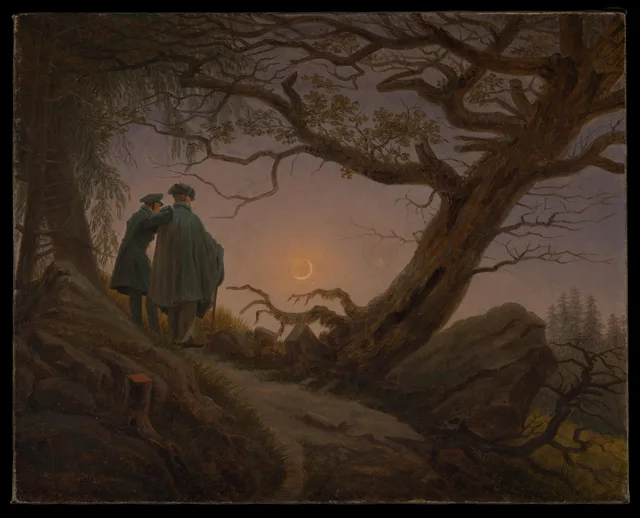 Two Men Contemplating the MoonCaspar David Friedrichca. 1825–30
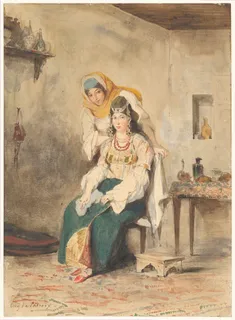 Saada, the Wife of Abraham Ben-Chimol, and Préciada, One of Their DaughtersEugène Delacroix1832
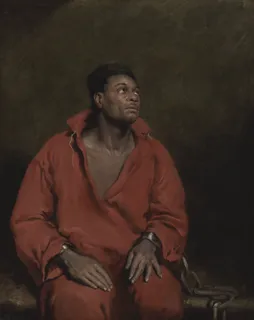 The Captive Slave (Ira Aldridge)John Philip Simpson1827
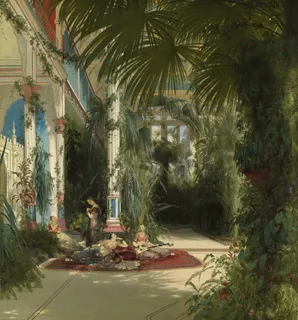 The Interior of the Palm House on the Pfaueninsel Near PotsdamCarl Blechen1834
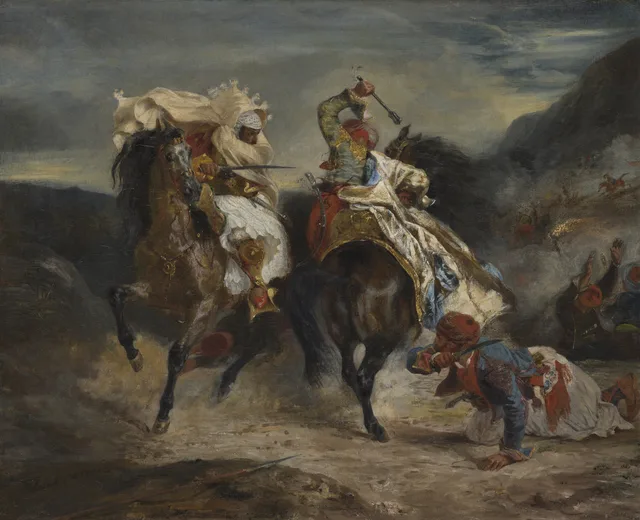 The Combat of the Giaour and HassanEugène Delacroix1826
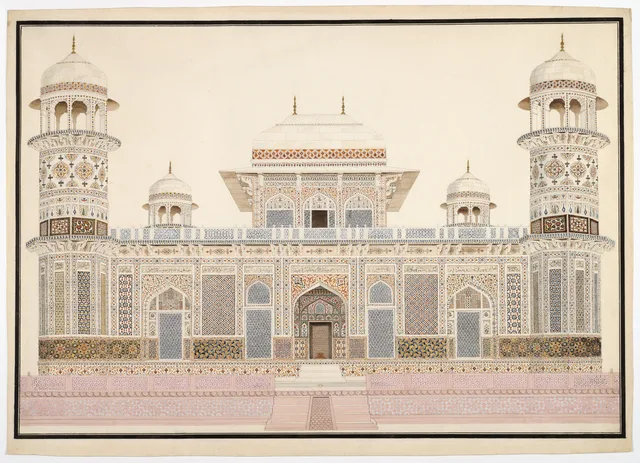 I'timad-ud-Daula's Tomb at AgraUnknown artist · Indiac. 1820
Too good to keep to yourself
This painting,
for someone who comes to mind
They open it at full size
and see every brushstroke.
About this work
- Artist
- Thomas Cole · 1801–1848
- Date
- 1830
- Medium
- Oil on wood panel
- Size
- 47.9 × 60.6 cm
- Culture
- Niagara Falls
- Collection
- The Art Institute of Chicago
- Image
- Original long edge 10490px · shown at 2560px
- Original
- View on the museum's website ↗