 Pyeongye
Artwork · 16th century · Antonio da Correggio
LeoTurn on Magnifier at the lower right and move slowly across the painting.
Full screen opens it edge to edge.Tap the painting to fill the screen.
Spread two fingers to look closer.
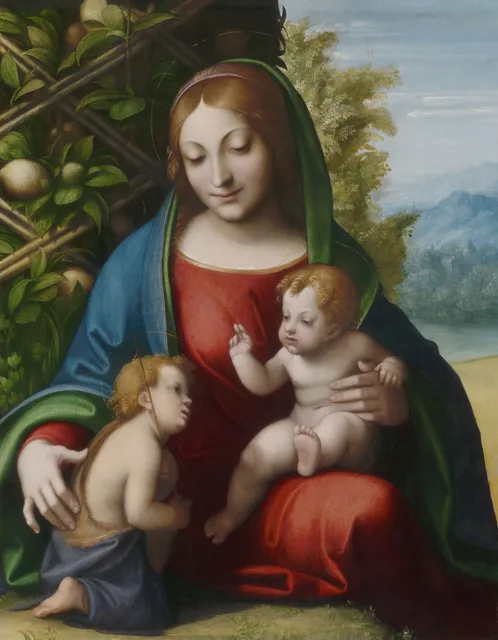
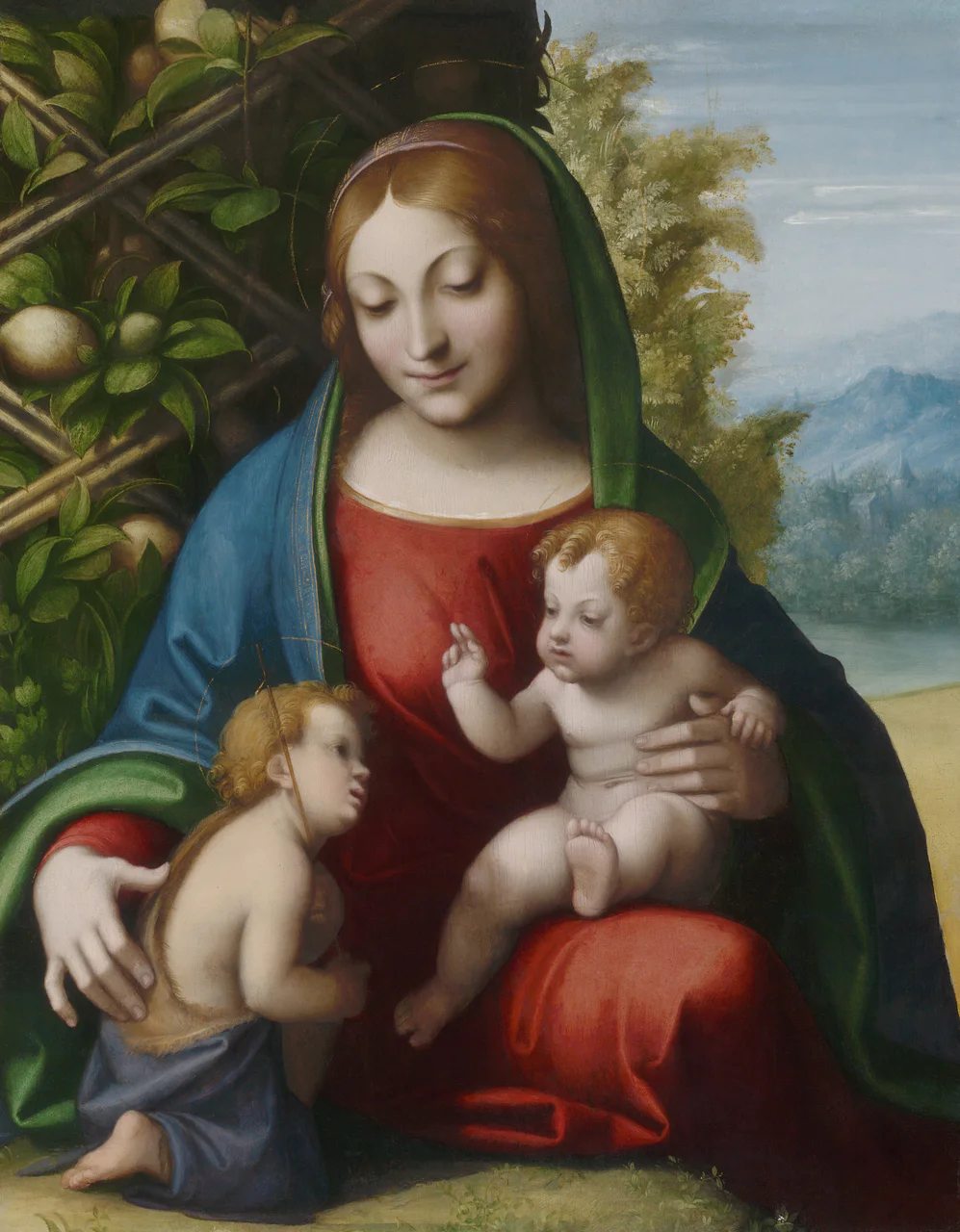
Virgin and Child with the Young Saint John the Baptist
Antonio da Correggioc. 1515Oil on panel64.2 × 50.2 cm
At a glance
- The Virgin, in a red dress and blue mantle, holds the Christ Child on her lap and reaches around the young John the Baptist, who presses in from the left.
- Antonio da Correggio, a painter from northern Italy, made it early in his career, around 1515, in oil on a wooden panel.
- It packs a lot into a small space: a triangle of figures, soft melting outlines, and gestures of real tenderness.
Reading the picture
5 places to look closer
Tap a number on the painting to jump to its note, or a close-up to see that spot in the whole picture.
Zoom in on Mary's face. Her eyelids are half lowered, and the corners of her mouth lift only slightly. There is no hard line where face meets hair; the shadows drift like smoke. The Art Institute notes that this mysterious smile recalls Leonardo da Vinci.
Look at the Christ Child's raised hand. Two fingers point up while the others fold down, the gesture of blessing you see again and again in pictures of Christ. Even so, it is unmistakably a baby's hand, with a soft crease of fat at the wrist.
Drop down to John at the lower left. The curly-haired boy tilts his head back to gaze up at the baby, and a thin staff runs diagonally past his shoulder. Around his waist he wears an animal skin, the sign of the grown-up John who would live in the wilderness.
Move to the trellis in the upper left. Wooden poles cross to make a lattice, and dark green leaves and round fruit hang between them. Light falls on the fruit from one side, so each one swells out of the shadow.
Finally, look into the distance on the right. Blue mountains rise through haze, and below them, among trees, are faint buildings with pointed towers. The museum sees in this landscape Correggio's knowledge of Northern European painting.
When it was painted
Around 1515, Correggio was about twenty-six. He took his name from his hometown, Correggio, a small town in northern Italy. It was a long way from the great art cities of Rome, Florence, and Venice.
That did not stop him from learning. The Art Institute points out that the triangle of figures recalls Raphael, while the soft outlines and Mary's smile recall Leonardo. What belongs to Correggio alone, the museum adds, is the warmth the three figures show one another.
In these years he landed a big job at home. In 1514 he was commissioned to paint a large altarpiece for the church of San Francesco in Correggio; that picture is now in Dresden. This panel is very different: small enough to hold close, the kind of image the museum describes as made for private devotion.
A few years later he moved to the nearby city of Parma, where he did his life's work. From 1526 to 1530 he painted the dome of Parma Cathedral with the Virgin rising into heaven. The museum sees the peaceful mood of this little panel as a preview of those radiant ceilings. Correggio died in 1534, at about forty-five.
The panel traveled a long road. In 1815 it appeared in a Paris catalogue of the collection of Massias, a former French diplomat at Karlsruhe. In 1965 it came to the Art Institute, and the next year Time magazine and several art journals wrote about Chicago's new Correggio.
Look once more at Mary's right hand at the lower left. Her long fingers curve around John's back, holding the boy close to his cousin.
Questions to think about
- Look for itCan you find the very thin gold rings drawn above the figures' heads?
- Why?Why do you think Correggio painted Mary with her eyes lowered, almost closed?
- What about you?Young Correggio mixed what he learned from Raphael and Leonardo into a style of his own. Where is the line between learning from someone else's work and simply copying it?
Same period
Painted around the same time,
somewhere else
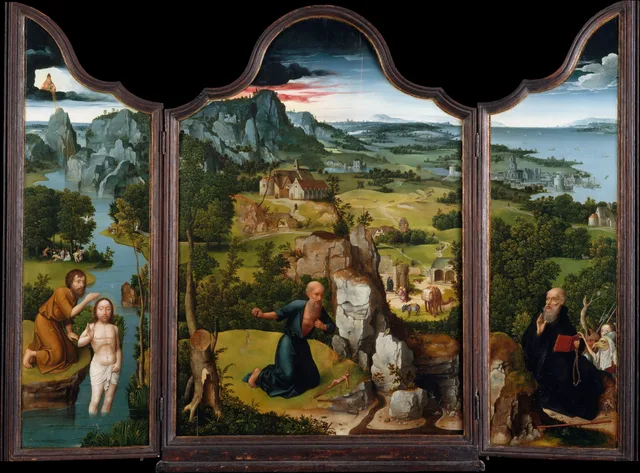 The Penitence of Saint JeromeJoachim Patinirca. 1515
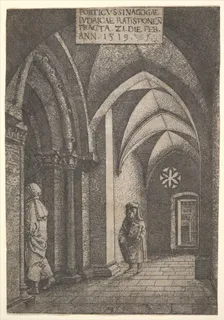 The Entrance Hall of the Regensburg SynagogueAlbrecht Altdorfer1519
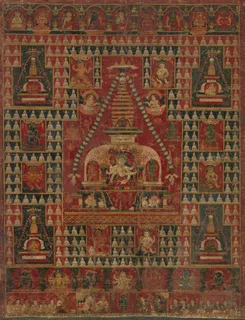 Ushnishavijaya Enthroned in the Womb of a StupaUnknown artist · Nepaldated 1510–19
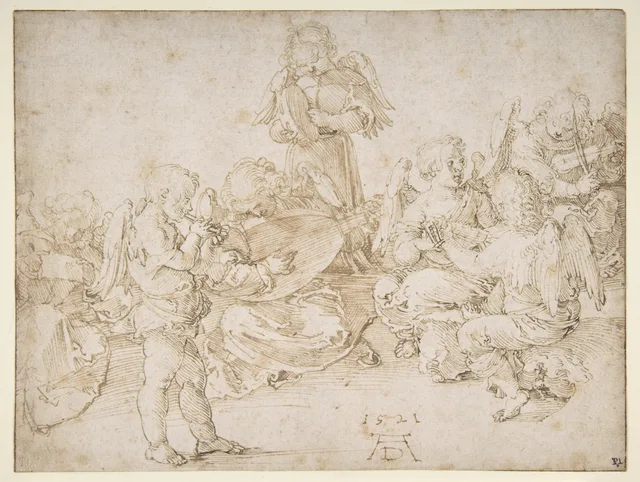 Music-Making AngelsAlbrecht Dürer1521
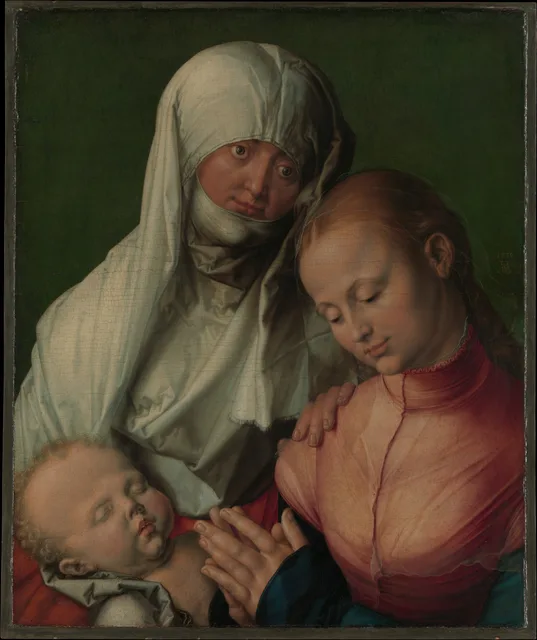 Virgin and Child with Saint AnneAlbrecht Dürerprobably 1519
 Head of a Young WomanAlbrecht Dürer1522
Too good to keep to yourself
This painting,
for someone who comes to mind
They open it at full size
and see every brushstroke.
About this work
- Artist
- Antonio da Correggio · 1489–1534
- Date
- c. 1515
- Medium
- Oil on panel
- Size
- 64.2 × 50.2 cm
- Culture
- Italy
- Collection
- The Art Institute of Chicago
- Image
- Original long edge 5096px · shown at 2560px
- Original
- View on the museum's website ↗