 Pyeongye
Artwork · 16th century · Joachim Patinir
LeoTurn on Magnifier at the lower right and move slowly across the painting.
Full screen opens it edge to edge.Tap the painting to fill the screen.
Spread two fingers to look closer.
At a glance
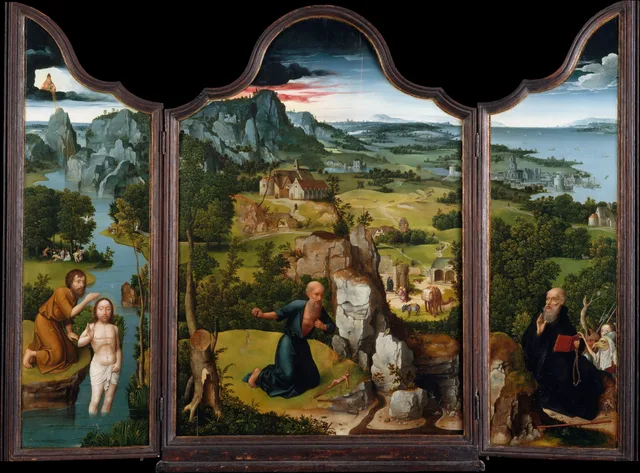
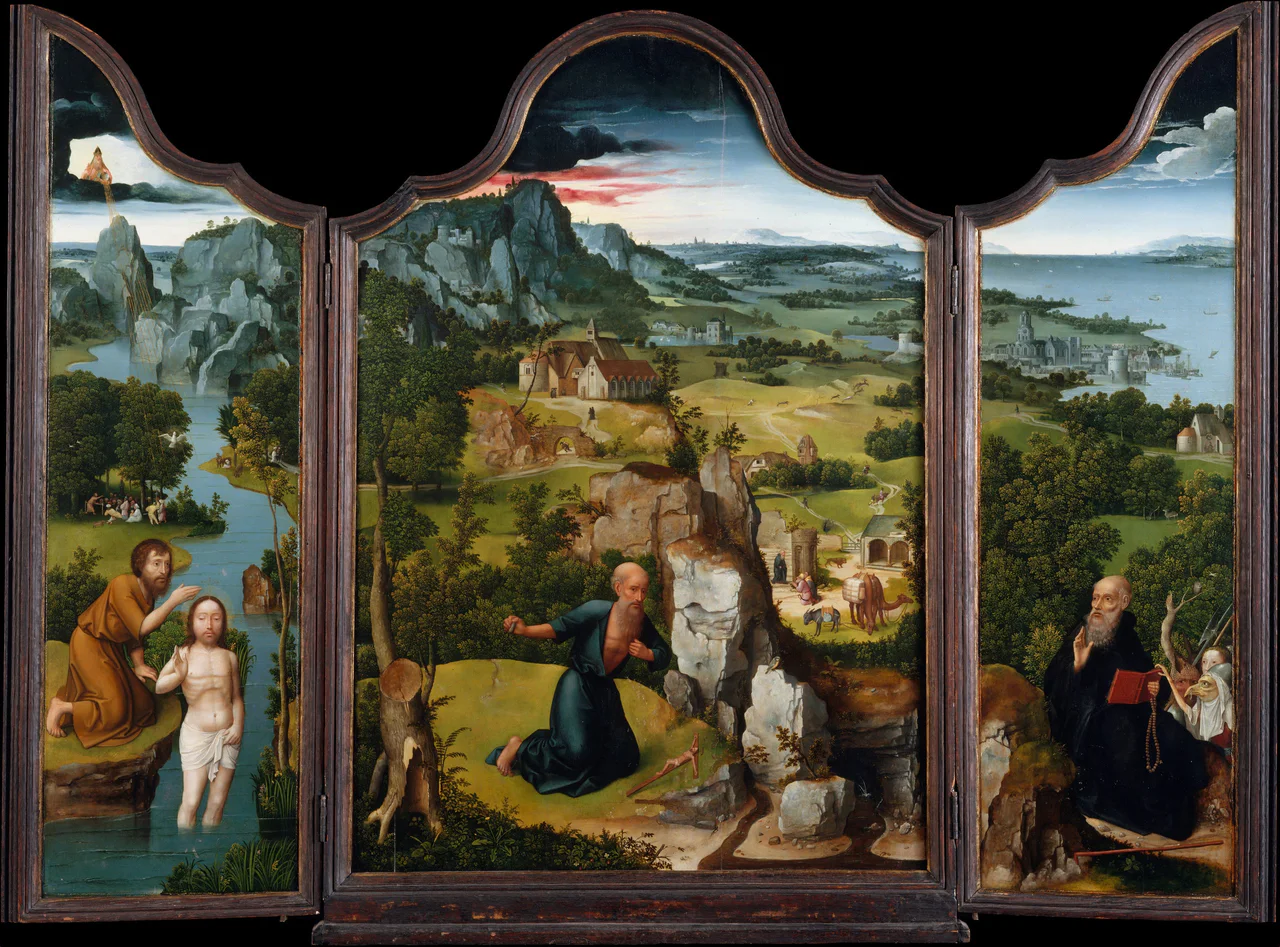
- The center panel shows Saint Jerome kneeling beside a rock; the wings show the Baptism of Christ and Saint Anthony surrounded by demons.
- Joachim Patinir, a painter in Antwerp, made this three-part altarpiece in oil on wood around 1515.
- The saints are small and the world around them is huge. You can wander through it for a long time, spotting a castle, a camel, and a few swans.
Reading the picture
5 places to look closer
Tap a number on the painting to jump to its note, or a close-up to see that spot in the whole picture.
Zoom in on the old man in the center panel. This is Saint Jerome. His robe is pulled open to bare his chest, and a small crucifix leans in the ground in front of him. He is repenting in the wilderness, praying over his past wrongs.
Now look behind him to the right. Loaded camels and a donkey stand in a yard, and merchants kneel before a monk. A lion walks near the gate. This is a scene from Jerome's legend: his lion tracked down the monastery's stolen donkey in a merchants' caravan and drove the whole group back home.
Look up at the far landscape. There is a castle ringed by a moat with white swans on the water, and beyond it a city full of spires. Patinir painted the near ground brown and green and made everything bluer as it goes back, so the view seems to stretch on forever.
Zoom in on the top of the left wing. God the Father, wearing a crown, looks down through a gap in the clouds, and golden rays pour down from him. Below, at the riverbank, John the Baptist is baptizing Christ.
In the right wing, Saint Anthony in a black habit holds a red book and a string of prayer beads. Behind him crowd a bird-headed monster and figures carrying spears. The saint does not turn around. He simply raises one hand.
When it was painted
In 1515 a new name went into the books of the painters' guild in Antwerp: Joachim Patinir. He came from the Meuse valley, from the small town of Dinant or nearby Bouvignes, and nobody recorded the year he was born. This altarpiece belongs to those first years after he became a master.
Antwerp at the time was a port packed with ships and merchants from all over Europe, and there were plenty of buyers for pictures. Painters often worked together. Patinir was close to the well-known painter Quentin Massys, and the two even shared at least one panel, with Massys painting the figures and Patinir the landscape.
Around Dinant, steep rock cliffs line the river Meuse. Many scholars think the strange, towering rocks in Patinir's paintings grew out of the landscape he knew from home.
In 1520 the German artist Albrecht Dürer arrived in Antwerp and stayed for months. In his travel diary he called Patinir a good landscape painter. The next year Dürer went to Patinir's wedding as a guest, and he noted in the same diary that he had drawn Patinir's portrait.
Patinir did not have much time left. He died in Antwerp in 1524, and Massys became the guardian of his young daughters. Centuries later, in 1936, this altarpiece entered The Metropolitan Museum of Art in New York.
Look at the center panel once more. Right beside the kneeling Jerome, a pale rock shoots up like a pillar. Follow the crags over into the left wing, and you can see why Dürer remembered him as a landscape painter.
Questions to think about
- Look for itCan you find one lion and two camels in the background of the center panel?
- Why?Why do you think Patinir painted the saint so small and gave the landscape so much room?
- What about you?Jerome has left other people behind to think about his own mistakes. Do those of us with busy lives also need quiet time alone to look back on ourselves?
Same period
Painted around the same time,
somewhere else
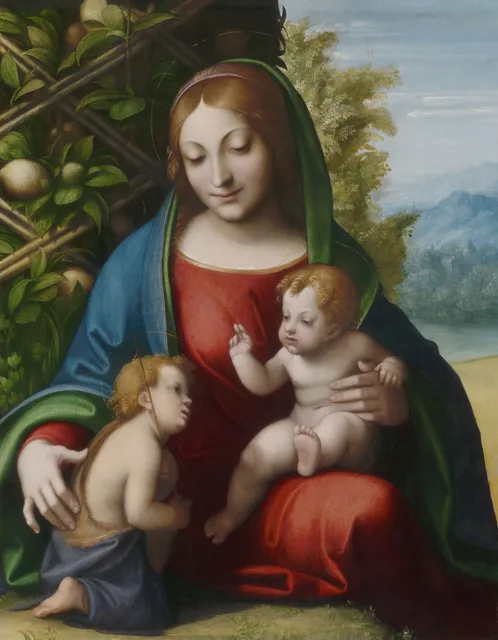 Virgin and Child with the Young Saint John the BaptistAntonio da Correggioc. 1515
 The Entrance Hall of the Regensburg SynagogueAlbrecht Altdorfer1519
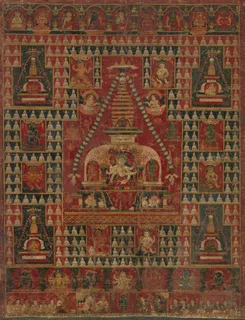 Ushnishavijaya Enthroned in the Womb of a StupaUnknown artist · Nepaldated 1510–19
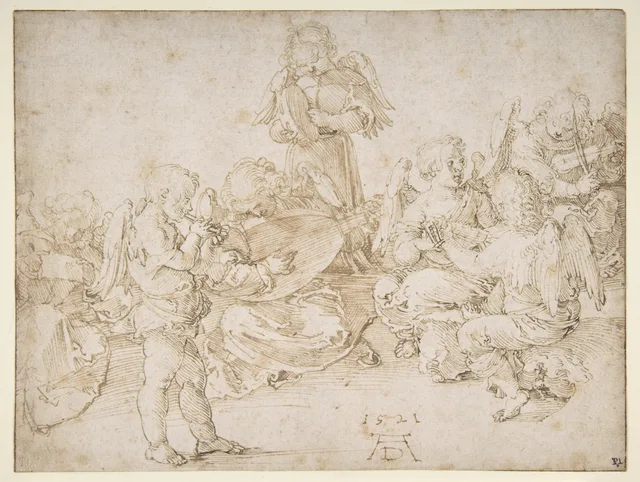 Music-Making AngelsAlbrecht Dürer1521
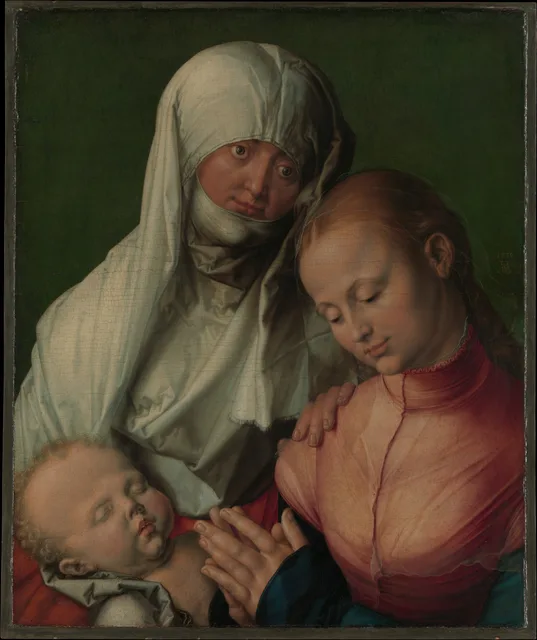 Virgin and Child with Saint AnneAlbrecht Dürerprobably 1519
 Head of a Young WomanAlbrecht Dürer1522
Too good to keep to yourself
This painting,
for someone who comes to mind
They open it at full size
and see every brushstroke.
About this work
- Artist
- Joachim Patinir · 1515–1524
- Date
- ca. 1515
- Medium
- Oil on wood
- Size
- 117.5 × 81.3 cm
- Collection
- The Metropolitan Museum of Art
- Image
- Original long edge 3811px · shown at 2560px
- Original
- View on the museum's website ↗