 Pyeongye
Artwork · 16th century · Albrecht Dürer
LeoTurn on Magnifier at the lower right and move slowly across the painting.
Full screen opens it edge to edge.Tap the painting to fill the screen.
Spread two fingers to look closer.
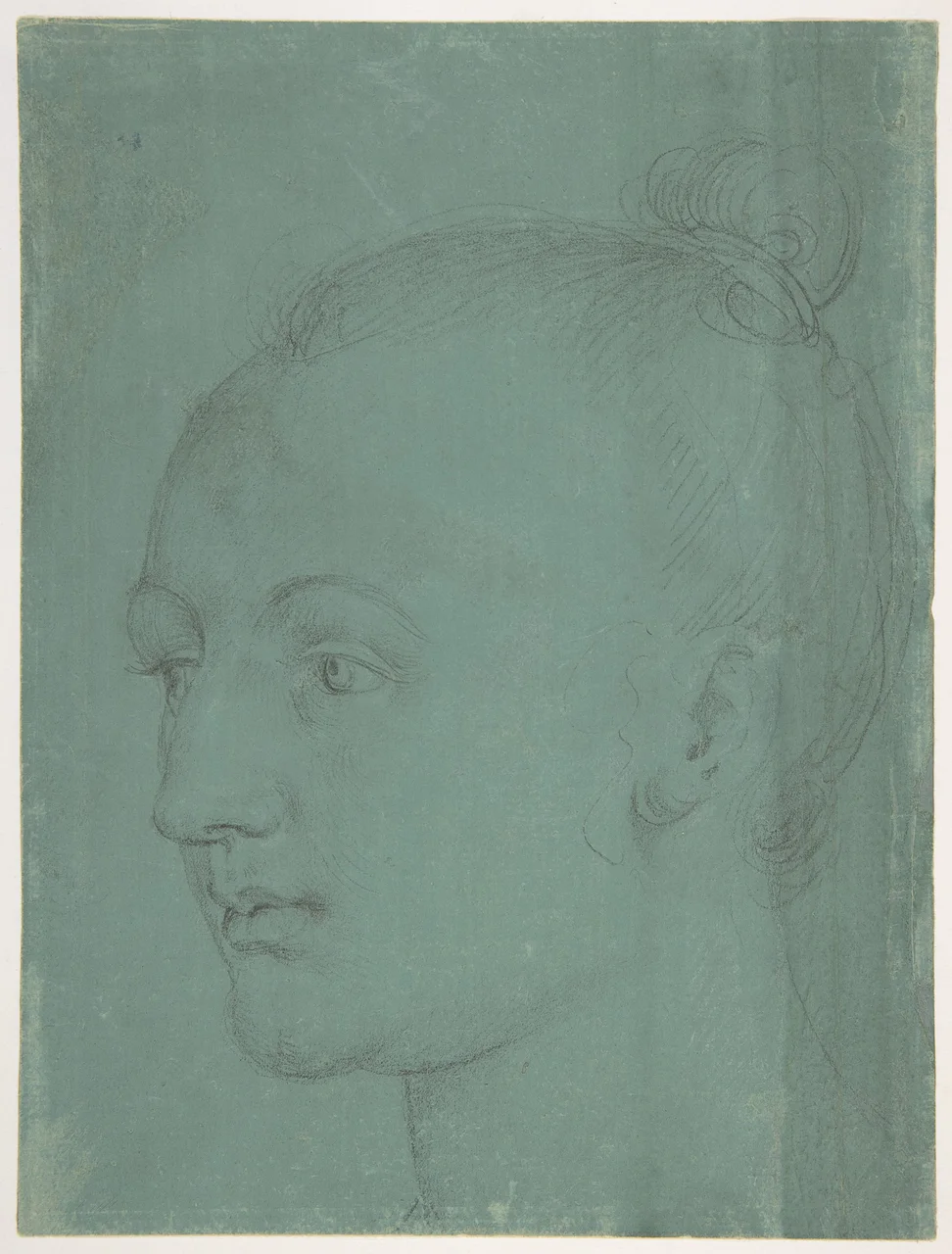
Head of a Young Woman
Albrecht Dürer1522Black chalk highlighted with white chalk (abraded) on green prepared paper.20 × 15.1 cm
At a glance
- A young woman with her hair pinned up turns her head to look toward the left, drawn large on the sheet.
- Albrecht Dürer of Nuremberg made it in 1522 in black chalk on paper prepared with a green coating.
- On a sheet only 20 cm tall, fine chalk lines capture even the fold of an eyelid and the fullness of a lip.
Reading the picture
4 places to look closer
Tap a number on the painting to jump to its note, or a close-up to see that spot in the whole picture.
Zoom in on the nearer eye. The upper lid is drawn as a double curve, and only the top of the iris is shaded dark. Above it, the brow is a row of short slanting strokes. Under the eye, layers of fine curved lines make the cheek seem to swell.
Look at the tip of the nose and the lips. Dürer pressed the chalk hard only under the nostril and along the line where the lips meet. A short shadow under the lower lip pushes it forward, so it looks full. The rest of the skin is simply the green of the paper.
Find the ear beyond the cheek. Its inner curves are marked with just a few dark touches, and curly hair spills down below it. Here and there on the green you can still see faint traces of white chalk. Dürer once used white to pick out the highlights, but most of it has rubbed away over the centuries.
Look at the top right, at the crown of her head. The pinned-up hair is wound into a series of round loops. The face is drawn with great care, while the hair is finished with a few quick, looping lines. You can see where Dürer chose to spend his time.
When it was painted
In 1522 Dürer was fifty-one. He had only recently come home to Nuremberg after more than a year on the road. By then his prints had made his name known across Europe.
That long trip began, of all things, with money. When Emperor Maximilian I died in 1519, the yearly pension he had granted Dürer was suddenly in doubt. So in the summer of 1520 Dürer set off for the Netherlands with his wife, Agnes. He went as far as Aachen for the coronation of the new emperor, Charles V, and that autumn his pension was confirmed.
All along the way he kept a diary. He wrote down what he spent, what gifts he received, and whom he met. He drew faces wherever he went, including the scholar Erasmus. He even traveled to Zeeland to see a whale that had washed ashore, only to find the tide had carried it away before he arrived.
The journey had a cost. A fever he caught on the trip troubled him for the rest of his life. He died in Nuremberg in 1528, six years after making this drawing.
The sheet later crossed the Atlantic. It belonged to the New York banker Robert Lehman, and it came to the Metropolitan Museum in 1975 with the rest of his collection. No one knows who the young woman was.
Look at her again. The white chalk has almost worn away, but the small shadow under her lower lip is still crisp. It is the same hand that had drawn face after face in strange cities, still at work after coming home.
The painter
Albrecht Dürer
1471–1528
When painting this, the artist was about 51 years old
All paintings by Albrecht Dürer →More by the same painter
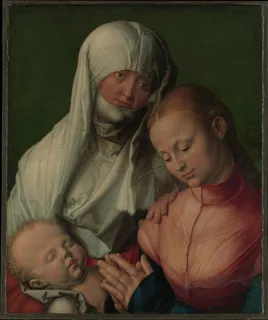
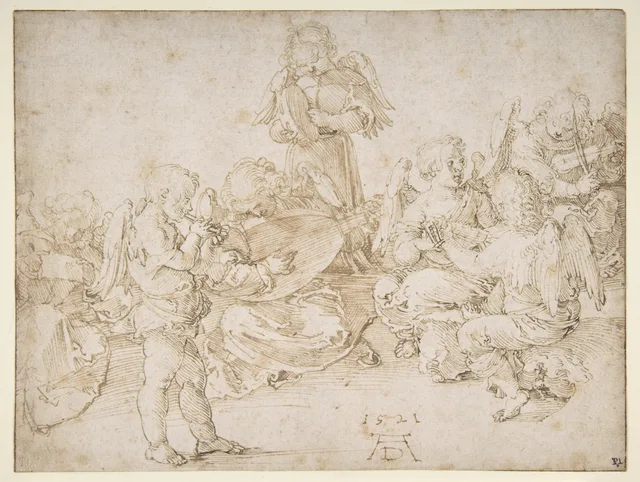
Questions to think about
- Look for itCan you find the traces of white chalk still left on the green paper?
- Why?Why do you think Dürer chose paper coated green instead of plain white paper?
- What about you?This woman's name is not written anywhere on the drawing. If your face ended up in someone's artwork, would you want your name to be remembered with it?
Same period
Painted around the same time,
somewhere else
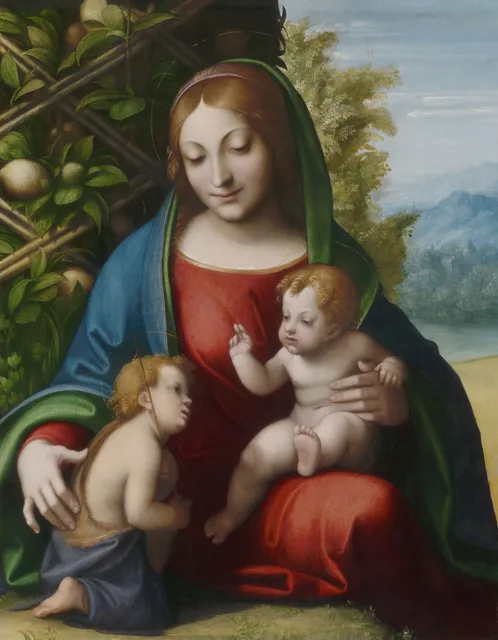 Virgin and Child with the Young Saint John the BaptistAntonio da Correggioc. 1515
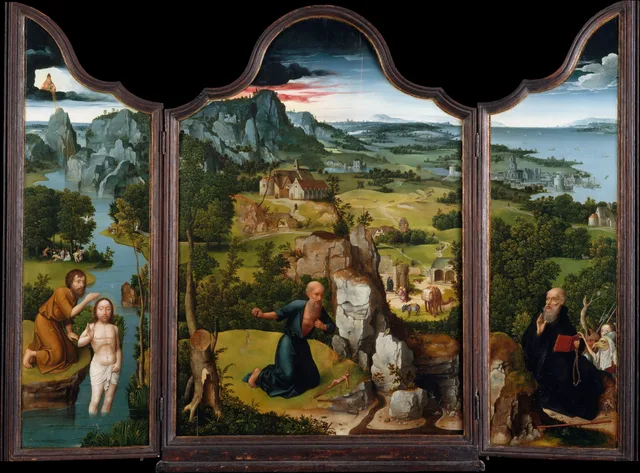 The Penitence of Saint JeromeJoachim Patinirca. 1515
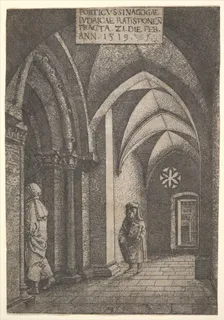 The Entrance Hall of the Regensburg SynagogueAlbrecht Altdorfer1519
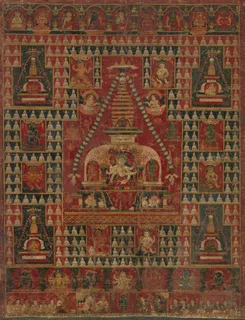 Ushnishavijaya Enthroned in the Womb of a StupaUnknown artist · Nepaldated 1510–19
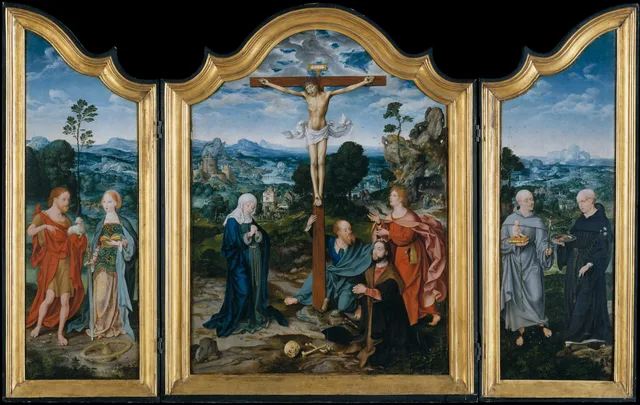 The Crucifixion with Saints and a DonorJoos van Cleveca. 1520
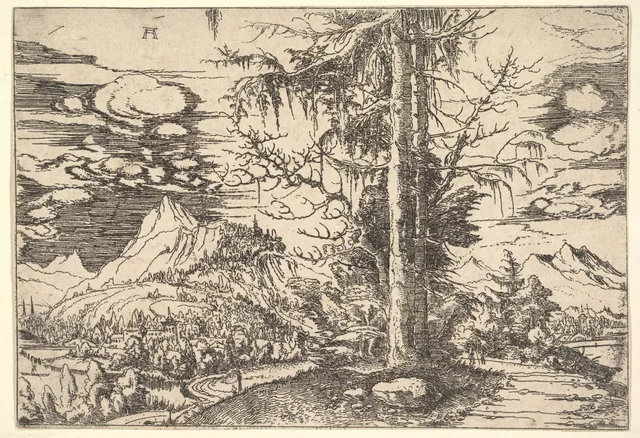 Landscape with a Double SpruceAlbrecht Altdorferca. 1521–22
Too good to keep to yourself
This painting,
for someone who comes to mind
They open it at full size
and see every brushstroke.
About this work
- Artist
- Albrecht Dürer · 1471–1528
- Date
- 1522
- Medium
- Black chalk highlighted with white chalk (abraded) on green prepared paper.
- Size
- 20 × 15.1 cm
- Collection
- The Metropolitan Museum of Art
- Image
- Original long edge 3765px · shown at 2560px
- Original
- View on the museum's website ↗