 Pyeongye
Artwork · 17th century · Juan Sánchez Cotán
LeoTurn on Magnifier at the lower right and move slowly across the painting.
Full screen opens it edge to edge.Tap the painting to fill the screen.
Spread two fingers to look closer.
At a glance
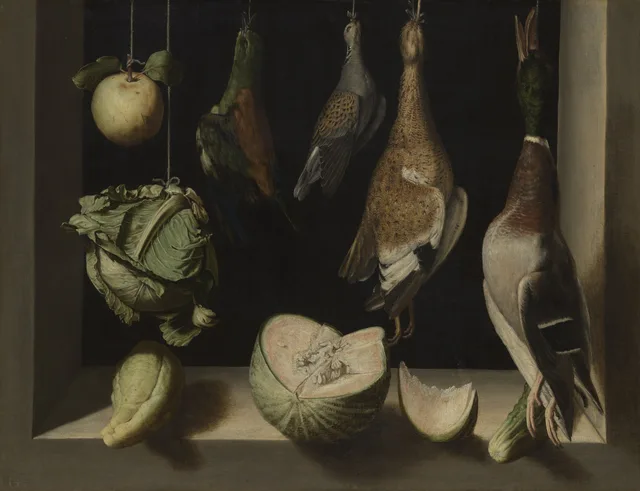
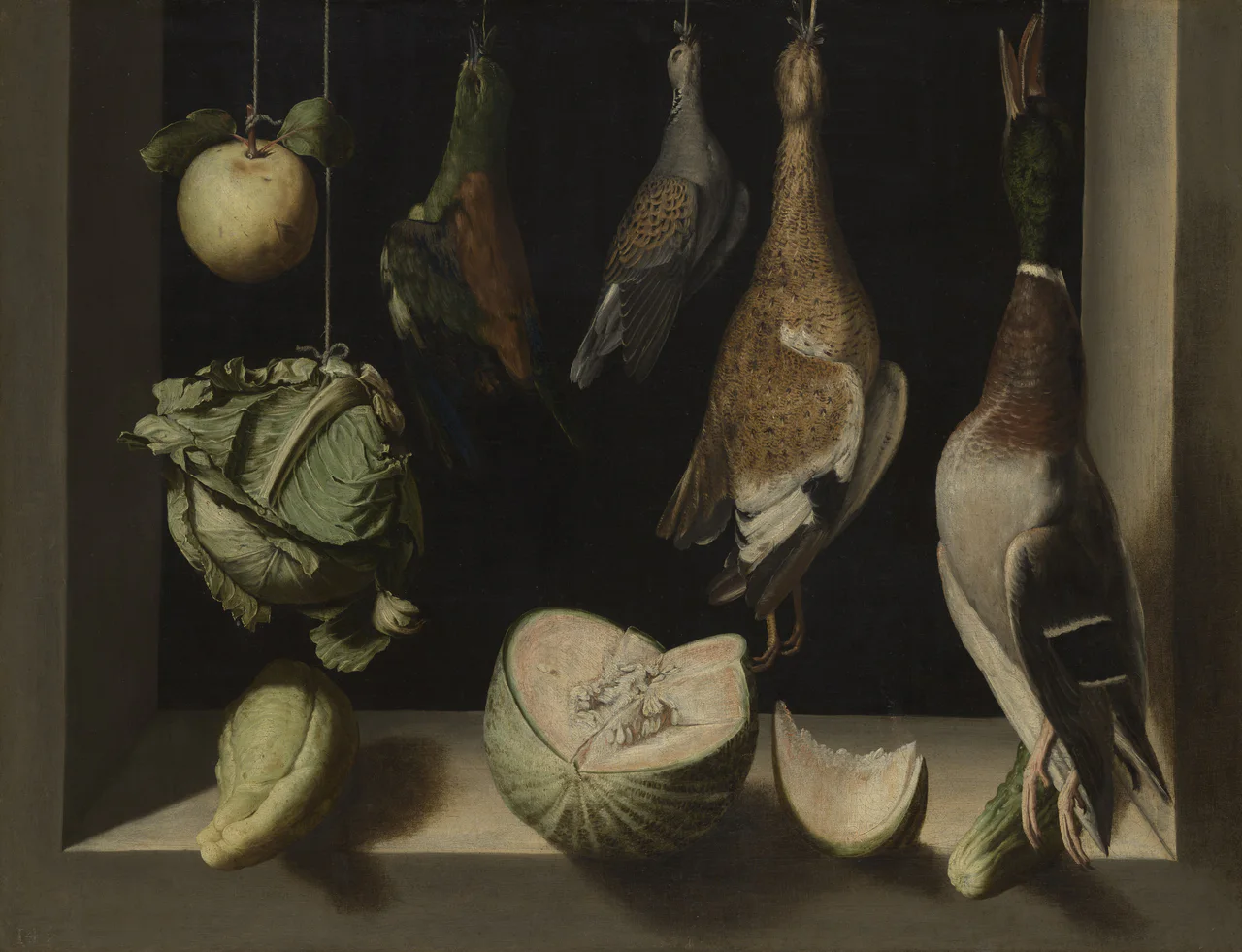
- A quince and a cabbage hang on strings inside a dark stone window frame, beside four dead game birds and a cut melon on the ledge.
- Juan Sánchez Cotán painted it in Toledo, Spain, around 1600 to 1603, shortly before he gave up his career to enter a monastery.
- It is the earliest European still life at the Art Institute of Chicago, and a single raking light makes every object stand out like a carved shape.
Reading the picture
5 places to look closer
Tap a number on the painting to jump to its note, or a close-up to see that spot in the whole picture.
Start with the pale fruit at top left. A thick cord is looped once around the quince's stem and runs straight up out of the picture. You can see brown bruises, tiny specks on the skin, and two curling leaves. Just to the right, a second cord drops past it to hold the cabbage below.
Now move down to the cabbage. Its outer leaves ripple and fold, and one thick rib cuts diagonally across the ball. The side facing the light is a soft pale green, while the lower leaves sink into the dark. Look for the knot of string tied at the top.
In the upper middle, two birds hang head up from their strings. The one on the left has a green head and a reddish-brown back. The dove on the right has a black-and-white striped patch on its neck, and its wing feathers overlap like scales, each one edged in tan.
Drop to the ledge and the melon. It has been split open, showing a tangle of seeds and fibers, and a cut wedge stands on its own to the right. The striped green rind sets off the pinkish flesh. Right above the melon, the claws of the next bird reach down into view.
Finish with the big duck on the far right. The green head, white collar, and chestnut breast are the markings of a male mallard. Two white bars cross its folded wing, and its pink feet almost touch a green cucumber at the edge of the ledge.
When it was painted
In the summer of 1603, Sánchez Cotán was forty-three. For about twenty years he had made a good living as a painter in Toledo. Then he decided to close up shop and join the Carthusians, a religious order known for silence and prayer, as a lay brother.
Before he left, he wrote a will and drew up an inventory of everything he owned. That list includes a number of still lifes. The Art Institute believes this canvas was painted right before he left Toledo, at the very end of that first career.
He had learned his trade in Toledo from the painter Blas de Prado, who was himself known for still lifes. The seventeenth-century painter and writer Francisco Pacheco noted that Sánchez Cotán was famous for still lifes before he became a Carthusian, and that he was following in his teacher's footsteps.
A lay brother lives and works in a monastery without being ordained a priest. Once inside, Sánchez Cotán set still life aside and painted religious images instead. He made large paintings for the Carthusian monastery in Granada, and he died in Granada in 1627.
The painting came to the Art Institute in 1955. Look at it again with his story in mind. The man who studied every bruise on a quince and every feather on a dove was about to leave all of these good things behind for a quiet cell.
Questions to think about
- Look for itCan you count how many things hang from strings and how many rest on the ledge?
- Why?Why do you think he set his food in an empty stone opening instead of on a plate or a kitchen table?
- What about you?Sánchez Cotán walked away from a successful career in his forties to live a completely different life. What would make you willing to give up something you are good at?
Same period
Painted around the same time,
somewhere else
Too good to keep to yourself
This painting,
for someone who comes to mind
They open it at full size
and see every brushstroke.
About this work
- Artist
- Juan Sánchez Cotán · 1560–1627
- Date
- c. 1600–3
- Medium
- Oil on canvas
- Size
- 67.8 × 88.7 cm
- Culture
- Spain
- Collection
- The Art Institute of Chicago
- Image
- Original long edge 11148px · shown at 2560px
- Original
- View on the museum's website ↗